Facts
The petitioner, a registered contractor, was awarded a contract (Agreement No. 44F-2/2012-13) for the construction of a PCC road in Munger for Rs. 5,50,205.
Source reference: para. 2The petitioner claimed he executed additional works (widening the road) worth Rs. 2,38,000 based on oral instructions and endorsements on a Measurement Book, which the department refused to pay.
Source reference: para. 2-3In a first round of litigation (CWJC No. 5436 of 2014), the High Court dismissed the writ petition due to disputed facts but granted liberty to seek arbitration.
Source reference: para. 4The petitioner then approached the Bihar Public Works Contracts Disputes Arbitration Tribunal (Reference Case No. 64/2015), which dismissed the claim with costs of Rs. 10,000 on 16.05.2019.
Source reference: para. 5The petitioner filed the present writ seeking to set aside the Tribunal’s award.
Source reference: no citationIssues
1. Whether the Arbitration Tribunal committed an error in law or fact by rejecting the claim for additional work in the absence of a formal supplementary agreement or work order.
Source reference: para. 17-182. Whether a contractor can raise additional claims after accepting the final contractual payment without protest.
Source reference: para. 193. Whether the High Court, under Articles 226 and 227, can interfere with a reasoned arbitral award involving factual appreciation.
Source reference: para. 20-21Law Applied
The Court applied the principle that contractual liability upon the State for extra work only arises when such work is duly authorized through a supplementary agreement or formal work order as per departmental procedure.
Source reference: para. 18It relied on the precedent set in New India Assurance Co. Ltd. v. Genus Power Infrastructure Ltd. (2015) 2 SCC 424, Union of India v. Master Construction Company (2011) 12 SCC 349, and ONGC Mangalore Petrochemicals Ltd. v. ANS Constructions Ltd. (2018) 3 SCC 373, which establish that once a contractor accepts payment in "full and final settlement" without contemporaneous protest or proof of coercion, they are estopped from raising further claims.
Source reference: para. 13, 19Reasoning
The Court reasoned that the petitioner failed to produce any valid authorization, revised estimate, or supplementary agreement from a competent authority for the additional work.
Source reference: para. 9-10, 18It noted that the High Court in the previous litigation had already observed that mere endorsements on applications do not constitute valid authorization.
Source reference: para. 12, 16Furthermore, the petitioner accepted the final payment on 31.03.2013 and only raised a protest five months later, failing to prove that the settlement was viliated by coercion or duress.
Source reference: para. 11, 19The Court emphasized that its supervisory jurisdiction under Article 226/227 is limited; it cannot act as an appellate body to re-evaluate evidence unless the Tribunal’s decision is patently illegal, perverse, or suffers from a jurisdictional error, none of which were found here.
Source reference: para. 20-21Holding
The Court answered the issues in the negative, holding that the Tribunal’s award was well-reasoned and legally sound.
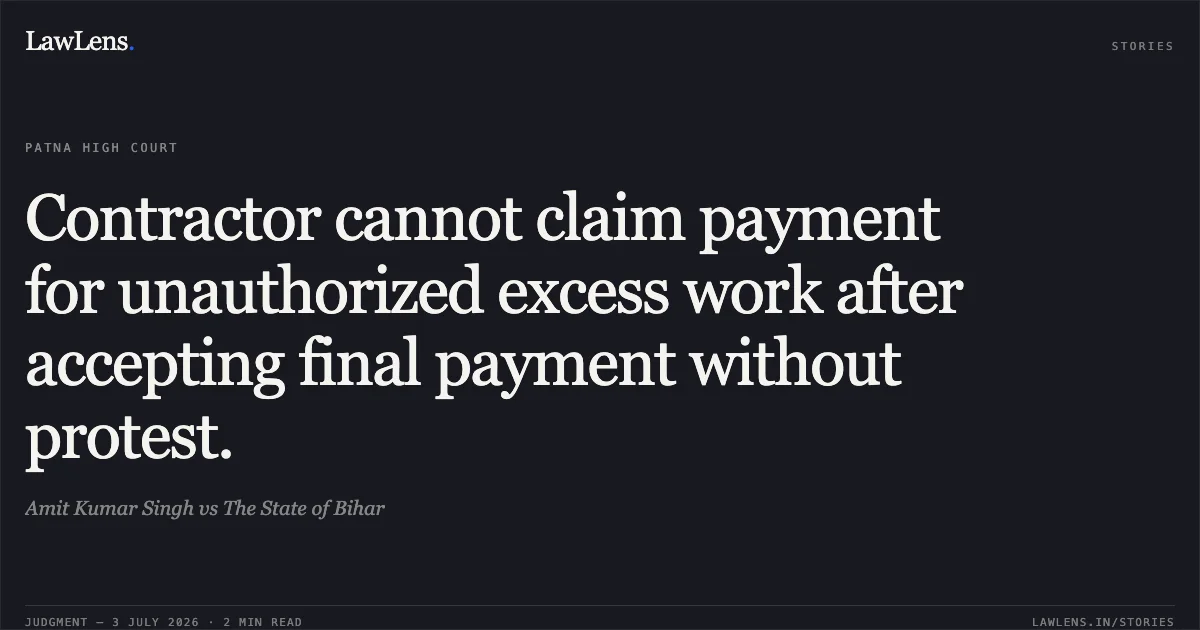
It held that a contractor cannot claim for unauthorized extra work, especially after receiving full and final payment without protest.
Source reference: para. 19, 22Consequently, the High Court dismissed the writ petition and all pending interlocutory applications, affirming the Tribunal's dismissal of the petitioner’s claim.
Source reference: para. 23-24Original Court PDF
Amit Kumar SinghvsThe State of Bihar
Click to open original judgment
Original judgment, available to read, download and summarize on LawLens.in


![Subsequent exoneration does not retrospectively invalidate a finalized promotion select list.. UNNIKRISHNAN M vs M/o Environment And Forests. CAT - ['Ernakulam']. LawLens](/stories/thumbnails/subsequent-exoneration-does-not-retrospectively-invalidate-a-finalized-promotion-select-li-ce80a0e84f2f4887857271e8b4341c42.webp)