Facts
In January 2013, IIIT-Allahabad (Respondent No. 2) issued an advertisement (FS-01/2013) for regular appointments to the post of Assistant Professor.
Source reference: p. 1, para. 1The Appellant, possessing a PhD and First-Class MS degree, applied and was interviewed on March 18, 2013.
Source reference: p. 1-2, para. 1-2Although the advertisement was for regular vacancies, Respondent No. 3 issued the Appellant a contractual appointment letter for 12 months on April 6, 2013.
Source reference: p. 2, para. 2Out of thirteen candidates selected, only the Appellant and one other were offered contractual terms instead of regular positions, with no reasons recorded for this distinction.
Source reference: p. 2, para. 2; p. 9, para. 12(D)Following a series of litigations and a 2017 Supreme Court remand for reconsideration, the Institute reiterated the contractual offer on June 27, 2017.
Source reference: p. 3, para. 5The Appellant challenged this before the High Court of Allahabad, which dismissed his petition and subsequent appeal on the grounds of acquiescence and the discretionary powers of the Selection Committee.
Source reference: p. 5-6, para. 8-9Issues
1. Whether a Selection Committee can arbitrarily grant a contractual appointment to a qualified candidate selected through a process specifically initiated for regular vacancies.
Source reference: p. 8, para. 122. Whether the Appellant's acceptance of a contractual appointment under economic pressure operates as an estoppel (acquiescence) against challenging the legality of the selection procedure.
Source reference: p. 7, para. 10; p. 10, para. 143. Whether the differential treatment of the Appellant vis-à-vis other regularly appointed candidates violates Articles 14 and 16 of the Constitution of India.
Source reference: p. 4, para. 6; p. 7, para. 10Law Applied
The Court primarily applied the constitutional mandates of Articles 14 and 16, which ensure equality of opportunity in public employment and prohibit arbitrary state action.
Source reference: p. 4, para. 6It relied on the principle that while judicial review of a Selection Committee's merit assessment is limited, the process must remain non-discriminatory and transparent.
Source reference: p. 10, para. 13Statement on the doctrine that "singular treatment" or denial of regular status without recorded reasons constitutes patent illegality, and that economic compulsion may mitigate the rigor of estoppel by conduct in employment disputes.
Source reference: p. 7, para. 10; p. 10, para. 14Reasoning
The Court reasoned that the recruitment process was explicitly for regular positions in Pay Band-III and IV, making no mention of contractual posts.
Source reference: p. 8, para. 12(A)It found that the Appellant was shortlisted and interviewed through the same rigorous process as those given regular appointments.
Source reference: p. 9, para. 12(C)The Court observed that if the Appellant was deemed unsuitable for regular appointment, he should not have been recommended at all; his recommendation for a contract role without any recorded justification indicated arbitrary and unequal treatment.
Source reference: p. 9, para. 13The Court rejected the Respondents’ argument regarding the finality of the Selection Committee’s discretion, noting that even a liberal approach to institutional primacy cannot justify the denial of a regular post to a fully qualified candidate when vacancies exist.
Source reference: p. 10, para. 13-14It further held that the lower courts were "excessively swayed" by the Appellant’s conduct in accepting the contract, overlooking the "patent illegalities" and "economic compulsion" that often govern such acceptances.
Source reference: p. 7, para. 10; p. 10, para. 14Holding
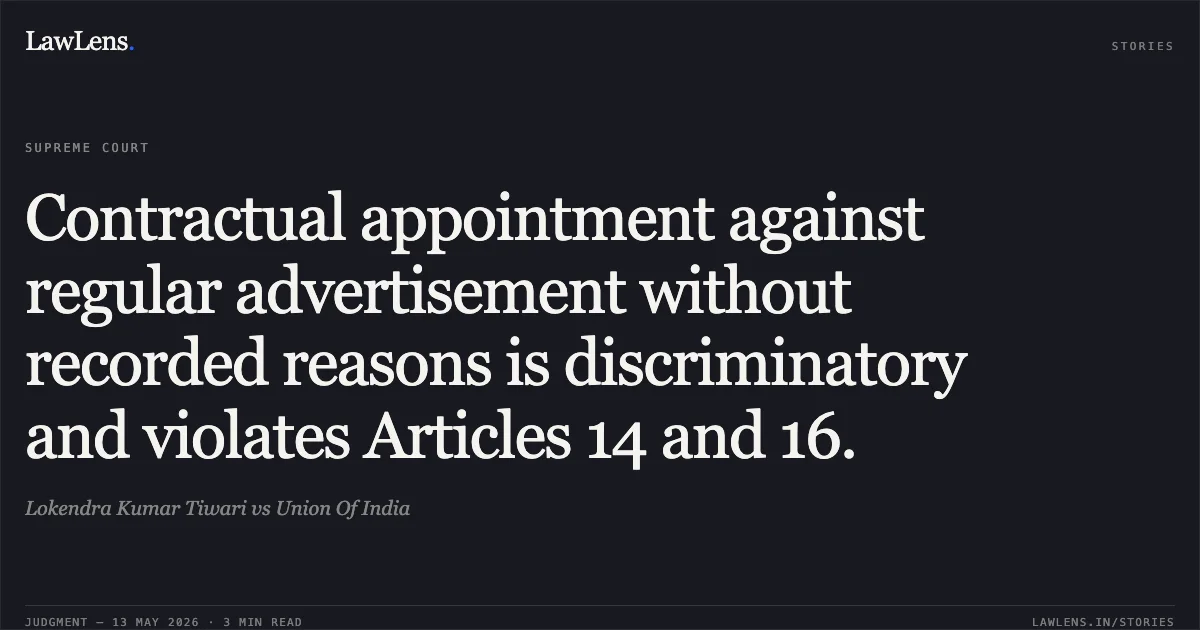
The Court held that the Appellant was entitled to a regular appointment as an Assistant Professor, as the denial was "patently illegal and unconstitutional".
The Supreme Court allowed the appeal, setting aside the judgments of the High Court and directing Respondent No. 2 to issue a regular appointment letter within four weeks, granting continuity of service for seniority purposes while denying back-wages.
Source reference: p. 10-11, para. 14-15Original Court PDF
Lokendra Kumar TiwarivsUnion Of India
Click to open original judgment
Original judgment, available to read, download and summarize on LawLens.in


