Facts
The appellant was awarded a railway contract in 2004 for yard line work, scheduled for completion in six months.
Source reference: para. 2The work was delayed for years due to the respondent's failure to provide P-Way materials; consequently, multiple extensions were granted without penalty under Clause 17A of the General Conditions of Contract (GCC).
Source reference: para. 3The appellant eventually requested foreclosure due to unworkable rates, but the respondent did not pay the dues, leading to arbitration.
Source reference: paras. 3–5The Arbitral Tribunal awarded the appellant ₹22,44,464 across seven claims, including costs, prolongation expenses, interest, and loss of profit.
Source reference: para. 6The District Judge, in a Section 34 petition, set aside Claim Nos. 1, 4, 5, 7, and 8 and reduced the post-award interest, prompting this Section 37 appeal.
Source reference: paras. 1, 7–8Issues
1. Whether the Arbitral Tribunal can award costs of arbitration when the contract (Clause 64.6) expressly stipulates that parties shall bear their own costs.
Source reference: para. 27, 322. Whether claims for idle labour, machinery, and prolongation (Claim No. 4) are sustainable in light of specific contractual bars under Clause 17A of the GCC and Clause 33 of Special Tender Conditions.
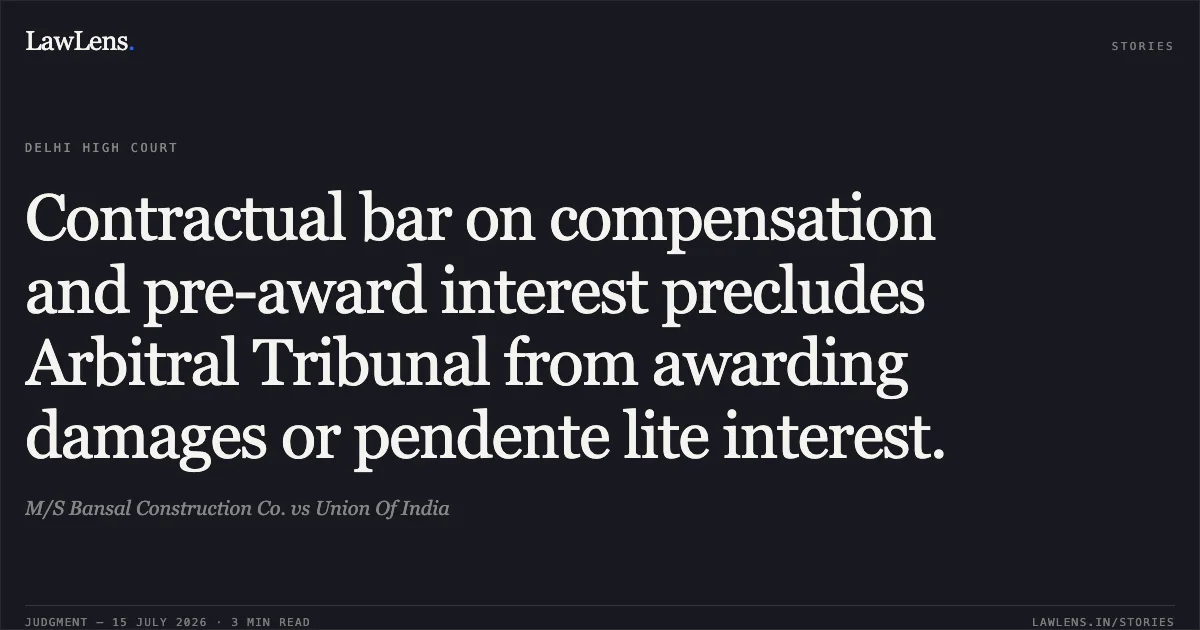
Source reference: para. 27, 453. Whether the Tribunal has the power to award pre-award and pendente lite interest when Clause 16(3) and Clause 64(5) of the GCC expressly prohibit such interest.
Source reference: para. 504. Whether a contractor is entitled to "loss of profit" (Claim No. 7) upon determination of a contract where Clause 61(3) of the GCC bars such compensation.
Source reference: para. 56Law Applied
The court primarily applied Section 31(7)(a) and Section 34 of the Arbitration and Conciliation Act, 1996, emphasizing that the Arbitrator is a "creature of the contract" and cannot act contrary to its express terms.
Source reference: para. 31, 53It relied on the Supreme Court's ruling in Union of India v. Larsen & Toubro Limited (2024), which establishes that if a contract prohibits pre-award/pendente lite interest, the Tribunal cannot award it even as "compensation".
Source reference: para. 34, 46The court further applied the principle from Garg Builders v. BHEL (2021) regarding the paramountcy of contractual bars on interest.
Source reference: para. 51The court relied on Union of India v. Bright Power Projects (2015), reinforcing that arbitrators are bound by the "Excepted Matters" and restrictive clauses like Clause 16(2) of the GCC.
Source reference: para. 53Reasoning
The High Court observed that the learned District Judge correctly identified that the Arbitrator ignored express contractual prohibitions.
Source reference: no citationRegarding Claim No. 1 (Costs), the court found that Clause 64.6 explicitly mandated that parties bear their own costs, making the award of ₹1,00,000 a patent illegality.
Source reference: para. 33–35For Claim No. 4 (Prolongation expenses), the court held that while the respondent was at fault for the delay, Clauses 17A(ii) and (iii) of the GCC limited the appellant's remedy solely to an extension of time, specifically barring compensation for delays.
Source reference: para. 42–43Clause 33 of the Special Tender Conditions prohibited claims for "idle labour/machinery," which the Tribunal failed to consider.
Source reference: para. 45Regarding Interest (Claims 5 and 8), the court noted that Clauses 16(3) and 64(5) of the GCC created a total bar on interest for any period prior to the date of the award; thus, the Tribunal’s grant of pre-reference and pendente lite interest was contrary to Section 31(7)(a).
Source reference: para. 50–52The "loss of profit" (Claim No. 7) was barred by Clause 61(3), which prohibits claims for anticipated profits upon contract determination.
Source reference: para. 56Holding
The Court held that an Arbitral Tribunal cannot override express negative covenants in a contract regarding costs, interest, and compensation for delays, as doing so constitutes a jurisdictional error and a violation of the terms of the agreement.
The Court dismissed the appeal and upheld the District Judge’s order setting aside Claim Nos. 1, 4, 5, 7, and 8.
Source reference: para. 61Acts & Sections Cited
6 provisions across 2 statutes referred to in this judgment. Each provision opens on LawLens.
Arbitration and Conciliation Act, 19963
Indian Contract Act, 18723
Original Court PDF
M/S Bansal Construction Co.vsUnion Of India
Click to open original judgment
Original judgment, available to read, download and summarize on LawLens.in