Facts
The Srinagar Development Authority (SDA) and the Town Planning Organization, Kashmir (CTPK), hired professionals on a purely contractual basis for the preparation of Master/Zonal Plans for Srinagar and Anantnag in 2017-2018
Source reference: para. 4Srinagar professionals were paid up to 31.08.2019, and Anantnag professionals up to June 2019
Source reference: para. 4Formal circulars were issued on 02.08.2019 and 18.06.2019, explicitly disengaging their services upon the expiry of their contracts
Source reference: para. 8The respondents filed writ petitions claiming they continued to work until June 2020 despite no formal extension
Source reference: para. 5A Single Judge (Writ Court) allowed the petitions, ordering remuneration up to 20.03.2020 based on experience certificates and communication from a subsequent Chief Town Planner
Source reference: para. 6, 10The UT Administration appealed this decision via a Letters Patent Appeal (LPA)
Source reference: para. 1Issues
1. Whether the respondents continued to perform their duties beyond the contractual period despite the issuance of formal disengagement circulars
Source reference: para. 72. Whether the experience certificates and internal communications relied upon by the Writ Court constituted sufficient evidence to mandate payment of remuneration from the public exchequer
Source reference: para. 7, 12Law Applied
The court applied the principle that contractual appointments are governed strictly by the terms of the service agreement
Source reference: para. 8It further relied on the evidentiary principle that claims for remuneration against the government must be supported by competent authorization rather than mere "verbal orders" or managed documents
Source reference: para. 9, 12The court also took judicial notice of external circumstances (abrogation of Article 370 and COVID-19 pandemic) to assess the probability of the continued performance of work in a disturbed region
Source reference: para. 9Reasoning
The Division Bench found that the Writ Court erred in ignoring the two specific circulars issued by the then-Chief Town Planner (CTPK), Fayaz Ahmad Khan, which had formally terminated the respondents’ services
Source reference: para. 8, 10The court reasoned that since the respondents worked directly under the CTPK, their claim of being unaware of these circulars was "little difficult to believe"
Source reference: para. 9-10The Bench scrutinized the experience certificates and found them to be "managed in connivance" with the former CTPK to "defraud the public exchequer"
Source reference: para. 12It noted that the mere delayed submission of equipment (laptops/data) in 2020 did not equate to the performance of professional duties
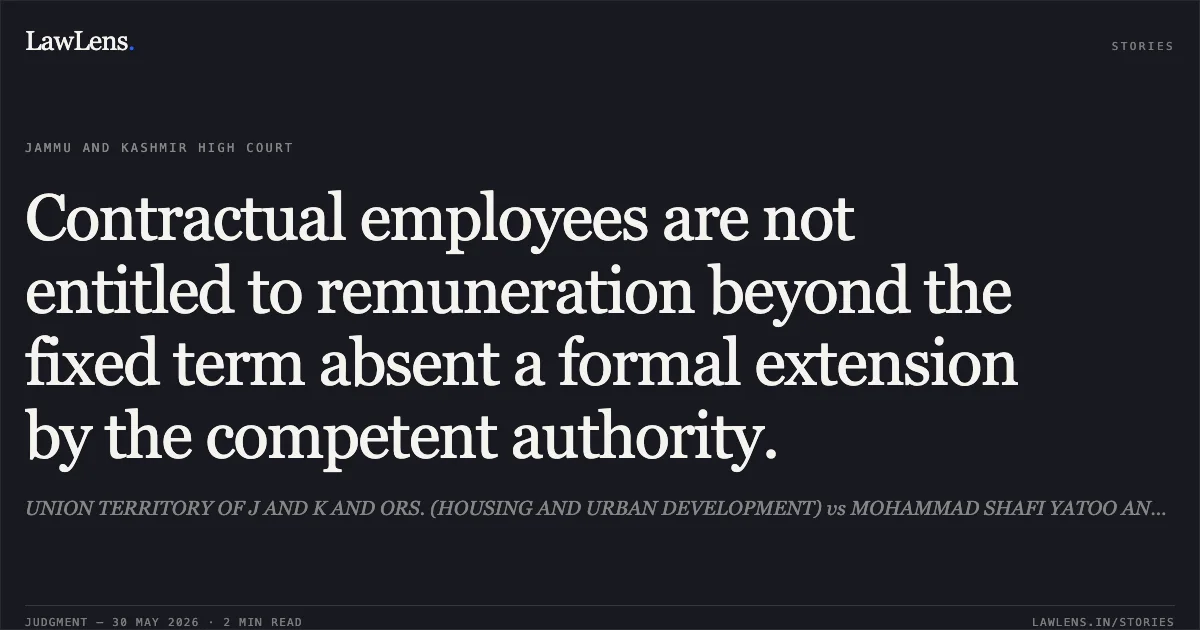
Source reference: para. 11-12The lack of any written extension from a competent authority proved fatal to the respondents' claim for remuneration beyond the contract period
Source reference: para. 11Holding
The Court answered the issues in the negative, holding that the respondents failed to demonstrate the performance of duties beyond their contract dates
The Court set aside the Single Judge’s judgment, finding it "not factually correct" and tainted by documentary evidence prepared solely to confer wrongful benefits
Source reference: para. 12-13The appeal was allowed, and the original writ petitions were dismissed
Source reference: para. 13Original Court PDF
UNION TERRITORY OF J AND K AND ORS. (HOUSING AND URBAN DEVELOPMENT)vsMOHAMMAD SHAFI YATOO AND ORS.
Click to open original judgment
Original judgment, available to read, download and summarize on LawLens.in


