Facts
The petitioners were engaged as Instructors in various Industrial Training Institutes (ITIs) under the Technical Education Department of the erstwhile State of Jammu and Kashmir between 2005 and 2016
Source reference: para. 3(c)-3(f)Their engagements followed public advertisements and merit-based selection, resulting in appointments on a consolidated salary/honorarium basis
Source reference: para. 3(c)Although the respondents classified these engagements as "academic arrangements" for fixed terms, the petitioners continued in service for several years, some exceeding seven years, often under interim judicial protection
Source reference: para. 6Upon the enactment of the Jammu and Kashmir Civil Services (Special Provisions) Act, 2010 ("the Act"), which provides for the regularization of ad-hoc, contractual, or consolidated employees after seven years, the petitioners sought regularization
Source reference: para. 3(d)Conversely, the respondents referred the posts to the Service Selection Recruitment Board (SSRB) for regular recruitment via Advertisement Notice No. 01 of 2011 and argued that "academic arrangements" are specifically excluded from the Act’s purview under Section 3(b)
Source reference: para. 3(d), 4(d)Issues
1. Whether the petitioners are entitled to consideration for regularization under the Jammu and Kashmir Civil Services (Special Provisions) Act, 2010, notwithstanding their classification as "academic arrangement" staff
Source reference: para. 11, 122. Whether the respondents can legally replace the petitioners with another set of contractual or academic arrangement employees before regular selections are finalized
Source reference: para. 10, 13Law Applied
The Tribunal applied the Jammu and Kashmir Civil Services (Special Provisions) Act, 2010, specifically Section 5, which mandates regularization of consolidated/contractual employees after seven years, and Section 3(b), which excludes fixed-term academic arrangements
Source reference: para. 3(a), 4(d)It further relied on the constitutional principle derived from Article 14 that a contractual employee cannot be replaced by another set of contractual employees if the work continues
Source reference: para. 8, 10Additionally, the court acknowledged the precedent in State of Karnataka v. Uma Devi, holding that temporary employees lack an inherent fundamental right to regularization unless covered by a statutory scheme or appointed via regular recruitment rules
Source reference: para. 4(e), 8Reasoning
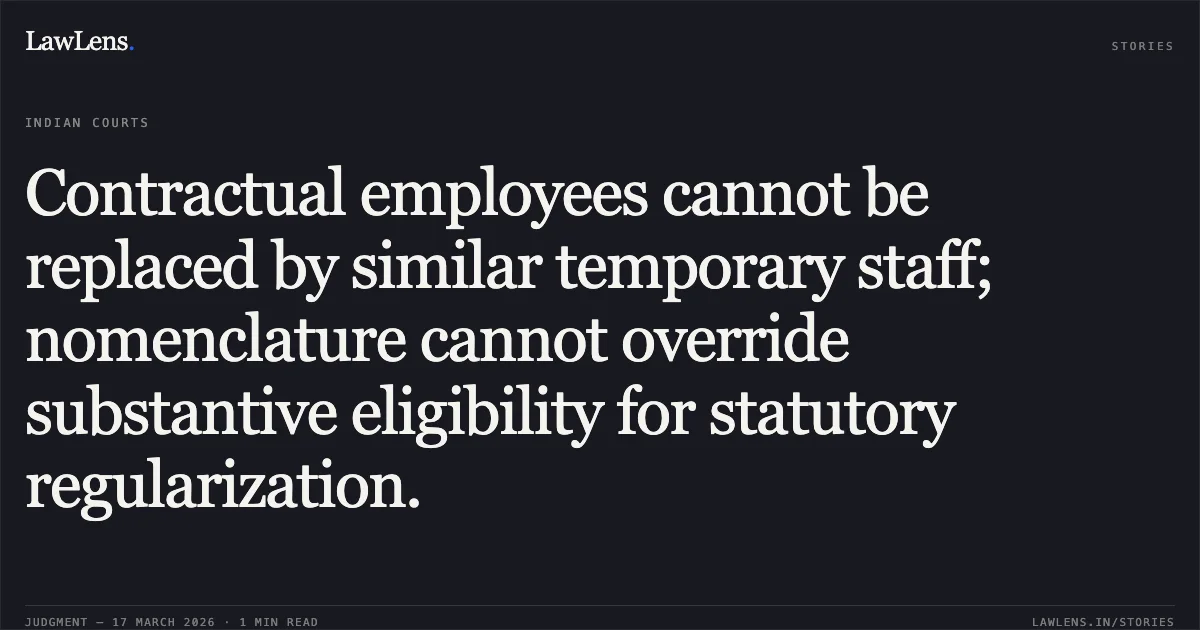
The Tribunal reasoned that while the respondents labeled the petitioners' service as "academic arrangements," the substance of their engagement—recruitment through advertisement, merit-based selection against clear vacancies, and continuous service for many years—indicated they were effectively consolidated or contractual employees
Source reference: para. 6, 11The Tribunal emphasized that the "true spirit" and factual reality of the engagement must be examined rather than relying solely on the departmental label to invoke the exclusion clause of Section 3(b) of the Act
Source reference: para. 11, 12While the Tribunal affirmed the State's right to conduct regular recruitment through the SSRB, it held that replacing one set of temporary/contractual employees with another similar set (e.g., via PPP or Self-Finance modes) is arbitrary and legally impermissible
Source reference: para. 10, 21The Tribunal concluded that cases must be evaluated individually to determine if they meet the Act’s criteria for regularization
Source reference: para. 12Holding
The Tribunal disposed of the applications by directing the respondents to individually examine each petitioner's case under the 2010 Act within four months
If a petitioner fulfills the statutory conditions and is not hit by the "exclusion clause in its true spirit," their case must be referred to the Empowered Committee for regularization
Source reference: para. 12The Tribunal held that the petitioners' services shall not be terminated nor replaced by another set of academic or contractual employees until regular selection is finalized and regular appointees join
Source reference: para. 13Petitioners were granted continuity of service for the period actually worked, though monetary benefits from regularization remain subject to the final administrative decision
Source reference: para. 14, 15Acts & Sections Cited
6 provisions across 1 statute referred to in this judgment. Linked provisions open on LawLens.
Jammu and Kashmir Civil Services (Special Provisions) Act, 20106
Original Court PDF
Samit SharmavsD/o Technical Education
Click to open original judgment
Original judgment, available to read, download and summarize on LawLens.in


![Authorities must decide pensionary and retiral-benefit claims through a reasoned order within eight weeks.. Habibullah khan vs HOME DEPARTMENT. CAT - ['Srinagar']. LawLens](/stories/thumbnails/authorities-must-decide-pensionary-and-retiral-benefit-claims-through-a-reasoned-order-wit-d0cbe8a8119c48fbabe7df9f2d353488.webp)