Facts
The appellant was engaged as a Laboratory Assistant under the Ex-Servicemen Contributory Health Scheme (ECHS) on a contractual basis starting in 2004, with subsequent extensions.
Source reference: p. 2, para. 2Following an inspection identifying laboratory deficiencies and multiple warnings regarding unprofessional conduct and lack of diligence, the respondents issued a termination notice on 21.05.2007.
Source reference: p. 2-3, para. 2-4Despite the appellant’s reply, his services were terminated on 19.06.2007.
Source reference: p. 2, para. 2The appellant challenged the termination via a writ petition (SWP No. 1077/2007), which was dismissed by the learned Single Judge on 02.08.2023.
Source reference: p. 2, para. 1The appellant then filed this Letters Patent Appeal (LPA), asserting that his termination was stigmatic and required a formal enquiry.
Source reference: p. 3-4, para. 7Issues
1. Whether a contractual employee whose services are terminated for unsatisfactory performance is entitled to the protection of Article 311 of the Constitution or a formal departmental enquiry.
Source reference: p. 4, para. 7; p. 7, para. 142. Whether the termination order in question was stigmatic in nature or a termination simpliciter governed by the contract of service.
Source reference: p. 4, para. 7; p. 8, para. 18Law Applied
The court primarily applied the principle that contractual employees do not hold a "civil post" and thus cannot claim protection under Article 311 of the Constitution.
Source reference: p. 7, para. 14-15It relied on Parshotam Lal Dhingra v. Union of India, which established that termination in accordance with contract terms is prima facie not a punishment.
Source reference: p. 5, para. 11Under State of U.P. v. Ram Chandra Trivedi, an order of termination simpliciter that does not cast stigma or visit the employee with evil consequences does not require an enquiry.
Source reference: p. 6, para. 12Oil and Natural Gas Commission v. Dr. Mohd. S. Iskender Ali confirmed that termination of a temporary employee based on unsuitability does not amount to punishment.
Source reference: p. 6, para. 13Reasoning
The Court observed that the appellant’s engagement was strictly governed by Clause (11) of the service agreement, which permitted termination for "professional incompetence" or "unsatisfactory performance" upon one month's notice.
Source reference: p. 4-5, para. 10The Court found that the respondents followed due process by issuing a show-cause notice and considering the appellant's reply before termination.
Source reference: p. 3-4, para. 6Distinguishing the present case from Anoop Jaiswal v. Government of India, the Court reasoned that the termination was not founded on specific allegations of misconduct or moral turpitude that would render it stigmatic.
Source reference: p. 7-8, para. 16Instead, the termination was a result of overall unsatisfactory performance and failure to meet professional standards, which does not necessitate a formal departmental enquiry for a contractual appointee.
Source reference: p. 8, para. 17-18Holding
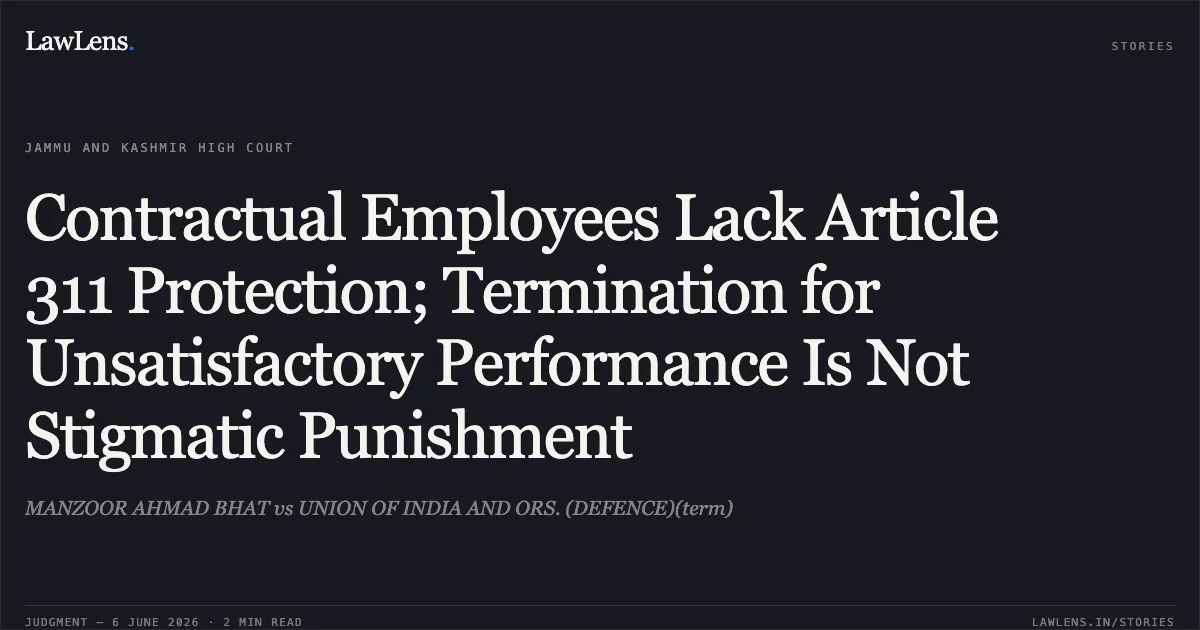
The High Court dismissed the appeal, holding that the appellant, being a contractual employee, had no right to the post and was not protected by Article 311.
The Court affirmed that the termination was a termination simpliciter based on the terms of the contract and unsatisfactory performance, rather than a punitive or stigmatic action. Consequently, no formal enquiry was required, and the judgment of the learned Single Judge was upheld.
Source reference: p. 8, para. 18-20Acts & Sections Cited
1 provisions across 1 statute referred to in this judgment. Linked provisions open on LawLens.
Letters Patent1
Original Court PDF
MANZOOR AHMAD BHATvsUNION OF INDIA AND ORS. (DEFENCE)(term)
Click to open original judgment
Original judgment, available to read, download and summarize on LawLens.in