Facts
Smt. Ashok Lata was initially appointed as a Hindi Teacher on a contractual basis for a maximum period of 89 days by appointment order dated 06.01.1999. Her engagement was extended from time to time, and she continued working in the Chandigarh Education Department until 31.03.2020. She claimed gratuity for approximately 21 years, 2 months and 25 days of service. The Controlling Authority awarded her ₹5,90,116/- with interest at 9% per annum from 01.05.2020
Source reference: pp.2–3, paras 2–3Balvinder Singh was appointed as a contractual Science Teacher for the academic session 2002–03. His appointment terms stated that he would not be entitled to Provident Fund, pension, gratuity or other benefits available to regular Government servants. He nevertheless continued serving the department for 16 years, 10 months and 22 days. His gratuity claim was allowed in the amount of ₹4,59,617/- with interest
Source reference: p.3, para.5The appellants’ statutory appeals against the orders granting gratuity were dismissed by the Appellate Authority as time-barred. The learned Single Judge dismissed the appellants’ writ petitions, holding that the delay exceeded the maximum period capable of being condoned under the Payment of Gratuity Act, 1972. The Division Bench thereafter condoned a delay of 317 days in filing the Letters Patent Appeals and considered the matters on merits
Source reference: pp.1, 3–4, paras 1–8Issues
Whether an employee appointed on a contractual basis, rather than to a regular Government post, is entitled to statutory gratuity under the Payment of Gratuity Act, 1972 after rendering the requisite continuous service?
Source reference: pp.4, 8–9, paras 11, 14, 16–18Whether a contractual term excluding gratuity and other benefits available to regular Government servants can defeat an employee’s statutory entitlement to gratuity under the Payment of Gratuity Act, 1972?
Source reference: pp.4, 9–10, paras 9, 18–19Whether the orders of the Controlling Authority, the Appellate Authority and the learned Single Judge warranted interference in the Letters Patent Appeals?
Source reference: pp.3–4, 10, paras 4–8, 20–21Law Applied
The Court applied Section 4 of the Payment of Gratuity Act, 1972, under which gratuity becomes payable upon termination of employment after an employee has rendered at least five years of continuous service, calculated at the prescribed rate based on the last drawn wages
Source reference: pp.5–6, para.12It also applied Section 2A, which defines continuous service and permits deemed continuity where the employee has actually worked for the statutory number of days during the relevant period
Source reference: pp.6–8, para.13The Court held that the Act attaches gratuity entitlement to the service actually rendered and does not require the employee to occupy a regular post
Source reference: p.8, para.14Relying on Neta Ram Sahu v. State of Chhattisgarh & Anr., (2018) 5 SCC 430, the Court reiterated that long and continuous service, including service initially rendered on a non-regular basis, cannot be disregarded for determining gratuity entitlement and that the Payment of Gratuity Act is beneficial legislation
Source reference: p.8, para.15The Court distinguished gratuity entitlement from regularisation and held that contractual status alone cannot defeat a statutory benefit
Source reference: p.10, para.19Reasoning
The Court accepted that both respondents were initially engaged contractually and were not regular Government employees. However, it held that the decisive question was not regular status but whether they fell within the statutory definition of an employee and had completed the requisite continuous service under the Act
Source reference: p.4, para.11In Ashok Lata’s case, the service records, attendance records, salary records and joining and relieving orders established approximately 21 years of service notwithstanding notional breaks
Source reference: pp.2–3, 9, paras 3, 16–17In Balvinder Singh’s case, the admitted period of service exceeded 16 years
Source reference: pp.3, 9–10, paras 5, 18Consequently, the contractual description of the appointments, and in Balvinder Singh’s case the clause excluding gratuity, could not override the statutory entitlement arising from continuous service under Section 4.
Source reference: no citationThe Court clarified that this conclusion did not confer regular employee status or decide any claim for regularisation
Source reference: p.10, para.19Since the authorities had properly determined the service periods and gratuity amounts, and the learned Single Judge had correctly upheld the dismissal of the delayed statutory appeals, no appellate interference was warranted
Source reference: p.10, paras 20–21Holding
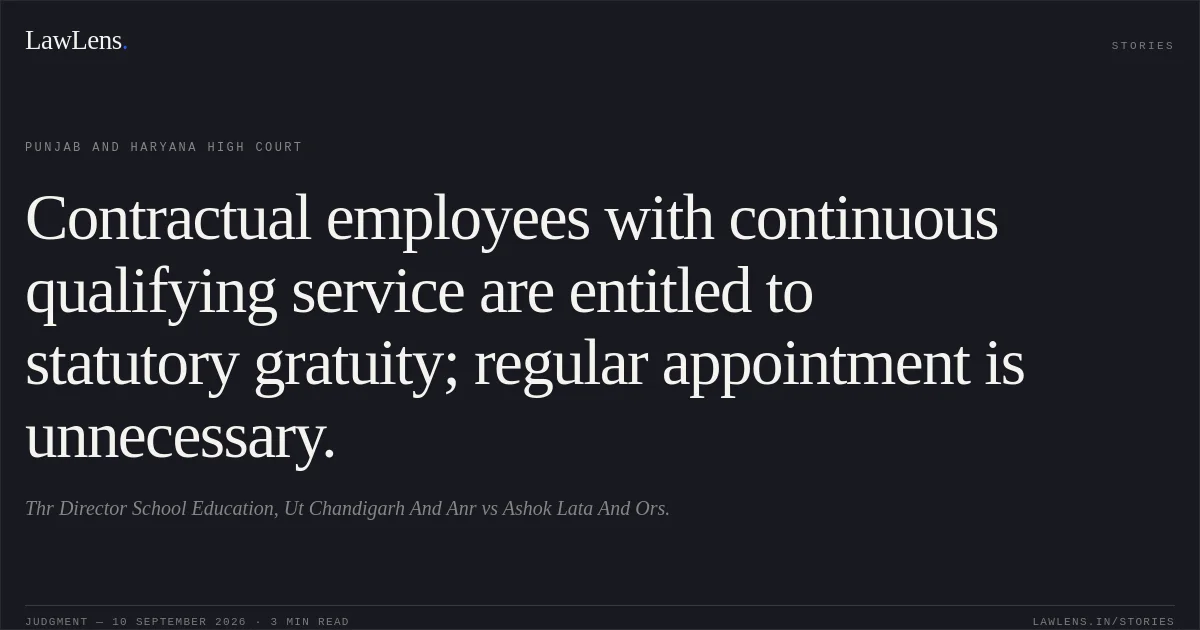
The Court held that contractual employees who satisfy the continuous-service requirements of the Payment of Gratuity Act, 1972 cannot be denied gratuity merely because their appointments were contractual or because their contracts excluded benefits available to regular employees
The gratuity awards of ₹5,90,116/- to Ashok Lata and ₹4,59,617/- to Balvinder Singh, together with applicable interest, were upheld
Source reference: pp.2–3, 9–10, paras 3, 5, 17–18Both Letters Patent Appeals were dismissed with no order as to costs, and all pending miscellaneous applications were disposed of
Source reference: p.10, paras 20–22Acts & Sections Cited
3 provisions across 1 statute referred to in this judgment. Linked provisions open on LawLens.
PAYMENT OF GRATUITY ACT, 19723
Original Court PDF
Thr Director School Education, Ut Chandigarh And AnrvsAshok Lata And Ors.
Click to open original judgment
Original judgment, available to read, download and summarize on LawLens.in