Facts
The Respondents (Ayurved Chikitsaks) were initially engaged on a contractual basis between 2002 and 2004 pursuant to advertisements dated 19.12.2001 and 06.10.2003
Source reference: para. 2Despite their "contractual" label, they were selected through a merit-based process and continued in uninterrupted service for over a decade
Source reference: para. 6In 2008, the State framed the Rajasthan Rural Ayurvedic, Unani, Homeopathy and Naturopathy Service Rules, 2008, to regularize such services. Following protracted litigation regarding selection criteria, the Respondents were substantively appointed vide orders dated 25.08.2015
Source reference: para. 5The State subsequently treated them as fresh "Probationer Trainees," denying them the benefit of their prior service (2002–2015) for pension, seniority, and privilege leave. A Single Bench partly allowed the Respondents' writ petition, directing the State to count the prior service for pension and leave, and invalidating the fresh probation requirement
Source reference: para. 1Issues
1. Whether services rendered on a contractual basis prior to substantive appointment can be counted as "qualifying service" for pension under the Rajasthan Civil Services (Pension) Rules, 1996
Source reference: para. 9, 152. Whether the Respondents could be subjected to a fresh two-year probation period on fixed remuneration after a decade of continuous service upon their substantive appointment in 2015
Source reference: para. 22, 533. Whether the Respondents are entitled to privilege leave for the period of contractual service under Rule 95 of the Rajasthan Service Rules, 1951
Source reference: para. 23, 56Law Applied
Rule 3(r) and Rule 12(b) of the Rajasthan Civil Services (Pension) Rules, 1996, which define "qualifying service" to include service rendered in an officiating or temporary capacity from the date of first appointment
Source reference: para. 40, 41Reconciliation of Pension Rules with Rule 2(e) interpreting the "Save as otherwise provided" clause to allow counting of past service upon regularization
Source reference: para. 44Rule 95 of the Rajasthan Service Rules, 1951, regarding the accrual of privilege leave for temporary employees subsequently appointed substantively
Source reference: para. 56Principles from the Hon'ble Supreme Court in Jaggo v. Union of India (2024) and Dharam Singh v. State of U.P. (2025), which prohibit "ad-hocism" and require the State, as a "constitutional employer," to recognize the realities of long-term continuous service regardless of the "temporary" or "contractual" label.
Source reference: para. 48, 50Reasoning
The Court rejected the State's argument that the "contractual" nature of the initial engagement barred all benefits. It reasoned that the Respondents were engaged against sanctioned posts via a selection process similar to "urgent temporary appointments" under the 1973 Rules
Source reference: para. 39Since the Respondents worked uninterruptedly from 2002/04 until 2015, were paid from the Consolidated Fund, and performed duties identical to regular employees, their service falls under the "temporary capacity" mentioned in Rule 12(b) of the Pension Rules
Source reference: para. 41, 47Regarding probation, the Court noted that the purpose of probation—evaluating suitability—had already been satisfied over a decade of satisfactory performance; hence, imposing a fresh probation period in 2015 was an "artificial" distinction that elevated form over substance
Source reference: para. 53-55Under Rule 95 of the RSR, 1951, the Court determined that as "temporary employees" who were substantively appointed without interruption, the Respondents were legally entitled to have their prior service credited for privilege leave
Source reference: para. 57Holding
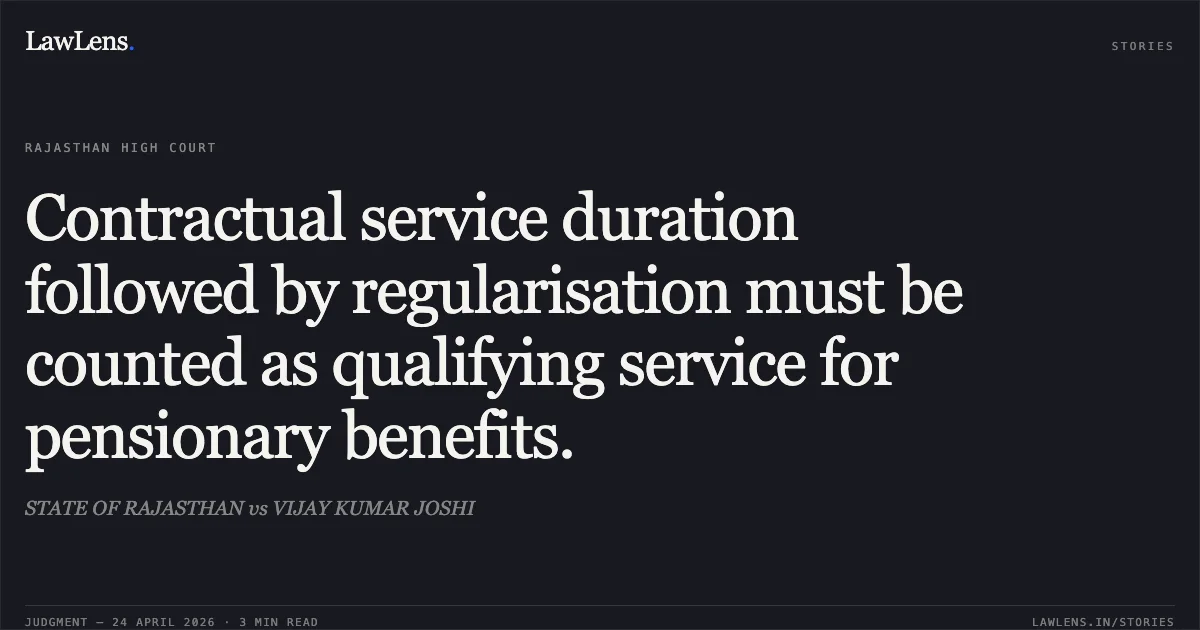
The period from 2002/2004 to 2015 constitutes "qualifying service" for pension under Rules 3(r) and 12(b) of the Pension Rules, 1996; subjecting the Respondents to a fresh probation period on fixed remuneration in 2015 was invalid, as their suitability had already been proven; and the Respondents are entitled to privilege leave for the entire service period per Rule 95 of the RSR, 1951.
The Division Bench dismissed the State's appeal and upheld the Single Bench's judgment. All pending applications were dismissed.
Source reference: para. 59, 60Acts & Sections Cited
11 provisions across 2 statutes referred to in this judgment. Linked provisions open on LawLens.
Rajasthan Civil Services (Pension) Rules, 19968
Rajasthan Service Rules, 19513
Original Court PDF
STATE OF RAJASTHANvsVIJAY KUMAR JOSHI
Click to open original judgment
Original judgment, available to read, download and summarize on LawLens.in


![Subsequent exoneration does not retrospectively invalidate a finalized promotion select list.. UNNIKRISHNAN M vs M/o Environment And Forests. CAT - ['Ernakulam']. LawLens](/stories/thumbnails/subsequent-exoneration-does-not-retrospectively-invalidate-a-finalized-promotion-select-li-ce80a0e84f2f4887857271e8b4341c42.webp)