01Facts
Petitioner No. 1 obtained financial assistance from the Technology Development Board (“TDB”) for developing and commercialising the “VERA PON System” for fibre-to-the-home optical access.
p. 2 · ¶ 2–4The parties executed a loan agreement dated 7 November 2007, subsequently modified by a supplementary agreement dated 16 July 2010.
p. 2 · ¶ 4After the project allegedly failed commercially, the Petitioners sought rescheduling of the loan; TDB agreed subject to post-dated cheques and execution of a further supplementary agreement, which the Petitioners did not accept.
p. 2 · ¶ 5–6TDB issued a show-cause notice and thereafter recalled the facility, while the Petitioners sought declaration of project failure and waiver of the loan and interest under Rule 19(13) of the Technology Development Board Rules, 1996.
p. 2 · ¶ 7In arbitration, the Petitioners relied on project failure and consequent waiver as defences to TDB’s recovery claim.
pp. 3–4 · ¶ 8–13The Tribunal held that determination of project success or failure was contractually reserved for the Monitoring Committee/Board and declined to adjudicate those matters, while allowing TDB’s recovery claim for ₹5,12,68,725 with interest and costs.
pp. 3–4 · ¶ 8–13The Petitioners challenged the award under Section 34 of the Arbitration and Conciliation Act, 1996.
02Issues
i.1. Whether the Arbitral Tribunal had jurisdiction to determine whether the project had failed and whether the Petitioners were entitled to waiver of the loan under Rule 19(13) of the TDB Rules, 1996, or whether those matters were contractually reserved for the Monitoring Committee/Board.
pp. 3, 7–8 · ¶ 8–11, 25–32ii.2. Whether the Tribunal could proceed with TDB’s recovery claim despite declining to adjudicate the Petitioners’ project-failure and waiver defences, or whether the arbitration was premature.
pp. 6–9 · ¶ 23–35iii.3. Whether TDB’s alleged failure to raise its jurisdictional objection at the proper stage, and its participation in evidence and cross-examination, violated Sections 4, 16 and 18 of the Act or rendered the award liable to be set aside under Sections 34(2)(a)(iii) or 34(2)(b)(ii).
pp. 4–5, 9–12 · ¶ 14–16, 36–4903Law Applied
The Court applied Section 34 of the Arbitration and Conciliation Act, 1996, under which an arbitral award may be set aside only on the statutory grounds specified therein, including inability of a party to present its case under Section 34(2)(a)(iii), violation of public policy under Section 34(2)(b)(ii), or patent illegality where applicable.
p. 9 · ¶ 37–38Section 18 requires equal treatment and a full opportunity to present one’s case.
p. 9 · ¶ 37–38Sections 4 and 16 embody waiver and procedural rules concerning objections to jurisdiction: objections must generally be raised without undue delay or by the statement of defence, though a delayed objection may be admitted if the Tribunal considers the delay justified.
pp. 4–5 · ¶ 15Contractually, Article 3.5 made the Monitoring Committee/Board’s decision regarding successful completion or failure of the project final and binding on the borrower, while Article 10.1 subjected disputes to arbitration but expressly excluded matters whose determination was provided for elsewhere in the Agreement.
pp. 7–8 · ¶ 26–28Rule 19(13) could be invoked for waiver only after the project had first been declared a failure.
p. 8 · ¶ 30–32Provisions in the judgment · 4 · Linked ones open on LawLens
Arbitration and Conciliation Act, 1996 Section 4Section 16Section 18Section 34
04Reasoning
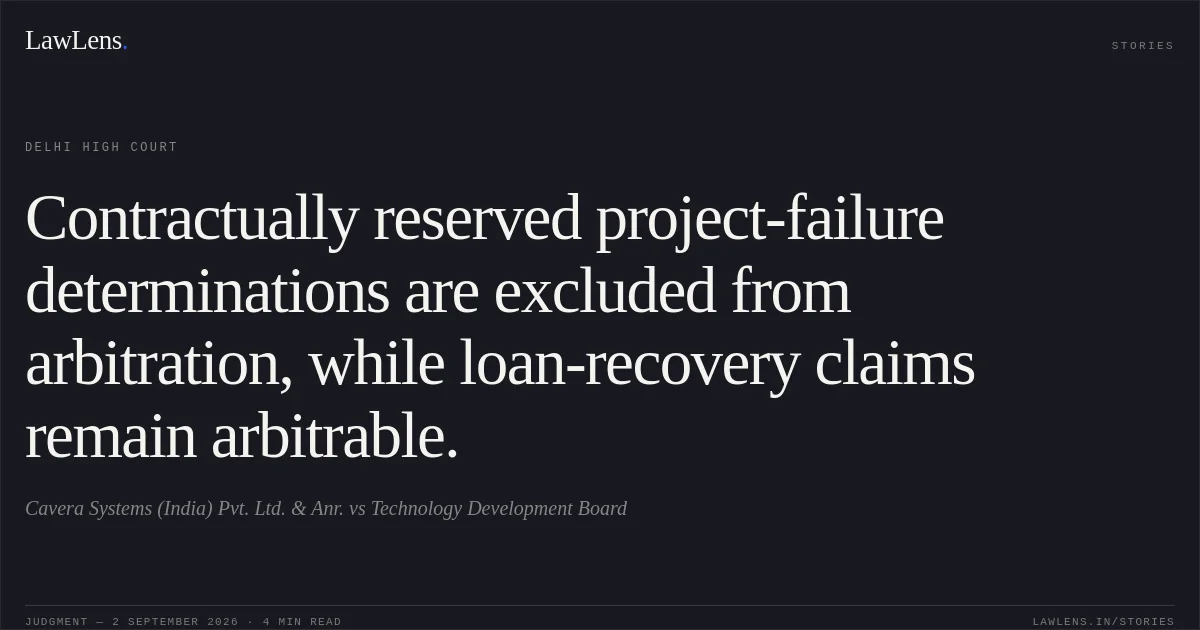
The Court held that Articles 3.5 and 10.1 created a specific contractual allocation of authority: project success or failure was to be determined by the Monitoring Committee/Board and was excluded from arbitration.
pp. 7–8 · ¶ 27–29Since waiver under Rule 19(13) was consequential upon a prior declaration of project failure, and no such declaration existed, the waiver claim had not crystallised into an enforceable defence before the Tribunal.
p. 8 · ¶ 32This did not deprive the Tribunal of jurisdiction over the entire dispute; it retained jurisdiction to adjudicate TDB’s loan-recovery claim.
p. 8 · ¶ 31The Court further held that the Petitioners had been able to present their factual and contractual case, because the relevant provisions were part of the governing agreement and were not new evidence or an undisclosed case introduced at the end of the proceedings.
pp. 10–12 · ¶ 39–48Mere delay in raising a jurisdictional objection, without proof that the Petitioners lacked a meaningful opportunity to respond or suffered actual prejudice, did not attract Section 34(2)(a)(iii).
p. 11 · ¶ 42–44The Tribunal’s interpretation was neither contrary to the Agreement nor impossible or patently illegal, and the Court declined to substitute its own view under Section 34.
p. 9 · ¶ 34–3505Holding
The Court answered the jurisdictional issues against the Petitioners.
p. 12 · ¶ 48–50It held that the Tribunal correctly excluded the determination of project failure and consequential waiver from arbitration, but was competent to decide TDB’s recovery claim.
p. 12 · ¶ 48–50The Petitioners were not denied a fair opportunity to present their case, and the alleged delayed jurisdictional objection did not establish prejudice or any ground under Section 34.
p. 12 · ¶ 48–50The challenge to the arbitral award was accordingly dismissed.
p. 12 · ¶ 48–50Original Court PDF
Cavera Systems (India) Pvt. Ltd. & Anr.vsTechnology Development Board
Click to open original judgment
Original judgment, available to read, download and summarize on LawLens.in