Facts
The deceased, Varshaben, married the respondent in an inter-caste civil marriage against her parents’ wishes.
Source reference: paras. 1–2.3; pp. 1–2The prosecution alleged that, during approximately six months of marriage, the respondent subjected her to physical and mental cruelty, abused her, consumed liquor, and assaulted her, thereby driving her to commit suicide by pouring kerosene on herself and setting herself ablaze on 30 April 2010.
Source reference: paras. 1–2.3; pp. 1–2She died during treatment on 5 May 2010.
Source reference: paras. 1–2.3; pp. 1–2The respondent allegedly sustained burn injuries while attempting to rescue her and was admitted to the same hospital.
Source reference: paras. 1–2.3; pp. 1–2The deceased’s complaint led to registration of II-C.R. No. 76 of 2010 for offences under Sections 498A, 306, 506 and 504 of the IPC.
Source reference: paras. 1–2.3; pp. 1–2After investigation and committal, the respondent was tried in Sessions/Atrocity Case No. 126 of 2010 and acquitted by the 6th Additional Sessions Judge, Rajkot, on 19 July 2012.
Source reference: paras. 1–2.3; pp. 1–2The State preferred the present appeal against acquittal under Section 378(1) and (3) of the Code of Criminal Procedure, 1973.
Source reference: paras. 1–2.3; pp. 1–2Issues
1. Whether the trial court was justified in acquitting the respondent of offences under Sections 306, 498A, 506 and 504 of the IPC
Source reference: para. 11; p. 72. Whether the trial court properly appreciated the oral and documentary evidence led by the prosecution
Source reference: para. 11; p. 73. Whether the acquittal suffered from any illegality, irregularity, perversity or manifest error warranting appellate interference
Source reference: para. 11; p. 7Law Applied
The Court considered Sections 306, 498A, 506 and 504 of the IPC, requiring proof of abetment of suicide, cruelty, criminal intimidation and intentional insult, respectively.
Source reference: paras. 1, 15–16; pp. 1, 10–11It applied the principle that the fact that a woman died within seven years of marriage does not, by itself, establish offences under Sections 306 or 498A; the prosecution must prove foundational facts through cogent and reliable evidence, as recognised in Ram Pyarey v. State of Uttar Pradesh, [2025] 6 SCC 820, and Ramesh Kumar v. State of Chhattisgarh, (2001) 9 SCC 618.
Source reference: para. 16; p. 11In an appeal against acquittal under Section 378 CrPC, the appellate court may reappreciate the evidence, but the accused carries a double presumption of innocence, and an acquittal should not be disturbed where two reasonable views are possible, in accordance with Chandrappa v. State of Karnataka, (2007) 4 SCC 415, Rajesh Prasad v. State of Bihar, [2022] 3 SCC 471, Babu Sahebagouda Rudragoudar v. State of Karnataka, (2024) 8 SCC 149, and Ramesh v. State of Karnataka, [2024] 9 SCC 169.
Source reference: paras. 18–21; pp. 12–15Reasoning
The High Court found that the prosecution evidence was materially inconsistent and insufficient to prove cruelty or abetment beyond reasonable doubt.
Source reference: no citationThe Executive Magistrate’s dying declaration recorded that there had been no quarrel with the respondent, that there was no reason for the deceased to commit suicide, and that the burns were accidental; this was treated as her first version.
Source reference: para. 14; p. 9The subsequent police-recorded version, which supported the prosecution case, materially contradicted the dying declaration, and doubts also arose concerning the documents at Exhibits 49 and 52, including the name appearing on Exhibit 49 and the absence of reliable handwriting or signature comparison.
Source reference: para. 15; p. 10The respondent’s serious burn injuries, his immediate act of taking the deceased to hospital, and his hospitalisation supported the possibility that he had attempted to rescue her.
Source reference: paras. 13, 17; pp. 8, 11The deceased’s parents had no regular knowledge of the couple’s life after the marriage and had first visited her only at the hospital, while the independent neighbour and landlady did not support the prosecution.
Source reference: paras. 13, 15; pp. 8, 10Applying the standard governing appeals against acquittal, the Court held that the trial court’s view was reasonable and that there were no firm or compelling grounds to substitute it with a finding of guilt.
Source reference: paras. 17–23; pp. 11–15Holding
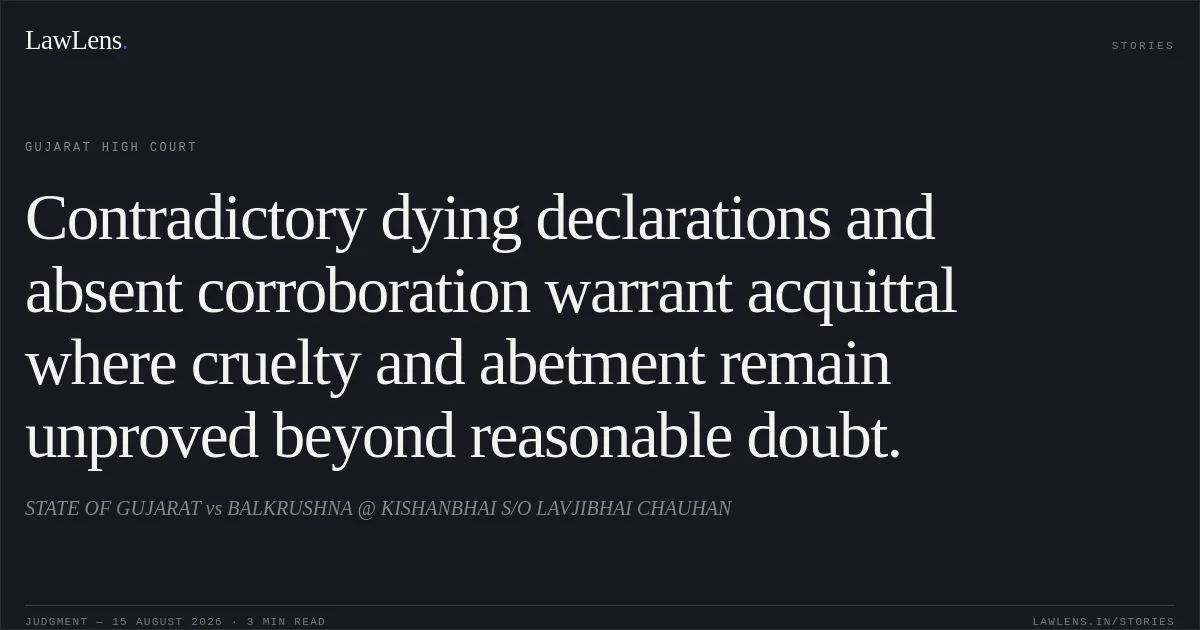
The High Court answered all issues against the State.
It held that the prosecution failed to establish beyond reasonable doubt that the respondent subjected the deceased to cruelty, abetted her suicide, or committed offences under Sections 498A, 306, 506 or 504 of the IPC.
Source reference: paras. 15, 22–23; pp. 10, 15The appeal against acquittal was dismissed, the trial court’s judgment dated 19 July 2012 was confirmed, the respondent’s bail bond was cancelled, and the record and proceedings were directed to be returned to the trial court.
Source reference: para. 24; p. 16Acts & Sections Cited
5 provisions across 2 statutes referred to in this judgment. Each provision opens on LawLens.
Code of Criminal Procedure, 19732
Indian Penal Code, 18603
Original Court PDF
STATE OF GUJARATvsBALKRUSHNA @ KISHANBHAI S/O LAVJIBHAI CHAUHAN
Click to open original judgment
Original judgment, available to read, download and summarize on LawLens.in