Facts
On 31 January 2016, Ramsingbhai Bhemabhai Koli and Bharatbhai Nanabhai Koli were travelling on motorcycle No. GJ-17-AD-7343 near Vanzar Hotel, Piplod village.
Source reference: p. 1A tempo bearing registration No. GJ-20-T-6330, allegedly driven rashly and negligently by respondent No. 1, collided with the motorcycle. Ramsingbhai sustained serious head injuries and died during treatment; the post-mortem recorded the cause of death as shock due to head injury.
Source reference: p. 1; p. 4The Motor Accident Claims Tribunal, Limkheda, in MACP No. 1844 of 2017, held the tempo driver 90% negligent and the motorcycle driver 10% contributorily negligent, and awarded compensation of Rs. 7,88,760.
Source reference: p. 4The deceased’s legal representatives preferred the present appeal under Section 173 of the Motor Vehicles Act, 1988, seeking enhancement of compensation and deletion of the finding of contributory negligence.
Source reference: p. 1; p. 2Issues
Whether the Tribunal was justified in attributing 10% contributory negligence to the motorcycle driver merely because the motorcycle was involved in the accident?
Source reference: p. 4–6Whether the compensation awarded by the Tribunal was just and required enhancement by correctly assessing income, future prospects, dependency and conventional heads of compensation?
Source reference: p. 2; p. 6–7Law Applied
The Court applied Section 173 of the Motor Vehicles Act, 1988, governing appeals against awards of the Motor Accident Claims Tribunal.
Source reference: p. 1It reiterated that the Motor Vehicles Act is beneficial legislation and that compensation must be just, fair, reasonable, equitable and based on a realistic assessment of the loss suffered.
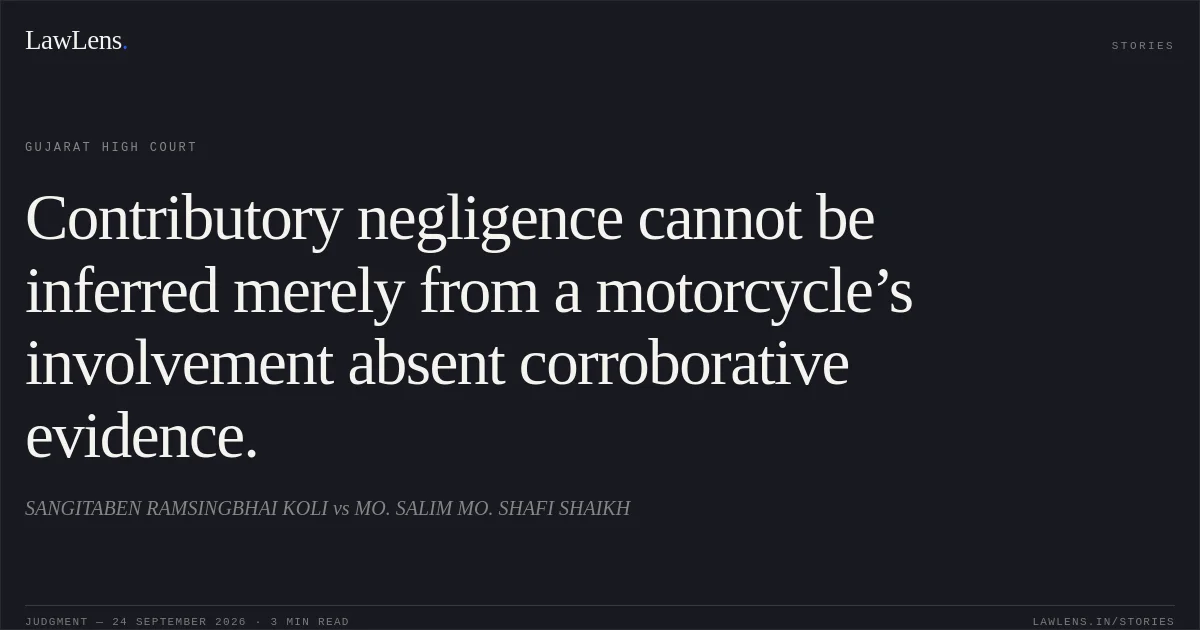
Source reference: p. 3–4For contributory negligence, the Court held that negligence must be established by evidence and cannot be inferred merely from the involvement of a vehicle in the accident; the absence of testimony from the offending vehicle’s driver may justify an adverse inference under Section 114 of the Evidence Act.
Source reference: p. 5–6The Court relied on Oriental Insurance Company Limited v. Kalu Ram , 2026 INSC 653, concerning proof of negligence and adverse inference against a driver who does not enter the witness box.
Source reference: p. 5–6For computation of compensation, it relied on National Insurance Co. Ltd. v. Pranay Sethi , (2017) 16 SCC 680, regarding future prospects and conventional amounts, and United India Insurance Co. Ltd. v. Satinder Kaur @ Satwinder Kaur , (2021) 11 SCC 780, regarding consortium payable to each eligible dependent.
Source reference: p. 6Reasoning
The Court found that the Tribunal had attributed 10% negligence to the motorcycle driver solely because the motorcycle was involved in the collision, without any corroborative or concrete evidence establishing negligent conduct on his part.
Source reference: p. 5–6The FIR and charge-sheet were filed against the tempo driver, while the tempo driver did not enter the witness box; consequently, an adverse inference was warranted against him under Section 114 of the Evidence Act.
Source reference: p. 6The Tribunal’s finding of contributory negligence was therefore unsustainable.
Source reference: p. 6On quantum, the Court held that the Tribunal had failed to properly assess the deceased’s income and the applicable conventional damages.
Source reference: p. 6Applying the principles in Pranay Sethi and Satinder Kaur , it recalculated future dependency loss at Rs. 16,12,800, and awarded Rs. 4,23,500 towards loss of estate, consortium and funeral expenses, resulting in total compensation of Rs. 20,36,300.
Source reference: p. 6After deducting the amount already awarded, the additional compensation came to Rs. 12,47,540.
Source reference: p. 6–7Holding
The appeal was partly allowed.
The Court set aside the Tribunal’s finding attributing 10% contributory negligence to the motorcycle driver.
Source reference: p. 7–8The claimants were held entitled to enhanced compensation of Rs. 12,47,540, with interest at 8% per annum from the date of filing of the claim petition until realisation.
Source reference: p. 7The Insurance Company was directed to deposit the enhanced amount within six weeks, and the Tribunal was directed to disburse the awarded amount, subject to verification, compliance with due procedure and deduction of court fees, if payable.
Source reference: p. 8Acts & Sections Cited
1 provisions across 1 statute referred to in this judgment. Each provision opens on LawLens.
Motor Vehicles Act, 19881
Original Court PDF
SANGITABEN RAMSINGBHAI KOLIvsMO. SALIM MO. SHAFI SHAIKH
Click to open original judgment
Original judgment, available to read, download and summarize on LawLens.in