Facts
On December 22, 2018, the deceased (Suresh) was riding a two-wheeler with a pillion rider when a bus belonging to the appellant Transport Corporation collided with him, resulting in his death
Source reference: p. 2The claimants (wife, father, and minor children) filed for compensation under Section 166 of the Motor Vehicles Act
Source reference: p. 2The Motor Accident Claims Tribunal (MACT) awarded Rs. 58,53,880/-, but deducted 10% for contributory negligence on the grounds that the deceased was not wearing a helmet
Source reference: p. 3The Transport Corporation appealed the quantum, specifically the 50% addition for future prospects and the non-deduction of EPF/ESI from the salary
Source reference: p. 4The claimants challenged the finding of contributory negligence
Source reference: p. 4Issues
1. Whether the Tribunal was justified in fixing 10% contributory negligence on the deceased for the alleged non-wearing of a helmet in the absence of framed issues or concrete evidence
Source reference: p. 52. Whether deductions toward EPF and ESI should be made from the gross salary for calculating loss of dependency
Source reference: p. 63. Whether the deceased, a contract employee for an ONGC contractor, was entitled to 50% or 40% addition for future prospects
Source reference: p. 7Law Applied
The Court applied the principles of the Motor Vehicles Act, 1988, and the precedent set by the Apex Court in M. Nithya & Ors. v. SBI General Insurance Co. Ltd. (2025 Supreme (SC) 1508), which mandates that for contributory negligence regarding headgear, specific issues must be framed and evidence adjudicated
Source reference: p. 5-6Regarding salary deductions, the Court followed its own precedent in Sriram General Insurance Company Ltd. v. Sumant A. Gulvadi (C.M.A.No.542 of 2021), holding that EPF and ESI are not deductible components of gross salary for compensation purposes
Source reference: p. 6For future prospects, the Court applied settled law distinguishing between permanent and contractual/private employment
Source reference: p. 7Reasoning
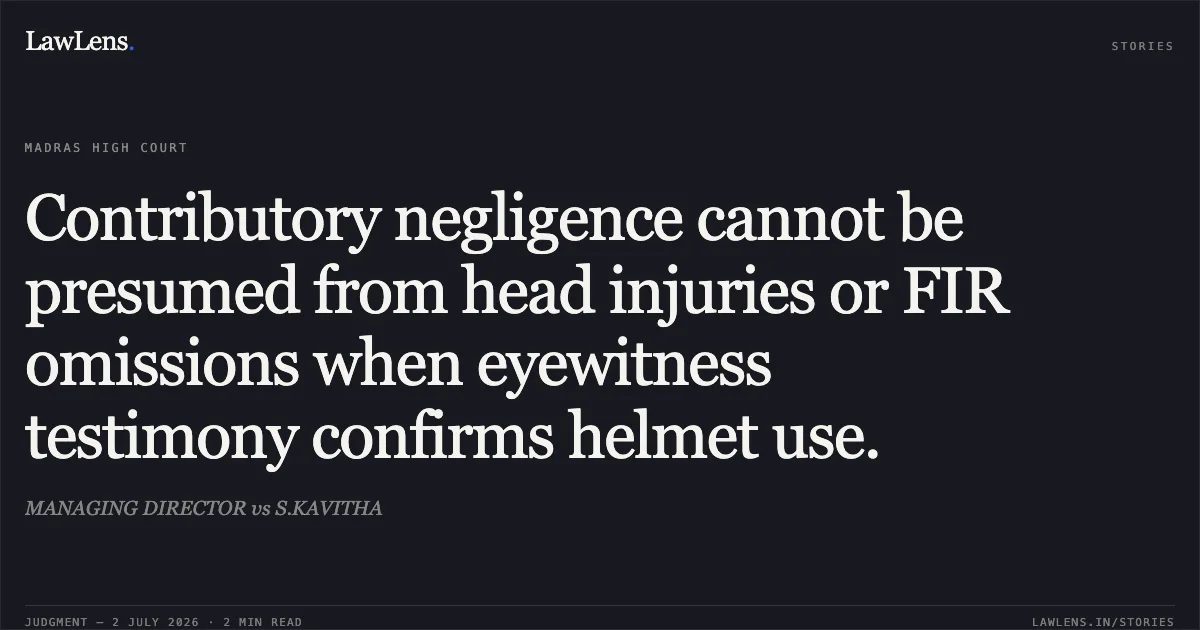
The Court found the Tribunal’s 10% deduction for contributory negligence unsustainable because an eye-witness (PW2) testified that the deceased wore a helmet, and the Tribunal's reliance on the absence of such mention in the FIR was a mere presumption
Source reference: p. 5Following M. Nithya, the Court held that negligence cannot be fixed without a specific issue and evidence showing the injury was caused by the lack of a helmet
Source reference: p. 6Regarding income, the Court upheld the refusal to deduct EPF/ESI as they are not salary components
Source reference: p. 6However, it modified the "future prospects" addition; since the deceased was a contract employee under the Contract Labour (Regulations and Abolition) Central Rules, 1971, rather than a permanent employee, the addition was reduced from 50% to 40% in line with established legal standards
Source reference: p. 7-8Holding
The Court partly allowed the appeal, setting aside the 10% deduction for contributory negligence and reducing the future prospects from 50% to 40%
The total compensation was re-calculated and increased to Rs. 60,83,832/- with 7.5% interest. The Transport Corporation was directed to deposit the modified amount within six weeks, with specific directions for the apportionment and protection of the minor claimants' shares in fixed deposits
Source reference: p. 9-10Acts & Sections Cited
2 provisions across 1 statute referred to in this judgment. Each provision opens on LawLens.
Motor Vehicles Act, 19882
Original Court PDF
MANAGING DIRECTORvsS.KAVITHA
Click to open original judgment
Original judgment, available to read, download and summarize on LawLens.in


