Facts
Respondent No. 1 was born to Hindu parents and was originally named Paramasivara. After converting to Islam in 2015 and changing his name to Sameer Ahamed, he applied for a Backward Class (Muslim) community certificate as a “Muslim Labbai”.
Source reference: para. 2–3The application was rejected on the ground that he had converted religion, not caste or community.
Source reference: para. 2–3While his writ petition challenging the rejection was pending, Tamil Nadu issued G.O. (Ms.) No. 314 dated 9 March 2024, permitting eligible persons from specified pre-conversion backward categories to receive certificates as members of recognised Backward Class Muslim communities.
Source reference: para. 5–6The High Court impleaded the State, heard its submissions, held the G.O. unconstitutional, dismissed the writ petition and sustained the rejection. The State appealed.
Source reference: para. 7–9, 16–18Issues
1. Whether the High Court could examine and invalidate the G.O. despite the absence of a formal prayer challenging its validity, where the State had notice and an opportunity to address the issue.
Source reference: para. 15–182. Whether a person’s pre-conversion backward-class status can, by itself, continue after conversion to Islam or establish membership of a notified Backward Class Muslim community.
Source reference: para. 34–39, 43–483. Whether the G.O. could validly authorise such certification, including where the State relied on a Jamath’s determination of community membership.
Source reference: para. 49–58Law Applied
Articles 14, 15(4) and 16(4) of the Constitution permit affirmative action for identifiable classes whose relevant social and educational backwardness is established; a class must share characteristics connected to the disadvantage the measure addresses (Indra Sawhney v. Union of India, 1992 Supp (3) SCC 217; Ashoka Kumar Thakur v. Union of India, (2008) 6 SCC 1).
Source reference: para. 35–38, 53A community certificate recognises rather than creates status, and executive instructions cannot alter substantive statutory or constitutional conditions.
Source reference: para. 61(f)Paragraph 3 of the Constitution (Scheduled Castes) Order, 1950 excludes persons professing religions other than Hinduism, Sikhism or Buddhism from Scheduled Caste status; that status cannot be restored or transferred by executive order (Chinthada Anand v. State of Andhra Pradesh, 2026 SCC OnLine SC 466).
Source reference: para. 49–51The Court also relied on G. Michael v. S. Venkateswaran, approved in Kailash Sonkar v. Maya Devi, (1984) 2 SCC 91, and C. Selvarani v. Special Secretary-cum-District Collector, (2024) 16 SCC 537, concerning the effect of conversion on caste membership; Kumari Madhuri Patil v. Addl. Commissioner, Tribal Development, (1994) 6 SCC 241, on accountable scrutiny of social-status claims; and Vishwa Lochan Madan v. Union of India, (2014) 7 SCC 707, on the absence of legally binding adjudicatory authority in private religious bodies.
Source reference: para. 45–47, 56–58Reasoning
The Court rejected the State’s procedural objection because the G.O.’s validity was inseparable from the relief sought, and the State had been impleaded, filed a counter-affidavit and addressed the issue.
Source reference: para. 16–18On the merits, it distinguished the existence of backward classes among Muslims—which may be established on relevant evidence—from the automatic transfer of a person’s former status into a different, notified Muslim community.
Source reference: para. 42–48, 52–55Conversion establishes religious affiliation, not membership of a historically constituted community such as Labbai; the G.O. therefore created an artificial route to such membership without establishing the necessary social and legal link.
Source reference: para. 42–48, 52–55The Court further held that the G.O. could not preserve an entitlement founded solely on backwardness within the former Hindu social order, and that the Scheduled Caste status of a convert to Islam could not be continued by executive action.
Source reference: para. 38–41, 49–52A Jamath could provide evidence of conversion or other relevant facts, but could not conclusively determine statutory reservation status in place of the competent public authority.
Source reference: para. 56–58Holding
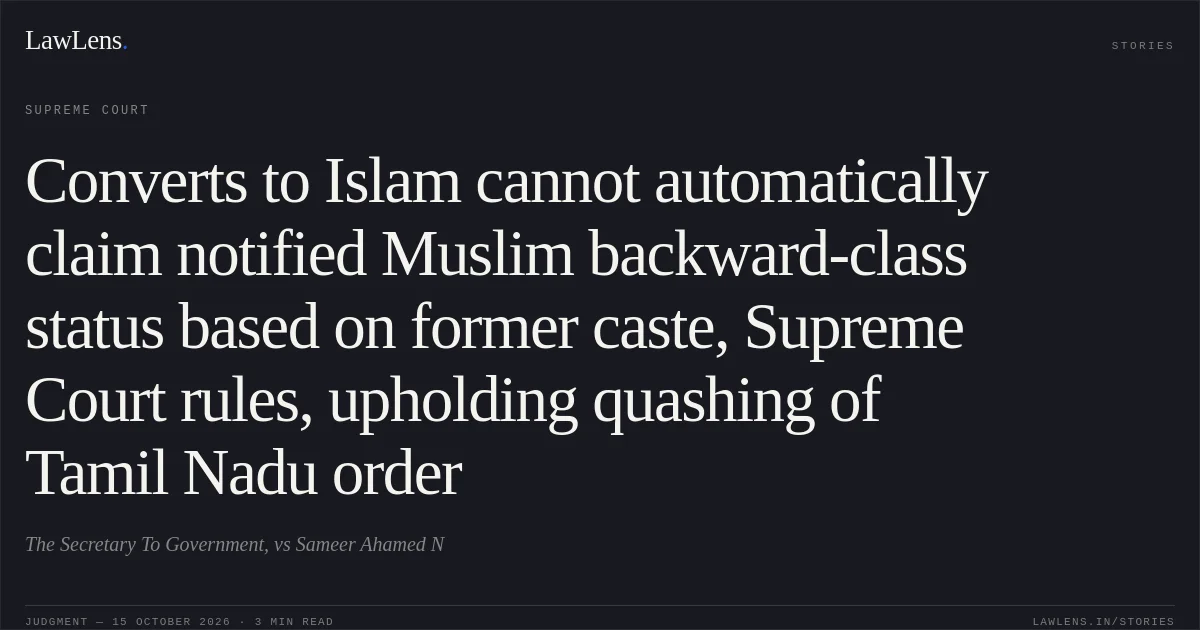
The Court held that conversion to Islam does not, by itself, carry forward pre-conversion backward-class status or confer membership of any notified Backward Class Muslim community; nor may a private religious body conclusively determine statutory entitlement.
It affirmed the High Court’s decision quashing G.O. (Ms.) No. 314 as unsustainable and dismissed the Special Leave Petition. Pending applications, including intervention applications, were disposed of.
Source reference: para. 63–64Acts & Sections Cited
1 provisions across 1 statute referred to in this judgment. Linked provisions open on LawLens.
Tamil Nadu Backward Class Muslims (Reservation of Seats in Educational Institutions including Private Educational Institutions and of Appointments or Posts in the Services under the State) Act, 20071
Original Court PDF
The Secretary To Government,vsSameer Ahamed N
Click to open original judgment
Original judgment, available to read, download and summarize on LawLens.in