Facts
On November 5, 2009, at approximately 12:45 p.m., the accused allegedly entered the agricultural field of the complainant, Dilipbhai Chanabhai, and inquired if his father was "Chana Lagha".
Source reference: p. 2, 39Upon confirmation, the accused allegedly struck the deceased on the head with a sword and fled, leaving behind a motorcycle and a sword cover.
Source reference: p. 3The deceased succumbed to injuries on November 11, 2009.
Source reference: p. 3The appellant was convicted by the 3rd Additional Sessions Judge, Jamnagar, under Sections 302 and 447 of the IPC and Section 135(1) of the Gujarat Police Act on January 28, 2013.
Source reference: p. 1, 8The appellant challenged this on grounds of misidentification, lack of motive, and procedural lapses in investigation.
Source reference: p. 9-14Issues
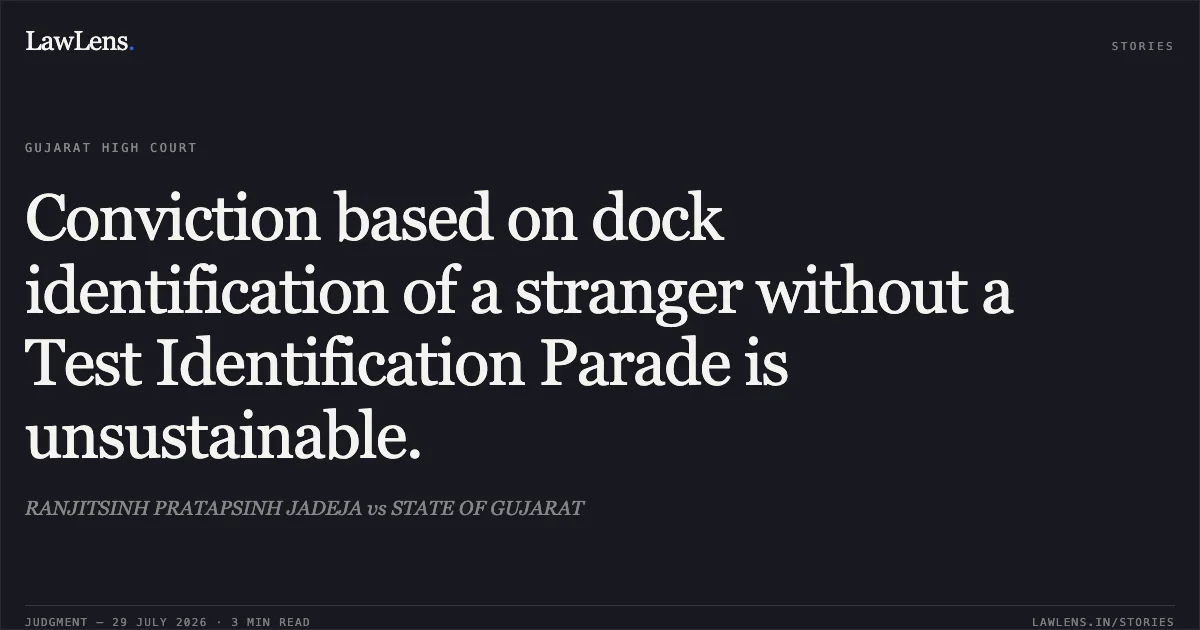
1. Whether the identification of the accused for the first time in court by witnesses who were strangers to him, in the absence of a Test Identification Parade (TIP), is reliable enough to sustain a conviction.
Source reference: p. 52, 612. Whether the prosecution proved the alleged motive and the use of the specific weapon (sword) beyond a reasonable doubt.
Source reference: p. 6, 683. Whether the delay in filing the FIR and lapses in the investigation (e.g., non-seizure of the victim’s motorcycle and complainant’s blood-stained clothes) vitiate the prosecution’s case.
Source reference: p. 15, 69Law Applied
Section 302 (Murder) and Section 447 (Criminal Trespass) of the IPC, and Section 135(1) of the Gujarat Police Act.
Source reference: p. 1-2The court relied on the Supreme Court precedents Nazim & Ors. v. State of Uttarakhand and Dhana Yadav v. State of Bihar, which established that while "dock identification" is substantive evidence, if the accused was a stranger to the witness, the absence of a TIP necessitates "extreme caution" and usually renders dock identification a weak piece of evidence.
Source reference: p. 55-61A conviction cannot be based on testimony that lacks internal consistency or is contradicted by medical evidence.
Source reference: p. 62-64Reasoning
The court found the identification of the appellant highly suspect because he was a total stranger to the eyewitnesses (complainant and his wife), and no TIP was conducted despite a three-year gap between the incident and the trial.
Source reference: p. 53, 62Crucially, the complainant admitted in cross-examination that his father (the deceased) stated he had no enmity with the accused and that the "real culprit" had not been arrested.
Source reference: p. 42, 48The medical evidence did not clearly support the use of a sword, as the doctors admitted the CLW (Contused Lacerated Wound) was also possible by a hard and blunt substance or a fall, and no "chop wounds" typical of sword strikes were found.
Source reference: p. 21, 37Furthermore, the prosecution failed to investigate the alleged "contract killing" motive involving the complainant's cousin uncles.
Source reference: p. 63, 68The 17-hour delay in the FIR and the non-seizure of critical evidence, like the blood-stained clothes of the complainant who allegedly carried his bleeding father, further undermined the prosecution’s narrative.
Source reference: p. 18, 65, 69Holding
The court answered the issues in the negative, holding that the prosecution failed to prove the charges beyond a reasonable doubt.
The court observed that the identification was inherently weak, the motive was unproven, and the investigation was perfunctory.
Source reference: p. 67-69The High Court allowed the appeal, quashed the conviction and life sentence dated January 28, 2013, and ordered the immediate release of the appellant.
Source reference: p. 71-72Acts & Sections Cited
5 provisions across 3 statutes referred to in this judgment. Each provision opens on LawLens.
Indian Penal Code, 18603
Gujarat Police Act, 1951.1
Code of Criminal Procedure, 19731
Original Court PDF
RANJITSINH PRATAPSINH JADEJAvsSTATE OF GUJARAT
Click to open original judgment
Original judgment, available to read, download and summarize on LawLens.in


![Subsequent exoneration does not retrospectively invalidate a finalized promotion select list.. UNNIKRISHNAN M vs M/o Environment And Forests. CAT - ['Ernakulam']. LawLens](/stories/thumbnails/subsequent-exoneration-does-not-retrospectively-invalidate-a-finalized-promotion-select-li-ce80a0e84f2f4887857271e8b4341c42.webp)