Facts
The prosecution alleged that, during the night of 24–25 July 1992, Pannalal Ram entered the deceased Triloki Ram’s room with co-accused Chhathu Ram, Budhan Ram and Gorakh Ram. It was alleged that Chhathu Ram and Budhan Ram restrained the deceased, while Pannalal Ram shot him in the neck with a country-made firearm. The prosecution further alleged that Raja Ram, Jamindar Ram and Chhauratan Ram restrained the deceased’s father outside the room. The deceased’s wife, Raj Kumari Devi, allegedly witnessed the assault and gave the fardbayan at about 7:00 a.m. on 25 July 1992
Source reference: pp. 2–5, paras 2–4A case was registered under Sections 448, 341, 302 read with Section 34 of the Indian Penal Code and Section 27 of the Arms Act. After investigation, charges were framed under Sections 452 and 302 read with Section 34 IPC against the accused, with an additional charge under Section 27 of the Arms Act against Pannalal Ram
Source reference: pp. 4–5, paras 5–6The trial court convicted the accused under Section 302 read with Section 34 IPC and Section 452 IPC, sentencing them to life imprisonment and rigorous imprisonment for one year, respectively. Pannalal Ram was additionally sentenced under Section 27 of the Arms Act
Source reference: p. 2, para 2The prosecution examined five witnesses, but did not examine the informant and alleged eyewitness Raj Kumari Devi, the Investigating Officer, or the post-mortem doctor
Source reference: pp. 5–6, para 7; pp. 24–27, paras 42–44Issues
1. Whether the prosecution proved beyond reasonable doubt that the appellants were responsible for the murder of Triloki Ram under Section 302 read with Section 34 IPC?
Source reference: p. 10, para 412. Whether the non-examination of Raj Kumari Devi, the alleged eyewitness and informant, materially weakened the prosecution case and warranted an adverse inference?
Source reference: p. 24, para 423. Whether the contradictions between the evidence of PW-1 and PW-2, particularly regarding their presence and the source of identification, rendered their testimony unreliable?
Source reference: pp. 25–26, para 434. Whether the non-examination of the Investigating Officer and the post-mortem doctor caused prejudice to the appellants and undermined the prosecution evidence?
Source reference: pp. 26–27, para 445. Whether the alleged identification of the accused in torchlight and lamp-light, viewed in the context of prior enmity, was sufficient to sustain the convictions?
Source reference: pp. 30–31, para 45Law Applied
The Court applied Sections 302 and 34 IPC concerning murder committed with common intention, Section 452 IPC concerning house-trespass after preparation for assault, and Section 27 of the Arms Act concerning use of an unauthorised firearm
Source reference: pp. 2, 4–6, paras 2, 4–6It relied on Takhaji Hiraji v. Thakore Kubersing Chamansing, (2001) 6 SCC 145, for the principle that withholding a material witness who could unfold the genesis or essential part of the prosecution case may justify an adverse inference
Source reference: p. 24, para 42It relied on Kapil Deo Sinha v. Kirandeo Prasad, 2008 (14) SCC 658, for the proposition that non-examination of the Investigating Officer and the medical officer, when coupled with unreliable ocular evidence, may cause serious prejudice and support acquittal
Source reference: pp. 26–27, para 44The Court further applied the reasonable-doubt and benefit-of-doubt principles stated in Kali Ram v. State of Himachal Pradesh, (1972) 2 SCC 808, namely that where two reasonable views are possible, the one favourable to the accused must be adopted and conviction cannot rest on evidence inconsistent with innocence
Source reference: pp. 28–30, para 44It also applied the principle from Aslam alias Imran v. State of Madhya Pradesh, 2025 INSC 403, that prior enmity is a double-edged circumstance which may provide both a motive for the offence and a motive for false implication
Source reference: pp. 30–31, para 45Reasoning
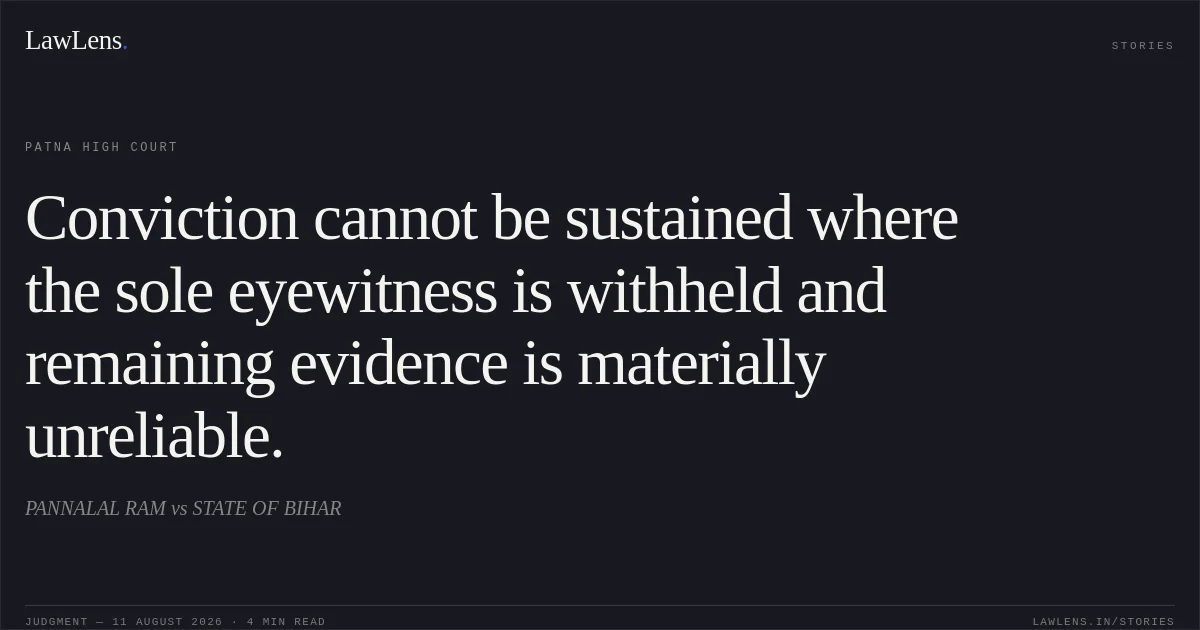
The Court held that the prosecution evidence was insufficient to meet the standard of proof beyond reasonable doubt. Raj Kumari Devi was the only alleged eyewitness to the actual shooting, yet she was not examined and no explanation for her non-examination was provided. The testimony of PW-1 and PW-2 was largely based on what they allegedly heard or were told after the occurrence, rather than on direct observation of the assault
Source reference: p. 24, para 42Their accounts materially conflicted regarding the presence and sleeping arrangements of PW-2 and the source of light in which the accused were allegedly identified. PW-1 claimed identification in diya and torch-light, but also stated that no lamp was burning where he slept
Source reference: pp. 25–26, para 43The Court further found that the absence of the Investigating Officer prevented the defence from confronting the witnesses with their Section 161 CrPC statements and from effectively challenging the investigation, seizures and timing of events. The non-examination of the post-mortem doctor left the medical report proved only through a formal witness who had no personal knowledge of its contents
Source reference: pp. 26–27, para 44The claimed identification of all seven accused at night, during confusion and while they were fleeing, was also considered doubtful. That doubt was intensified by the admitted prior criminal litigation and recent custody suffered by the prosecution witnesses, creating a plausible motive for false implication
Source reference: pp. 30–31, para 45Taken cumulatively, these defects made the evidence unsafe for sustaining convictions under Sections 302/34, 452 IPC and Section 27 of the Arms Act
Source reference: pp. 31–32, paras 46–47Holding
The High Court allowed the appeals and set aside the judgment of conviction and order of sentence dated 27 January 1996. It held that the prosecution had failed to establish the charges beyond reasonable doubt and acquitted the appellants by extending to them the benefit of doubt
As the appellants were on bail, their bail bonds were cancelled and their sureties discharged
Source reference: p. 32, para 49The Court also directed the High Court Legal Services Authority to pay ₹10,000 to the appointed Amicus Curiae for her assistance
Source reference: p. 33, para 50Acts & Sections Cited
9 provisions across 3 statutes referred to in this judgment. Each provision opens on LawLens.
Indian Penal Code, 18606
Arms Act, 19591
Code of Criminal Procedure, 19732
Original Court PDF
PANNALAL RAMvsSTATE OF BIHAR
Click to open original judgment
Original judgment, available to read, download and summarize on LawLens.in