Facts
Nima, daughter of complainant Bhagga, had been married to Premlal for approximately seven years and had two children.
Source reference: paras. 4–10Following alleged matrimonial discord and Premlal’s subsequent “Nata” marriage, Nima was residing with her parents.
Source reference: paras. 4–10On 12 January 2023, Premlal allegedly contacted Nima by telephone and asked her to meet him. She thereafter left her parental home and did not return.
Source reference: paras. 4–10Her body was recovered on 15 January 2023 from a field near Village Sindhu, bearing injuries to the head and face.
Source reference: paras. 4–10An FIR under Section 302 IPC was registered against Premlal, who was subsequently charged and tried before the Additional District and Sessions Judge, Mavli.
Source reference: paras. 4–10The Trial Court convicted him under Section 302 IPC and imposed the death penalty, resulting in a statutory murder reference under Section 366 Cr.P.C. and an appeal by Premlal.
Source reference: paras. 1–3, 10–11The prosecution case rested primarily on circumstantial evidence, including alleged last-seen evidence, call-detail records, recoveries, medical evidence, and FSL/DNA evidence.
Source reference: paras. 19, 28, 62, 70Issues
1. Whether the prosecution proved beyond reasonable doubt that Premlal caused Nima’s death under Section 302 IPC through a complete and legally reliable chain of circumstantial evidence.
Source reference: paras. 28, 76–792. Whether the alleged last-seen circumstance, motive, recoveries under Section 27 of the Evidence Act, medical evidence, FSL/DNA evidence, and call-detail records sufficiently connected Premlal with the offence.
Source reference: paras. 28–52, 53–753. If the conviction were sustainable, whether the case fell within the “rarest of rare” category warranting the death penalty, or whether a lesser sentence was appropriate.
Source reference: paras. 15–20, 23–24Law Applied
The Court applied Section 302 IPC concerning punishment for murder and the settled principles governing cases based on circumstantial evidence.
Source reference: para. 77Relying on Sharad Birdhichand Sarda v. State of Maharashtra, (1984) 4 SCC 116, and the principles derived from Hanumant v. State of Madhya Pradesh, the Court held that every circumstance must be fully and reliably proved, the circumstances must form a complete chain consistent only with the guilt of the accused, and must exclude every reasonable hypothesis of innocence.
Source reference: para. 77The Court treated last-seen evidence as requiring reliable proof of the accused’s proximity to the deceased sufficiently close to the time of death.
Source reference: paras. 28–32Evidence under Section 27 of the Indian Evidence Act could be relied upon only to the extent that a reliable and voluntary disclosure led to a legally proved recovery.
Source reference: paras. 43–47, 63–68Electronic evidence required foundational proof regarding ownership and exclusive use of the mobile numbers, authenticity of the records, and their nexus with the accused.
Source reference: paras. 70–75Medical and forensic evidence were regarded principally as corroborative and incapable, by themselves, of completing an otherwise deficient chain of circumstances.
Source reference: paras. 60, 68–69On capital sentencing, the Court applied the principle that death is an exceptional punishment reserved for cases in which the alternative option is unquestionably foreclosed and the “rarest of rare” standard is satisfied.
Source reference: paras. 15–20Reasoning
The Court found that the prosecution failed to establish the last-seen circumstance because PW-10 and PW-12 disclosed the alleged fact only after substantial and unexplained delays, their conduct was considered unnatural, and the Investigating Officers admitted that no such circumstance had emerged during the initial investigation.
Source reference: paras. 29–33The alleged matrimonial motive was weakened by evidence of divorce followed by reconciliation and the absence of proof of continuing discord.
Source reference: paras. 37–39The recoveries were considered unreliable because they were witnessed only by police personnel, the disclosure statements were prepared solely by the Investigating Officer, and the subsequent recovery of a blood-stained stone and towel from an area already searched contradicted the first Investigating Officer’s evidence.
Source reference: paras. 43–48The FSL report showing the deceased’s DNA on the recovered stone and mixed DNA on the towel could not cure the defects in the recovery and chain of custody.
Source reference: paras. 62–69Similarly, the call-detail records only showed calls between two numbers; the prosecution neither proved exclusive use of those numbers nor examined the relevant Nodal Officers or established location data.
Source reference: paras. 70–75Although the medical evidence established death from ante-mortem head injuries, the doctors acknowledged the absence of defensive injuries and the possibility of injuries caused by a fall on rocks; further, no injuries or blood traces were found on Premlal.
Source reference: paras. 53–61Applying the Sharad Birdhichand Sarda standard, the Court held that suspicion, however strong, could not substitute for proof and that the incomplete chain entitled Premlal to the benefit of doubt.
Source reference: paras. 76–79Holding
The Court allowed Premlal’s criminal appeal and answered the murder reference in the negative.
It set aside the Trial Court’s judgment of conviction and death sentence dated 8 December 2025 and acquitted Premlal of the charge under Section 302 IPC by extending the benefit of doubt.
Source reference: para. 80He was directed to be released forthwith unless required in another case.
Source reference: para. 81In accordance with Section 481 BNSS, 2023, he was also directed to furnish a personal bond of ₹50,000 and a surety bond for the like amount, effective for six months, undertaking to appear before the Supreme Court if notice of any challenge to the judgment was received.
Source reference: para. 81Acts & Sections Cited
5 provisions across 3 statutes referred to in this judgment. Each provision opens on LawLens.
Code of Criminal Procedure, 19733
Indian Penal Code, 18601
Bharatiya Nagarik Suraksha Sanhita, 20231
Original Court PDF
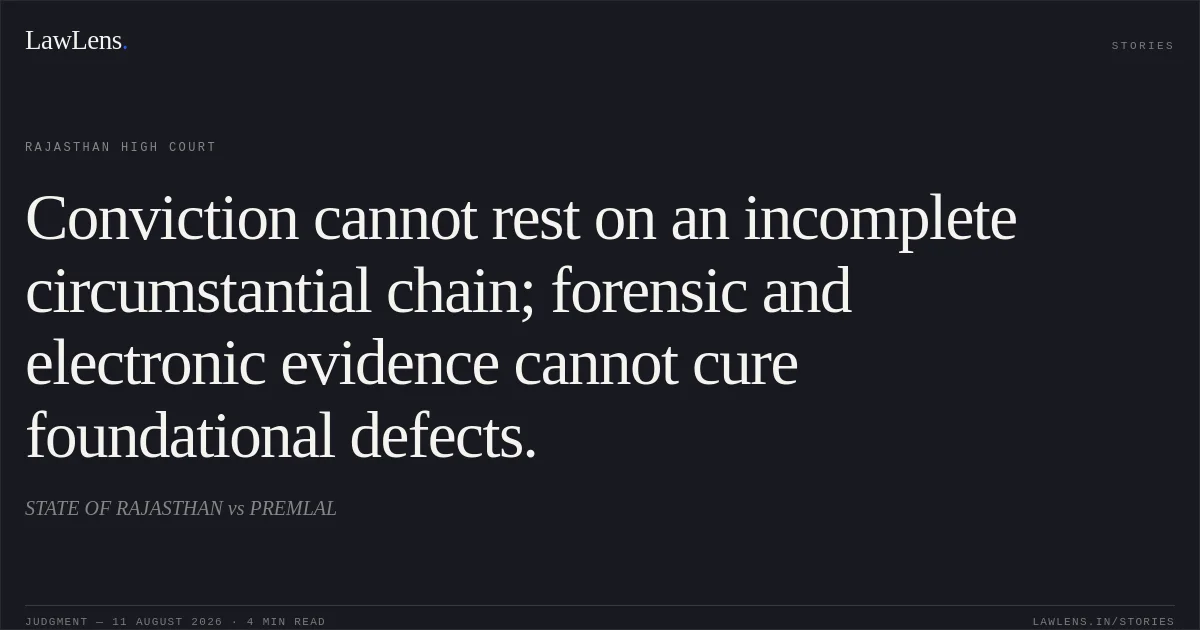
STATE OF RAJASTHANvsPREMLAL
Click to open original judgment
Original judgment, available to read, download and summarize on LawLens.in