Facts
The appellants were prosecuted in connection with Udwantnagar P.S. Case No. 79 of 1992 arising from an alleged assault on 27 May 1992, when informant Gopal Singh was repairing the ridge of agricultural land.
Source reference: para. 4The prosecution alleged that Jai Kumar Singh, Jaggu Yadav, and Srikant Yadav assaulted Gopal Singh and his brother Tapan Singh with lathis, while Awadhesh Yadav used a bhala.
Source reference: para. 4The case was instituted under Sections 341, 323 and 324 read with Section 34 IPC; cognizance was subsequently taken under Sections 341, 323, 324 and 307 read with Section 34 IPC.
Source reference: para. 5The trial Court convicted appellant nos. 1 to 3 under Section 323 read with Section 34 IPC and appellant no. 4 under Section 324 read with Section 34 IPC, sentencing them to one year and three years’ rigorous imprisonment, respectively.
Source reference: para. 1During the appeal, appellant no. 2 died and the appeal abated against him; the appeal continued against appellant nos. 1, 3 and 4.
Source reference: para. 2The prosecution examined seven witnesses, including the informant, an injured witness, seizure-list witnesses, and a hostile witness, but did not examine the doctor who allegedly prepared the injury reports.
Source reference: paras. 6–7, 12The parties were involved in a longstanding land dispute concerning the place of occurrence, and the defence produced several revenue records and orders relating to possession of the land.
Source reference: paras. 8, 11, 20Issues
1. Whether the prosecution proved beyond reasonable doubt that the surviving appellants voluntarily caused hurt to the informant and his brother in furtherance of their common intention, thereby attracting Sections 323/324 read with Section 34 IPC.
Source reference: paras. 20–282. Whether the ocular evidence could be relied upon despite the witnesses’ interested or chance-witness status, material inconsistencies, lack of independent corroboration, and the admitted land dispute.
Source reference: paras. 21–223. Whether the injury reports could establish the alleged injuries and the use of a bhala when the doctor who prepared them was not examined and the reports were merely proved through a formal witness.
Source reference: paras. 23–264. Whether the doubtful seizure of blood-stained earth, non-seizure of the alleged weapons, and absence of physical evidence at the place of occurrence entitled the appellants to the benefit of doubt.
Source reference: para. 27Law Applied
The Court applied Sections 323 and 324 IPC, read with Section 34 IPC.
Source reference: no citationSection 324 requires proof not only of voluntary hurt but also that the hurt was caused by an instrument of shooting, stabbing, cutting, or another dangerous weapon; the means and the causal connection between the weapon and injury must be established.
Source reference: no citationRelying on Chandradeep @ Chandeep Sao v. State of Bihar, 2014 (2) PLJR 286, the Court held that proof of the doctor’s handwriting or signature does not prove the contents of an injury report, particularly where the weapon alleged is material to a Section 324 charge.
Source reference: para. 23Under the principles discussed in State of Uttarakhand v. Darshan Singh, (2020) 12 SCC 605, medical evidence is ordinarily corroborative, but where it completely or fundamentally contradicts the ocular account, it may discredit the prosecution case.
Source reference: para. 25The Court also applied the principle that enmity is a double-edged weapon—it may provide motive for the offence or for false implication—and that interested testimony must therefore be scrutinised with particular care.
Source reference: paras. 20–21Relying on Munna Lal v. State of Uttar Pradesh, (2023) 18 SCC 661, the Court treated failure to seize and produce the alleged weapons as significant where the ocular evidence was already doubtful.
Source reference: para. 27The prosecution was required to establish guilt beyond reasonable doubt, and material doubts had to operate in favour of the accused.
Source reference: para. 28Reasoning
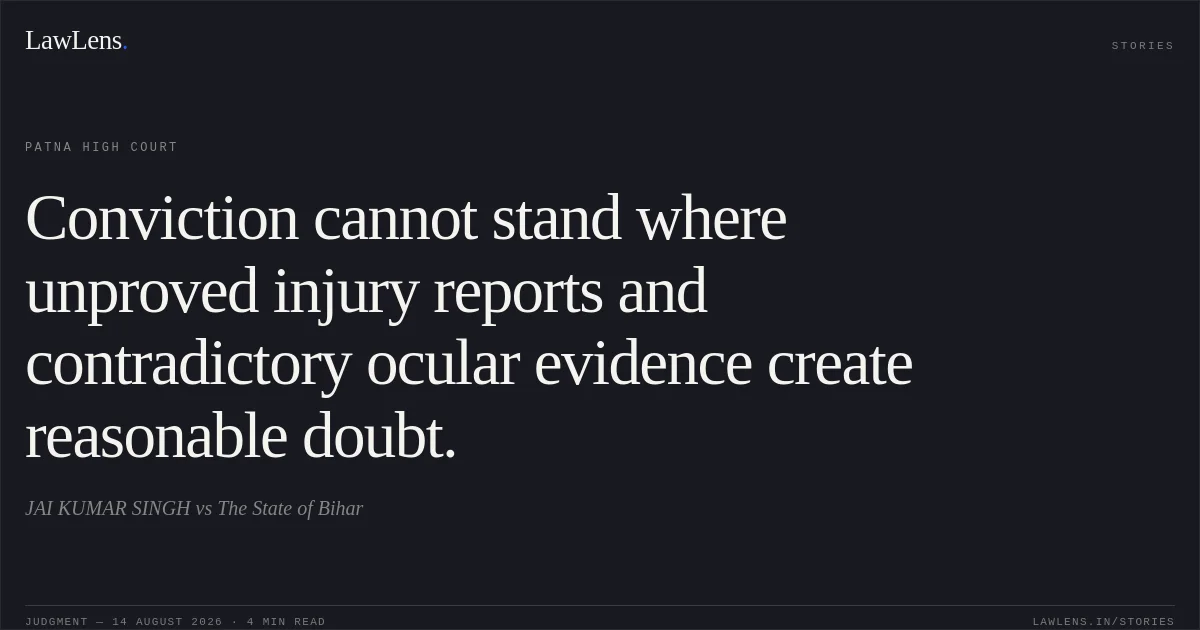
The Court found that the prosecution evidence did not satisfy the required standard of proof.
Source reference: no citationThe informant and his brother were directly interested witnesses involved in the land dispute, while P.W.4 was a chance witness whose conduct-related assertions rendered the occurrence improbable; the only independent witness, P.W.5, turned hostile.
Source reference: paras. 21–22The witnesses also differed regarding the assailants, weapons, and location of injuries.
Source reference: para. 22The doctor was not examined, and P.W.7 merely proved the handwriting and signature on the injury reports, leaving the nature, severity, and causation of the injuries unproved.
Source reference: paras. 23–24The reports, even if considered, recorded only simple incised injuries and no penetrating injury, which was inconsistent with the alleged repeated bhala thrusts and weakened the Section 324 charge.
Source reference: para. 24The Court further noted that the seizure of blood-stained earth was doubtful because the seizure witnesses admitted that their signatures were obtained at the police station; the earth was not sent for forensic examination, the weapons were not seized, and no sign of digging or ridge construction was found at the alleged place of occurrence.
Source reference: para. 27These cumulative infirmities created a reasonable doubt regarding both the occurrence and the appellants’ participation.
Source reference: para. 28Holding
The Court answered the issues in favour of the surviving appellants and held that the prosecution failed to prove the charges under Sections 323 and 324 read with Section 34 IPC beyond reasonable doubt.
The appeal was allowed, the judgment of conviction and order of sentence dated 22 April 2004 were set aside insofar as they concerned Jai Kumar Singh, Srikant Yadav @ Srikant Singh, and Awadhesh Yadav @ Awadhesh Singh, and all three were acquitted.
Source reference: para. 29As they were on bail, they were discharged from the liabilities of their bail bonds.
Source reference: para. 30The appeal against Jaggu Yadav had already abated due to his death.
Source reference: paras. 2, 29Acts & Sections Cited
7 provisions across 2 statutes referred to in this judgment. Each provision opens on LawLens.
Indian Penal Code, 18606
Code of Criminal Procedure, 19731
Original Court PDF
JAI KUMAR SINGHvsThe State of Bihar
Click to open original judgment
Original judgment, available to read, download and summarize on LawLens.in