Facts
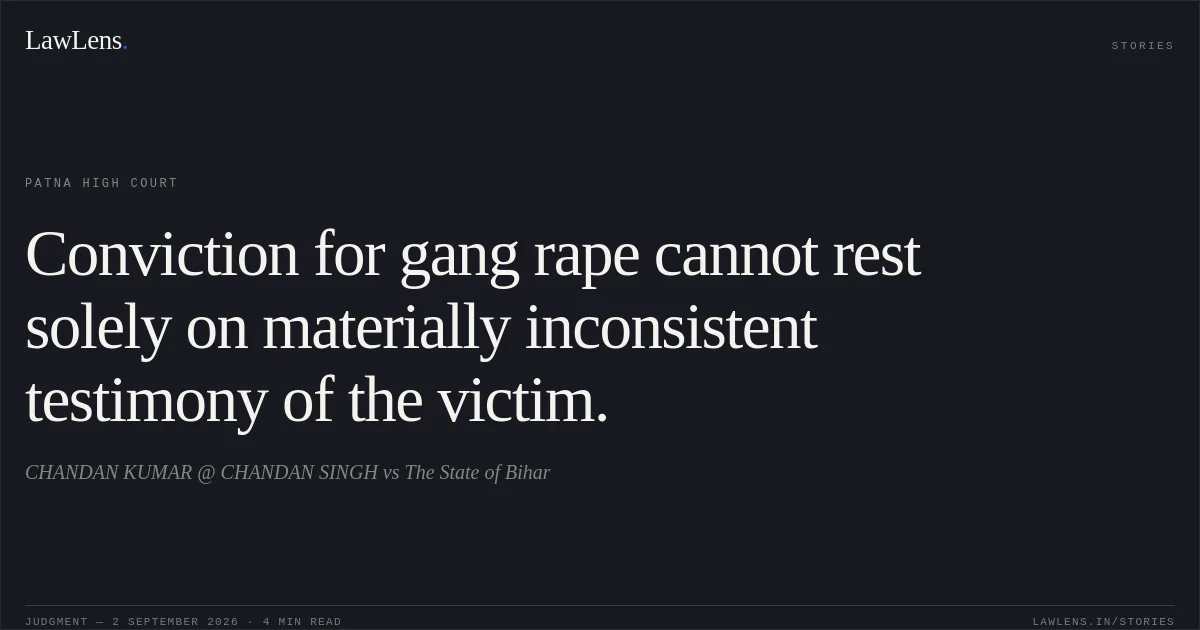
The prosecution alleged that on 29 October 2016, the victim, while returning from Kayamnagar, was taken on a motorcycle by two boys to a boring room near Ram Shahar Bagicha, where one boy allegedly committed rape and another attempted to do so. The appellant, Chandan Kumar, was alleged to have been present at the spot and was apprehended by villagers, while the other two accused, Govind Singh and Golu Singh, escaped.
Source reference: pp. 2–4, paras 4–7The appellant was charged under Sections 376D, 379 and 34 IPC and Section 4 of the POCSO Act. The trial court ultimately convicted him under Section 376D IPC and sentenced him to 20 years’ rigorous imprisonment with a fine of ₹50,000.
Source reference: p. 2, para 3During trial, the medical officer and investigating officer were examined under Section 299 CrPC while the appellant was declared absconding, though he was subsequently permitted to cross-examine them.
Source reference: pp. 4–5, para 8Issues
Whether the prosecution proved beyond reasonable doubt that the appellant participated in, or shared a common intention to commit, gang rape punishable under Section 376D IPC.
Source reference: pp. 6–7, paras 10–13; pp. 24–27, paras 41–43Whether the victim’s testimony, considered with the medical and investigative evidence, was sufficiently consistent and reliable to sustain the appellant’s conviction without material corroboration.
Source reference: pp. 22–27, paras 36–43Whether the delay in registration and transmission of the FIR, inconsistencies regarding the occurrence, and deficiencies in investigation created a reasonable doubt in the prosecution case.
Source reference: pp. 17–25, paras 33–41Whether the prosecution established that the victim was below 18 years of age so as to attract the POCSO Act.
Source reference: p. 10, 17, paras 17 and 37Law Applied
The Court applied Section 376D IPC, which requires proof of gang rape and the participation or common intention of the accused; Sections 34 and 379 IPC and Section 4 of the POCSO Act were also part of the charges, although the POCSO charge failed for want of proof of minority.
Source reference: pp. 3–4, paras 5–7; p. 22, para 37Under the principles governing conviction on the sole testimony of a prosecutrix, such testimony may be sufficient if it is wholly reliable and possesses the quality of a “sterling witness”; the Court relied on Rai Sandeep @ Deepu v. State (NCT of Delhi), (2012) 8 SCC 21, which requires consistency from the initial version through trial and material correlation with supporting evidence.
Source reference: pp. 26–27, para 42The Court further applied the principle that delayed transmission of an FIR may raise suspicion of embellishment or ante-timing, while recognising that delay is not automatically fatal if satisfactorily explained, relying on Meharaj Singh (L/Nk.) v. State of U.P., (1994) 5 SCC 188, and Chotkau v. State of U.P., (2023) 6 SCC 742.
Source reference: pp. 19–21, para 35It also applied the presumption of innocence and the rule that the prosecution must prove guilt beyond reasonable doubt; statutory presumptions do not eliminate the prosecution’s initial burden, as reflected in Babu v. State of Kerala, (2010) 9 SCC 189, Latu Das v. State of Assam, 2019 SCC OnLine Gau 5947, and Ramanand v. State of U.P., AIR 2022 SC 5273.
Source reference: pp. 27–29, paras 44–46Reasoning
The Court found that the victim’s evidence was materially inconsistent. Her written information stated that two unknown boys took her on a motorcycle after promising to drop her home, whereas her Section 164 CrPC statement stated that five persons had taken her away and did not name any accused.
Source reference: p. 22, para 36Her trial testimony also conflicted with the written information concerning whether she had gone for photography, where she had been before the alleged occurrence, and the role and identity of the accused.
Source reference: pp. 23–24, paras 38–39The Court considered her conduct of voluntarily accompanying allegedly unknown persons to a lonely location to be unnatural in the circumstances.
Source reference: p. 17, para 33The medical evidence disclosed no external or internal injury, an old hymenal rupture, and no definite opinion that rape had occurred.
Source reference: p. 24, para 40The investigating officer found no physical indications of the occurrence, did not seize the alleged motorcycle, identified no eyewitnesses, and confirmed that the independent witnesses named in the investigation were not examined.
Source reference: pp. 24–25, paras 37 and 41The delayed transmission of the FIR to the jurisdictional court, without adequate explanation, further weakened its reliability.
Source reference: pp. 18–21, para 35Since the victim was not a wholly reliable or “sterling” witness and the remaining evidence did not independently connect the appellant with the offence, the Court held that conviction under Section 376D IPC was unsafe.
Source reference: pp. 25–27, paras 41–43Holding
The High Court allowed the appeal, set aside the judgment of conviction dated 1 July 2023 and the order of sentence dated 10 July 2023, and acquitted the appellant of the charges by granting him the benefit of doubt.
As the appellant was in custody, the Court directed that he be released forthwith unless required in any other case. The trial court records were directed to be returned to the trial court.
Source reference: p. 29, paras 47–48Acts & Sections Cited
10 provisions across 3 statutes referred to in this judgment. Each provision opens on LawLens.
Indian Penal Code, 18602
Code of Criminal Procedure, 19736
Protection of Children from Sexual Offences Act, 20122
Original Court PDF
CHANDAN KUMAR @ CHANDAN SINGHvsThe State of Bihar
Click to open original judgment
Original judgment, available to read, download and summarize on LawLens.in