Facts
The Petitioner applied for L-1 wholesale liquor licenses for its Gwalior and Mohali units under the 2022 Excise Policy.
Source reference: para. 3While initial "Approval Letters" were issued, the Excise Department subsequently requested Police Verification Certificates (PVCs) after discovering a CBI FIR (dated 17.08.2022) involving an employee in the "Delhi Excise Policy Scam".
Source reference: para. 4Later, the Enforcement Directorate (ED) arraigned the Petitioner company as Accused No. 12 in a Supplementary Prosecution Complaint for money laundering (PMLA).
Source reference: para. 32Consequently, the Deputy Commissioner rejected the license applications on 17.04.2023.
Source reference: para. 7After a series of litigations and remands, the Financial Commissioner's order dated 17.02.2026 (2nd FC Order) affirmed the rejection, which the Petitioner challenged via this writ petition.
Source reference: para. 2, 10Issues
1. Whether the expression "has no criminal background" in Section 13(1)(c) of the Delhi Excise Act, 2009 must be equated strictly with a "conviction."
Source reference: para. 14, 172. Whether the Petitioner fulfills the qualifications for the grant of a license under Section 13(1)(c) in light of pending CBI and ED proceedings.
Source reference: para. 293. Whether the "Approval Letters" constituted a final grant of license, necessitating cancellation proceedings under Section 17 rather than a rejection of the application.
Source reference: para. 55-56Law Applied
Interpretation of Section 13(1)(c) of the Delhi Excise Act, 2009, which requires an applicant to possess "good moral character" and "no criminal background".
Source reference: para. 13The doctrine that liquor trade is res extra commercium, allowing the State to impose stringent eligibility criteria.
Source reference: para. 15, 70Principles of statutory interpretation to read the word "or" as "and" (conjunctive) to prevent the term "criminal background" from becoming nugatory.
Source reference: para. 18, 27Reliance on Ashok Lanka v. Rishi Dixit regarding mandatory eligibility scrutiny.
Source reference: para. 23Reliance on Jugal Kishore Pandey v. State of U.P. to define "character" and "criminal background" as broader than mere conviction.
Source reference: para. 26Invocation of the "useless formality theory" from Canara Bank v. VK Awasthy.
Source reference: para. 51The principle that writ courts should not revive illegal orders.
Source reference: para. 50Reasoning
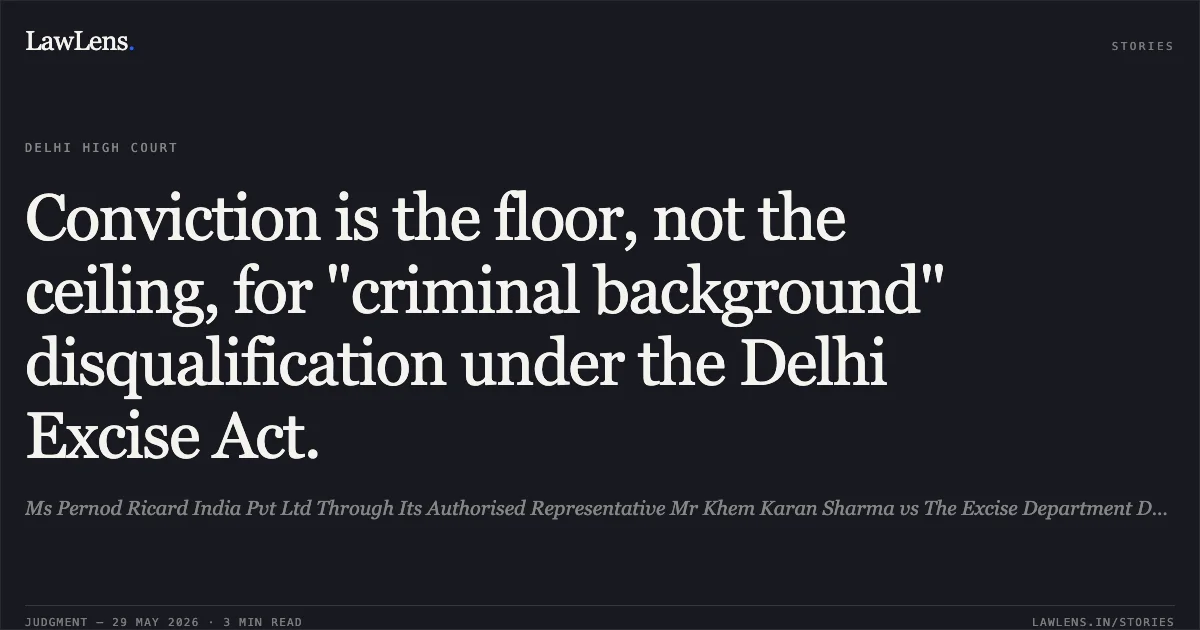
The Court reasoned that "criminal background" is a broader term than "conviction"; equating them would render the legislative intent of Section 13(1)(c) futile.
Source reference: para. 17, 27Analyzing the Petitioner’s status, the Court found that being an accused in a PMLA complaint where cognizance has been taken for a major excise scam constitutes a "criminal background".
Source reference: para. 39, 47The Court rejected the Petitioner's claim that the "Approval Letters" were final licenses, noting they were merely conditional approvals and did not match the statutory Form L-1.
Source reference: para. 59-63On procedure, the Court held that the Department was entitled to re-examine eligibility upon receiving new information about criminal investigations before the final issuance of the license.
Source reference: para. 68, 77Following the "useless formality theory," the Court determined that remanding the matter would be vain as the Petitioner is demonstrably ineligible on admitted facts.
Source reference: para. 53Holding
The Court clarified that "criminal background" under the Act does not require a prior conviction.
The Court dismissed the petition, holding that the Petitioner is ineligible for an L-1 license due to its "criminal background" under Section 13(1)(c).
Source reference: para. 83-84The Court held that the decision-making process was not arbitrary and there was no final grant of license that would have required cancellation proceedings.
Source reference: para. 63, 83The Petitioner was granted liberty to apply afresh if the status of the pending criminal cases changes.
Source reference: para. 85Acts & Sections Cited
4 provisions across 3 statutes referred to in this judgment. Each provision opens on LawLens.
Prevention of Money-Laundering Act, 20021
Arms Act, 19591
Original Court PDF
Ms Pernod Ricard India Pvt Ltd Through Its Authorised Representative Mr Khem Karan SharmavsThe Excise Department Delhi Government Of Nct Of Delhi & Ors.
Click to open original judgment
Original judgment, available to read, download and summarize on LawLens.in


