Facts
The petitioner (Accused No. 2) is the brother-in-law of the deceased. On April 14, 2026, the deceased visited his father-in-law (Accused No. 1) to bring his wife (Accused No. 4) back to their marital home
Source reference: p. 4Following a confrontation, it is alleged that Accused No. 1 poured petrol on the deceased, and the petitioner ignited a matchstick, setting the deceased on fire
Source reference: p. 5A dying declaration was recorded before a Judicial Magistrate on April 15, 2026, after a doctor certified the deceased was conscious and fit
Source reference: p. 5The victim succumbed to burn injuries on May 2, 2026, leading to the registration of Crime No. 138/2026 for offences under Sections 109, 103(1), and 3(5) of the Bharatiya Nyaya Sanhita (BNS), 2023
Source reference: p. 6An independent eyewitness (a nearby tea shop owner) corroborated the events in a witness statement
Source reference: p. 15-17The petitioner sought to quash the FIR under Section 528 of the BNSS (corresponding to Section 482 Cr.P.C.), arguing that his arrest and the proceedings were based solely on an uncorroborated dying declaration
Source reference: p. 7Issues
1. Whether criminal proceedings can be quashed at the FIR stage when the prosecution relies on a dying declaration supported by independent witness statements
Source reference: p. 18-282. Whether a conviction or continued incarceration can be sustained solely on the basis of a dying declaration without further corroboration
Source reference: p. 19Law Applied
The Court applied Section 103(1) (Punishment for Murder) and Section 3(5) (Common Intention) of the BNS, 2023
Source reference: p. 6Regarding dying declarations, it relied on the principles from Khushal Rao v. State of Bombay and Smt. Paniben v. State of Gujarat, establishing that a dying declaration is a substantive piece of evidence and corroboration is a rule of prudence, not law
Source reference: p. 20-22It followed the Constitution Bench ruling in Laxman v. State of Maharashtra, holding that medical certification of fitness is a matter of satisfaction for the Magistrate
Source reference: p. 22-23The court cited State of Himachal Pradesh v. Chaman Lal (2026), affirming that conviction can rest solely on a voluntary and truthful dying declaration
Source reference: p. 19Mirza Jawed Ahmed Baig v. State of AP, which held that the evidentiary value of such declarations is a matter of trial and cannot be adjudicated in quashment proceedings
Source reference: p. 27-28Reasoning
The Court rejected the petitioner’s contention that the arrest was based solely on an uncorroborated dying declaration. It noted that the deceased assigned specific overt acts—naming the petitioner as the one who lit the matchstick—while in a medically certified fit state
Source reference: p. 30The Court highlighted that the declaration was significantly corroborated by the ocular testimony of an independent eyewitness (the tea shop owner), the FSL report confirming petrol in the seized bottle, and the post-mortem report linking death to burn injuries
Source reference: p. 17, 30The Court reasoned that under its extraordinary jurisdiction (Section 528 BNSS), it cannot conduct a "mini-trial" or weigh evidence when a prima facie case for a grave offence like murder is established
Source reference: p. 31The presence of a neutral public officer (Magistrate) during the recording of the declaration further enhanced its reliability
Source reference: p. 30Holding
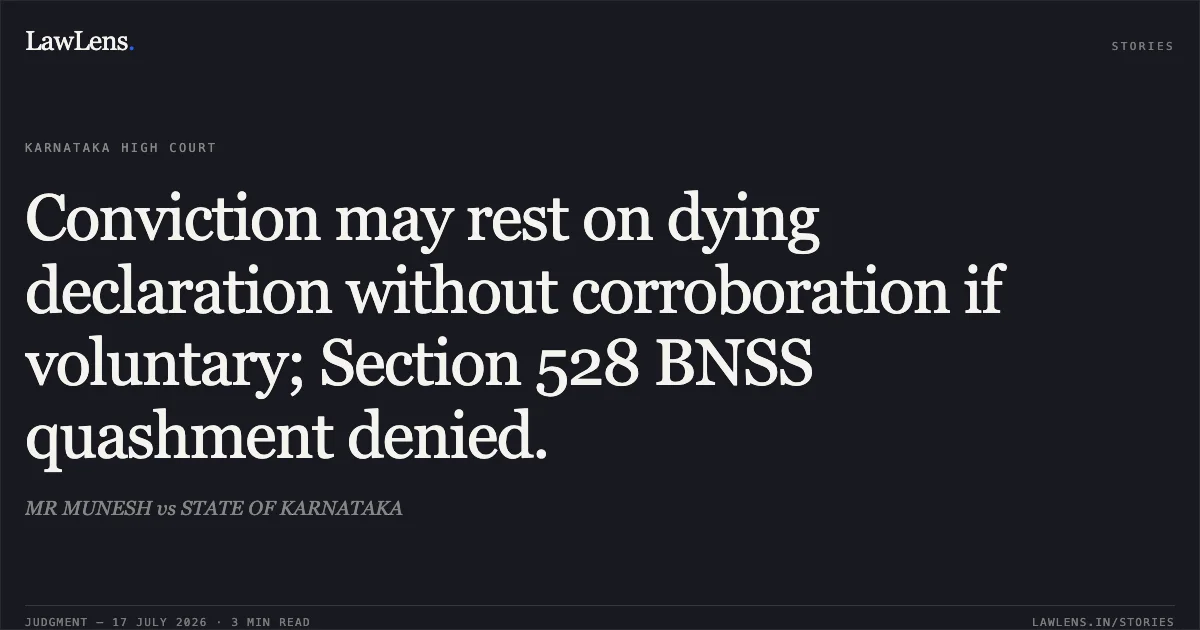
The Court answered that a dying declaration is a substantive piece of evidence and, in this case, was supported by ocular and scientific evidence
The Court held that the truthfulness and evidentiary value of the declaration are matters for trial and do not warrant quashing the FIR at the threshold
Source reference: p. 32The petition was dismissed, and the petitioner was directed to establish his innocence through a full-fledged trial
Source reference: p. 32Acts & Sections Cited
8 provisions across 4 statutes referred to in this judgment. Each provision opens on LawLens.
Bharatiya Nyaya Sanhita, 20233
Bharatiya Nagarik Suraksha Sanhita, 20231
Code of Criminal Procedure, 19732
Indian Penal Code, 18602
Original Court PDF
MR MUNESHvsSTATE OF KARNATAKA
Click to open original judgment
Original judgment, available to read, download and summarize on LawLens.in


![Subsequent exoneration does not retrospectively invalidate a finalized promotion select list.. UNNIKRISHNAN M vs M/o Environment And Forests. CAT - ['Ernakulam']. LawLens](/stories/thumbnails/subsequent-exoneration-does-not-retrospectively-invalidate-a-finalized-promotion-select-li-ce80a0e84f2f4887857271e8b4341c42.webp)