Facts
On December 30, 2020, the deceased, Munia Yadav, was fetching water when the appellant (her daughter-in-law) struck her on the head with a stone and an axe, resulting in fatal head injuries
Source reference: para 4, 17Eyewitness accounts from the deceased’s husband (PW-1) and son (PW-2) confirmed the assault
Source reference: para 17, 18The appellant was convicted by the Trial Court for murder under Section 302 IPC, concealment of evidence under Section 201 IPC, and Sections 4 & 5 of the Chhattisgarh Tonahi Pratadna Nivaran Adhiniyam, 2005 (dealing with witchcraft-related harassment), and was sentenced to life imprisonment
Source reference: para 3, 9The appellant challenged this, contending that the act was committed in a sudden heat of passion without premeditation
Source reference: para 10Issues
1. Whether the death of Munia Yadav was homicidal in nature
Source reference: para 132. Whether the appellant was the perpetrator of the crime
Source reference: para 153. Whether the act of the appellant falls under Exception 4 to Section 300 IPC, warranting a conversion of the conviction from Section 302 IPC to Section 304 IPC
Source reference: para 20Law Applied
The court primarily applied the distinction between murder (Section 302 IPC) and culpable homicide not amounting to murder (Section 304 IPC).
Source reference: para 26, 28It relied on Exception 4 to Section 300 IPC, which mitigates murder to culpable homicide if the act is committed without premeditation in a sudden fight in the heat of passion
Source reference: para 26, 28The court cited Basdev v. State of Pepsu regarding the distinction between 'intent' and 'knowledge'
Source reference: para 21The court relied on Gurmukh Singh v. State of Haryana, which provided a multi-factor test for sentencing, including the nature of the weapon, the lack of previous enmity, and the spur-of-the-moment nature of the incident
Source reference: para 24It further applied the four-ingredient test for Exception 4 established in Arjun v. State of Chhattisgarh and Rambir v. State (NCT of Delhi)
Source reference: para 26, 28Reasoning
The court affirmed the Trial Court's finding that the death was homicidal based on medical evidence (PW-8) showing a depressed fracture of the temporal bone
Source reference: para 14The Court confirmed the appellant’s identity through the consistent eyewitness testimonies of PW-1 and PW-2
Source reference: para 19Regarding the nature of the offense, the Court observed that there was no evidence of premeditation or motive
Source reference: para 30The assault occurred "all of a sudden" and out of anger
Source reference: para 30The court reasoned that the appellant satisfied the four requirements of Exception 4 to Section 300: (i) it was a sudden fight, (ii) there was no premeditation, (iii) the act was done in the heat of passion, and (iv) the assailant did not act in an unusually cruel manner
Source reference: para 30Consequently, the court found that while the appellant had the requisite "guilty knowledge and intention" that the injuries were likely to cause death, the lack of premeditation moved the offense into the realm of Section 304 Part-I IPC
Source reference: para 30-31Holding
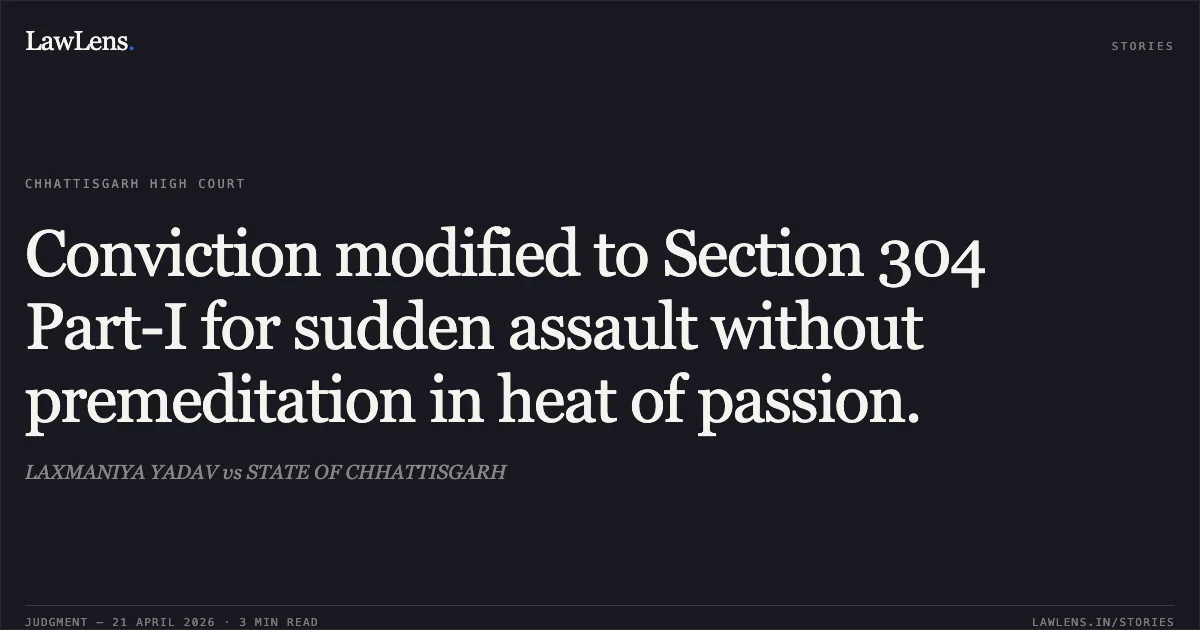
The Court partly allowed the appeal, setting aside the conviction under Section 302 IPC and altering it to Section 304 Part-I IPC
The appellant was sentenced to 10 years of Rigorous Imprisonment (RI)
Source reference: para 32The convictions and sentences under Section 201 IPC and Sections 4 & 5 of the Adhiniyam, 2005, were affirmed
Source reference: para 32The appellant was ordered to serve the remaining sentence as modified
Source reference: para 35Acts & Sections Cited
9 provisions across 3 statutes referred to in this judgment. Each provision opens on LawLens.
Code of Criminal Procedure, 19732
Indian Penal Code, 18605
Original Court PDF
LAXMANIYA YADAVvsSTATE OF CHHATTISGARH
Click to open original judgment
Original judgment, available to read, download and summarize on LawLens.in