Facts
The applicant was charged under Sections 363 and 366 of the IPC for an incident occurring in 2009. After being released on bail and having charges framed in 2018, the applicant absconded during the trial.
Source reference: p. 2, 7Invoking Section 299 of the Code of Criminal Procedure (CrPC), the trial court recorded prosecution evidence in the applicant's absence.
Source reference: p. 3, 7On 30.08.2025, the 4th Additional Sessions Judge, Amreli, convicted the applicant and sentenced him to 10 years of rigorous imprisonment and a fine of Rs. 1 lakh despite his continued absence.
Source reference: p. 1-2Upon his subsequent arrest with a conviction warrant, the applicant filed for suspension of sentence, challenging the legality of a conviction recorded without an opportunity for cross-examination or a statement under Section 313 of the CrPC.
Source reference: p. 4, 15Issues
1. Whether a trial court can legally pass a judgment of conviction against an absconding accused solely based on evidence recorded under Section 299 of the CrPC without affording the accused an opportunity to defend himself.
Source reference: p. 82. Whether the failure to record the statement of the accused under Section 313 of the CrPC and the lack of cross-examination vitiates the conviction.
Source reference: p. 13-14Law Applied
Section 299 of the CrPC, which permits recording and preserving evidence in the absence of an absconding accused, and Section 353(6) of the CrPC, regarding the presence of the accused during judgment.
Source reference: p. 9-11Principle of fair trial and the right to cross-examination under Section 137 of the Evidence Act, as elucidated in Arunaben @ Anitaben v. State of Gujarat (2025), which held that Section 299 is for preservation of evidence only and does not authorize conviction in absentia.
Source reference: p. 11-14Reasoning
The High Court reasoned that the purpose of Section 299 of the CrPC is strictly limited to the "preservation of evidence" to prevent loss of testimony due to the passage of time.
Source reference: p. 8While Section 353(6) allows for an acquittal in the absence of an accused if no prima facie case is made out, it does not empower a court to convict.
Source reference: p. 9The court found that because the applicant was absconding, he was denied the "acid test" of cross-examination and the mandatory requirement of explaining incriminating circumstances under Section 313 of the CrPC.
Source reference: p. 12-13Moving straight to conviction upon recording evidence under Section 299 is a misinterpretation of the statute and a violation of criminal jurisprudence, as the accused must be given a chance to recall available witnesses and defend himself once apprehended.
Source reference: p. 9, 14Holding
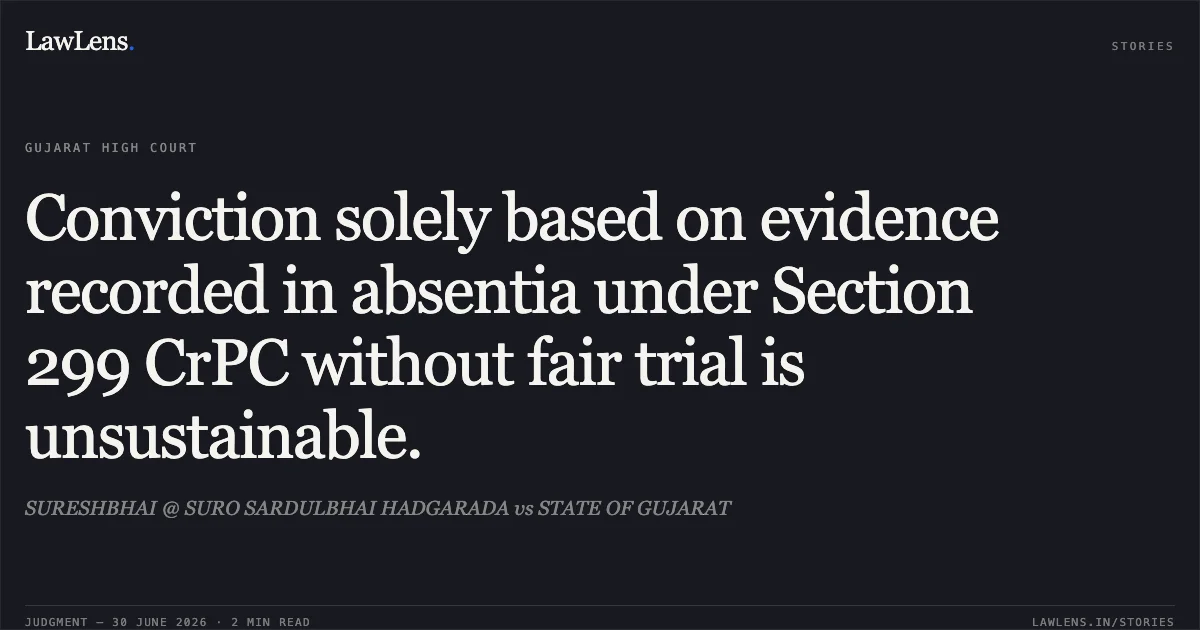
The High Court held that no judgment of conviction can be passed solely on evidence recorded under Section 299 of the CrPC without affording the accused a fair trial.
The judgment and order of conviction dated 30.08.2025 were quashed and set aside. The court remanded the matter back for a de novo trial (decision afresh), directing the trial court to allow the accused to recall and cross-examine available prosecution witnesses and complete the trial within six months. The application for suspension of sentence was disposed of as the conviction itself was set aside.
Source reference: p. 15-16Acts & Sections Cited
10 provisions across 3 statutes referred to in this judgment. Each provision opens on LawLens.
Bharatiya Nagarik Suraksha Sanhita, 20231
Indian Penal Code, 18603
Code of Criminal Procedure, 19736
Original Court PDF
SURESHBHAI @ SURO SARDULBHAI HADGARADAvsSTATE OF GUJARAT
Click to open original judgment
Original judgment, available to read, download and summarize on LawLens.in


![Subsequent exoneration does not retrospectively invalidate a finalized promotion select list.. UNNIKRISHNAN M vs M/o Environment And Forests. CAT - ['Ernakulam']. LawLens](/stories/thumbnails/subsequent-exoneration-does-not-retrospectively-invalidate-a-finalized-promotion-select-li-ce80a0e84f2f4887857271e8b4341c42.webp)