Facts
The Appellant was convicted by the Trial Court for the repeated sexual assault of a minor neighbor (aged approx. 14 years) between January and September 2020
Source reference: para. 6The incident surfaced when the victim’s pregnancy was detected at 27 weeks during a medical examination for amenorrhea
Source reference: para. 7, 11The victim (PW-01) testified that the Appellant committed the first act of forcible intercourse on January 15, 2020, and continued the abuse by threatening to kill her and her family
Source reference: para. 6, 11During the trial, the victim gave birth to a child, and a DNA profile was conducted
Source reference: para. 9The Trial Court convicted the Appellant under Section 376(3), 376(2)(n), and 506 of the IPC, and Section 6 of the POCSO Act, sentencing him to rigorous imprisonment for his natural life
Source reference: para. 4The Appellant challenged the conviction primarily on the grounds of disputed age and lack of credible evidence
Source reference: para. 18-20Issues
1. Whether the victim was a "child" below 18 years of age at the time of the incident as per Section 2(d) of the POCSO Act?
Source reference: para. 28(i)2. Whether the testimony of the prosecutrix, corroborated by medical and DNA evidence, is sufficient to sustain a conviction for aggravated penetrative sexual assault?
Source reference: para. 28(iii) & (iv)3. Whether the prosecution proved the charge of criminal intimidation under Section 506 IPC?
Source reference: para. 28(v)Law Applied
The Court applied Section 2(d) of the POCSO Act, 2012, defining a child as any person under 18
Source reference: para. 30For age determination, it followed the hierarchy of evidence established in Rule 12 of the Juvenile Justice (Care and Protection of Children) Rules, 2007, as affirmed in Jarnail Singh v. State of Haryana, prioritizing school records and birth certificates over medical opinions
Source reference: para. 31Regarding the weight of the victim's testimony, the Court relied on Ganesan v. State and State (NCT of Delhi) v. Pankaj Chaudhary, which held that a conviction can be based solely on the trustworthy and sterling testimony of a prosecutrix without further corroboration
Source reference: para. 61-63Reasoning
The Court first determined the victim’s age to be approximately 14 years and 3 months at the time of the offense based on the school admission register [Ex. P-13C] and marksheet [Ex. P-27], which were corroborated by the oral testimony of the victim’s mother (PW-02)
Source reference: para. 33-40Addressing the merits, the Court found the victim’s testimony (PW-01) to be natural and consistent, particularly regarding the threats that caused the delay in disclosure
Source reference: para. 45-46The Court noted that the ocular evidence was conclusively bolstered by the medical testimony of PW-06, who confirmed a 27-week pregnancy [para. 50-52], and a DNA report [Ex. P-49] which scientifically proved the Appellant was the biological father of the victim's child
Source reference: para. 73The Court distinguished this case from precedents cited by the Appellant, noting that the presence of both medical and DNA evidence provided an "unimpeachable footing" for the prosecution
Source reference: para. 71-73Holding
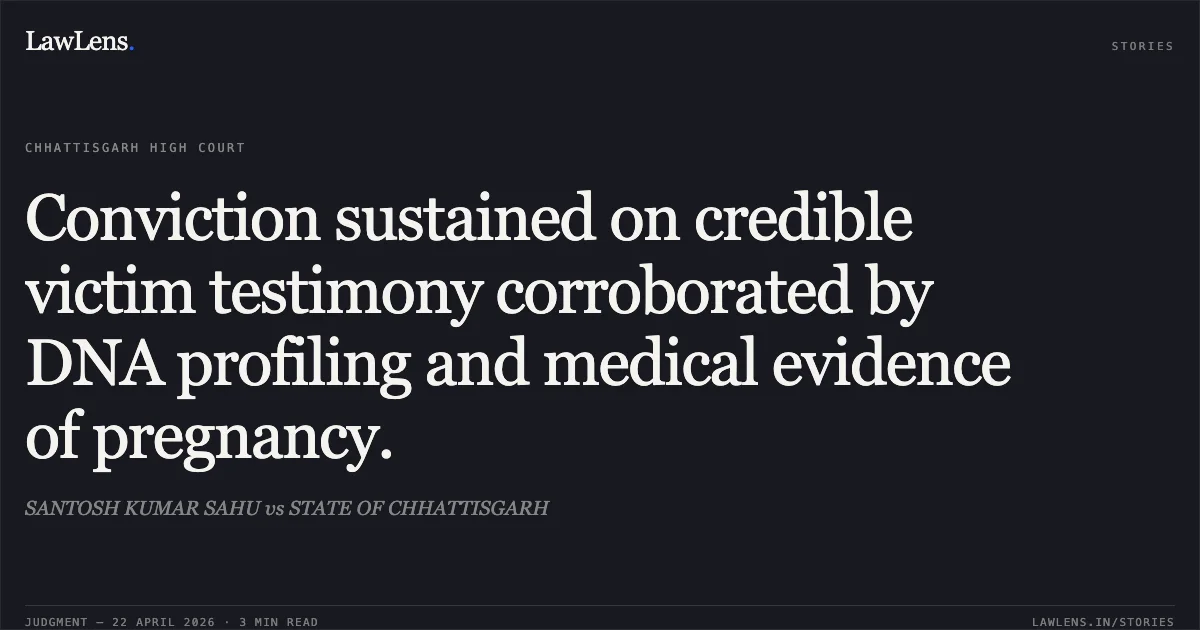
The High Court answered all issues in the affirmative, finding that the prosecution successfully proved the victim's minority and the Appellant's guilt beyond a reasonable doubt
The Court held that the Trial Court’s appreciation of evidence was sound and lacked perversity. Consequently, the appeal was dismissed, and the judgment of conviction and sentence of life imprisonment (meaning incarceration for the remainder of his natural life) was affirmed
Source reference: para. 67-68, 79-80Acts & Sections Cited
13 provisions across 6 statutes referred to in this judgment. Each provision opens on LawLens.
Negotiable Instruments Act, 18811
Bharatiya Nagarik Suraksha Sanhita, 20231
Indian Penal Code, 18605
Code of Criminal Procedure, 19732
Juvenile Justice (Care and Protection of Children) Act, 2015.1
Original Court PDF
SANTOSH KUMAR SAHUvsSTATE OF CHHATTISGARH
Click to open original judgment
Original judgment, available to read, download and summarize on LawLens.in