Facts
The case originated from a complaint by Gautam Kumar Yadav (informant) alleging that on January 20, 2014, while returning from Dumra Court, he was intercepted by the appellants and other accused persons. He was blindfolded, assaulted, and forcibly detained in a house until the police rescued him on January 24, 2014
Source reference: p. 3-4The informant further alleged that the accused demanded a ransom of Rs. 1,00,00,000/- via his mobile phone
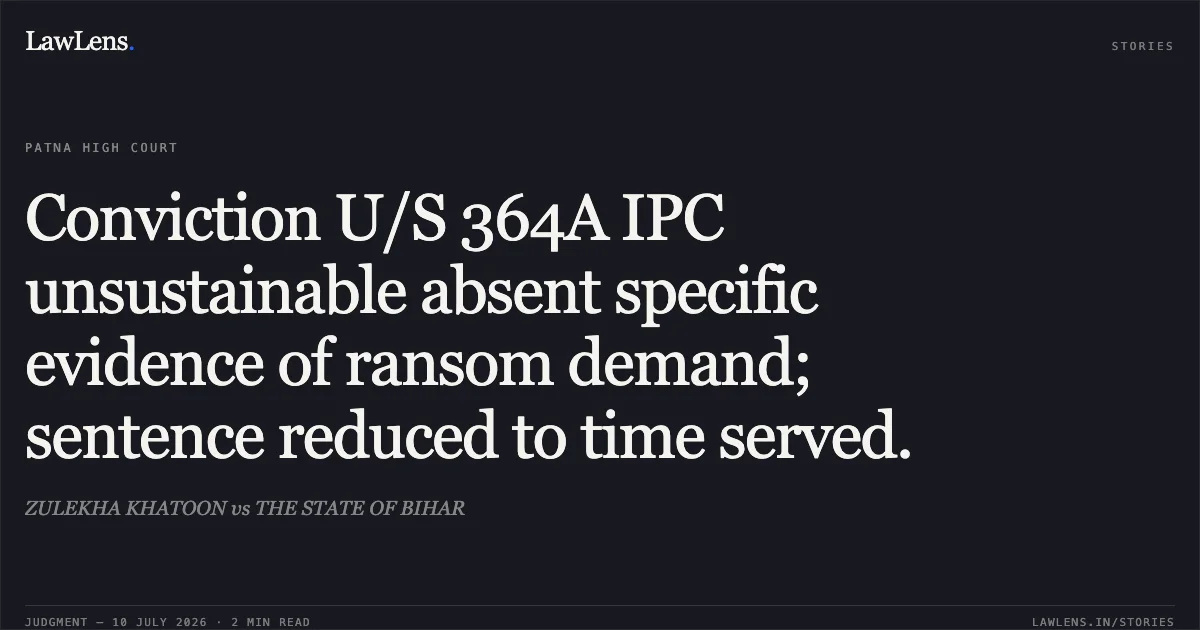
Source reference: p. 4The Trial Court (Additional Sessions Judge-I, Sitamarhi) convicted the appellants under Section 364(A) of the IPC (Kidnapping for ransom) and sentenced them to life imprisonment
Source reference: p. 5The appellants challenged this conviction on the grounds that the evidence did not support the charge of ransom.
Source reference: no citationIssues
1. Whether the prosecution successfully established the essential ingredients of Section 364(A) of the IPC, specifically the demand for ransom
Source reference: p. 62. Whether the act committed by the appellants amounted to abduction under Section 363 of the IPC rather than kidnapping for ransom
Source reference: p. 6Law Applied
Section 364(A) of the IPC, which requires proof of kidnapping or abduction coupled with a demand for ransom or a threat to cause death/hurt
Source reference: p. 6Section 363 of the IPC regarding the punishment for kidnapping/abduction in the absence of a ransom element
Source reference: p. 6-7The court distinguished between "kidnapping" (applicable to minors/unsound mind) and "abduction" (applicable to adults where force or deceit is used)
Source reference: p. 6The court applied the principle of "set off" for the period of incarceration already undergone by the appellants during the trial and appeal
Source reference: p. 7Reasoning
The High Court observed that while seven witnesses were examined, four were declared hostile and did not support the prosecution
Source reference: p. 5Although the informant (P.W. 6) was considered a "sterling witness," his testimony contained inherent contradictions regarding the charge of ransom
Source reference: p. 5-6The court noted that the informant failed to specify which accused person demanded the ransom, and no independent evidence or family testimony corroborated that a ransom demand was ever made
Source reference: p. 6Since the informant was a major, the court determined that the act constituted "abduction" through the application of force (blindfolding and assault) rather than kidnapping for ransom
Source reference: p. 6Consequently, the offense under Section 364(A) could not be sustained, and the conviction was downgraded to Section 363 IPC
Source reference: p. 7Holding
The Court set aside the Trial Court's judgment and order of conviction under Section 364(A) of the IPC
The appellants were instead held convicted under Section 363 of the IPC
Source reference: p. 7Noting that the appellants had already been in custody for periods ranging from six to more than nine years—exceeding the typical punishment for such an offense—the Court ordered their immediate release, provided they were not required in any other case
Source reference: p. 6-7The appeals were partly allowed
Source reference: p. 7Acts & Sections Cited
5 provisions across 2 statutes referred to in this judgment. Each provision opens on LawLens.
Code of Criminal Procedure, 19731
Indian Penal Code, 18604
Original Court PDF
ZULEKHA KHATOONvsTHE STATE OF BIHAR
Click to open original judgment
Original judgment, available to read, download and summarize on LawLens.in


