Facts
The Appellant was convicted by the Trial Court on December 12, 2024, under Section 376(2)(i) IPC and Section 6 of the POCSO Act for the sexual assault of a minor girl, ‘T’, on June 7, 2017
Source reference: p. 1-2The Prosecution alleged the Appellant entered the victim's room while she was resting and committed penetrative sexual assault
Source reference: p. 3The Appellant pleaded false implication due to a financial dispute and an inter-faith relationship between his brother and the victim's sister
Source reference: p. 9-10The Trial Court relied on ocular testimony, medical evidence (MLC), and a DNA report matching the Appellant’s profile to the victim’s samples
Source reference: p. 2-3The Appellant challenged the conviction on grounds of disputed age and a broken chain of custody regarding biological samples
Source reference: p. 11Issues
1. Whether the Prosecution established the minor status of the victim in accordance with the statutory hierarchy for age determination
Source reference: p. 13 / para 242. Whether the delay in forwarding biological samples and alleged tampering vitiated the scientific evidence
Source reference: p. 16 / para 333. Whether the conviction under Section 6 of the POCSO Act (Aggravated Penetrative Sexual Assault) was maintainable in the absence of specific aggravating circumstances
Source reference: p. 20-21 / para 45Law Applied
The Court applied Section 94 of the Juvenile Justice (Care and Protection of Children) Act, 2015, which grants primacy to school records for age determination
Source reference: p. 13It followed State of Uttar Pradesh v. Anurudh (2026) regarding the mandatory hierarchy of evidence for victim age
Source reference: p. 12Regarding evidence integrity, the court applied the principle from Edakkandi Dineshan @ P. Dineshan v. State of Kerala (2025), holding that defective investigation alone does not entitle an accused to acquittal if other evidence is reliable
Source reference: p. 20For sentencing, it applied Section 4 (Penetrative Sexual Assault) vs Section 6 (Aggravated PSA) of the POCSO Act, noting that the 2019 Amendment could not be applied retrospectively to an offence committed in 2017
Source reference: p. 21-22Reasoning
The Court found the Prosecutrix's age was duly proved via school records (Admission Register and parent affidavits) under Section 94 of the JJ Act, especially since the defense failed to challenge these documents during cross-examination
Source reference: p. 14-15Regarding the DNA evidence, the Court rejected claims of tampering, noting that witnesses PW-9, PW-11, and PW-15 consistently testified that seals were intact upon delivery to the FSL
Source reference: p. 17-18The DNA profile match provided conclusive corroboration of the victim’s ocular testimony
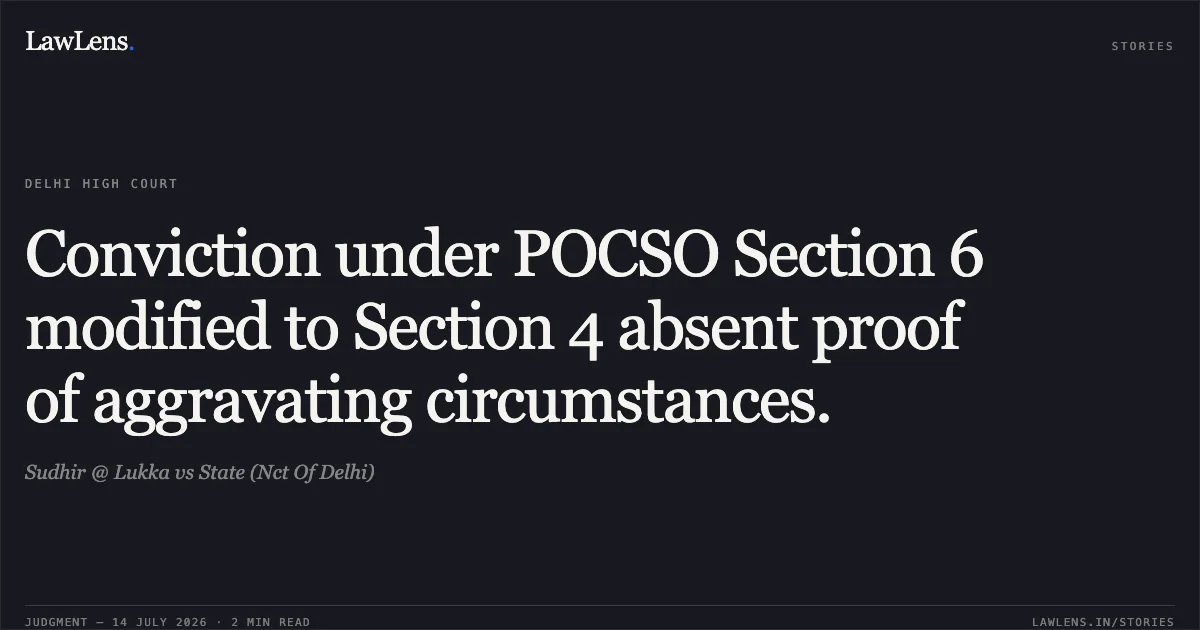
Source reference: p. 19However, the Court identified a legal error in the conviction under Section 6 of POCSO; since the victim was not below 12 years and no other aggravating factors under Section 5 were proved, the offense fell under Section 4
Source reference: p. 22Furthermore, since the crime occurred in 2017, the pre-amendment minimum sentence of seven years applied rather than the 2019 ten-year minimum
Source reference: p. 22Holding
The Court upheld the conviction but modified it from Section 6 to Section 4 of the POCSO Act
It held that the Prosecution successfully proved penetrative sexual assault but failed to prove "aggravated" circumstances
Source reference: para 48Considering the Appellant’s 9-year incarceration (exceeding the 7-year minimum), satisfactory jail conduct, and socio-economic status, the Court modified the sentence to the period already undergone
Source reference: p. 23-24The Appellant was ordered to be released forthwith, subject to the payment of the fine and compensation
Source reference: p. 24Acts & Sections Cited
15 provisions across 5 statutes referred to in this judgment. Each provision opens on LawLens.
Bharatiya Nagarik Suraksha Sanhita, 20232
Indian Penal Code, 18601
Protection of Children from Sexual Offences Act, 20128
Code of Criminal Procedure, 19733
Juvenile Justice (Care and Protection of Children) Act, 2015.1
Original Court PDF
Sudhir @ LukkavsState (Nct Of Delhi)
Click to open original judgment
Original judgment, available to read, download and summarize on LawLens.in


