Facts
The complainant, Tejabhai Raval, alleged that on 09.03.1998, while returning from Radhanpur, he witnessed five accused persons—armed with dhariyas (scythes), a barchhi (spear), and sticks—intercept a rickshaw near Bismillabad bus stand.
Source reference: p. 2The accused allegedly dragged the deceased, Ramjibhai Raval, out of the vehicle and assaulted him to death as revenge for a decade-old murder case in which the deceased's father had been acquitted.
Source reference: p. 2The Trial Court (Additional Sessions Judge, Mehsana) acquitted the accused on 10.08.1999, citing lack of reliable evidence.
Source reference: p. 3The State appealed the acquittal.
Source reference: p. 2During the pendency of the appeal, Respondent No. 3 (Thakore Shivabhai) died, and the appeal abated against him.
Source reference: p. 2Issues
1. Whether the Trial Court committed a manifest error by acquitting the accused despite medical evidence and the recovery of weapons with bloodstains.
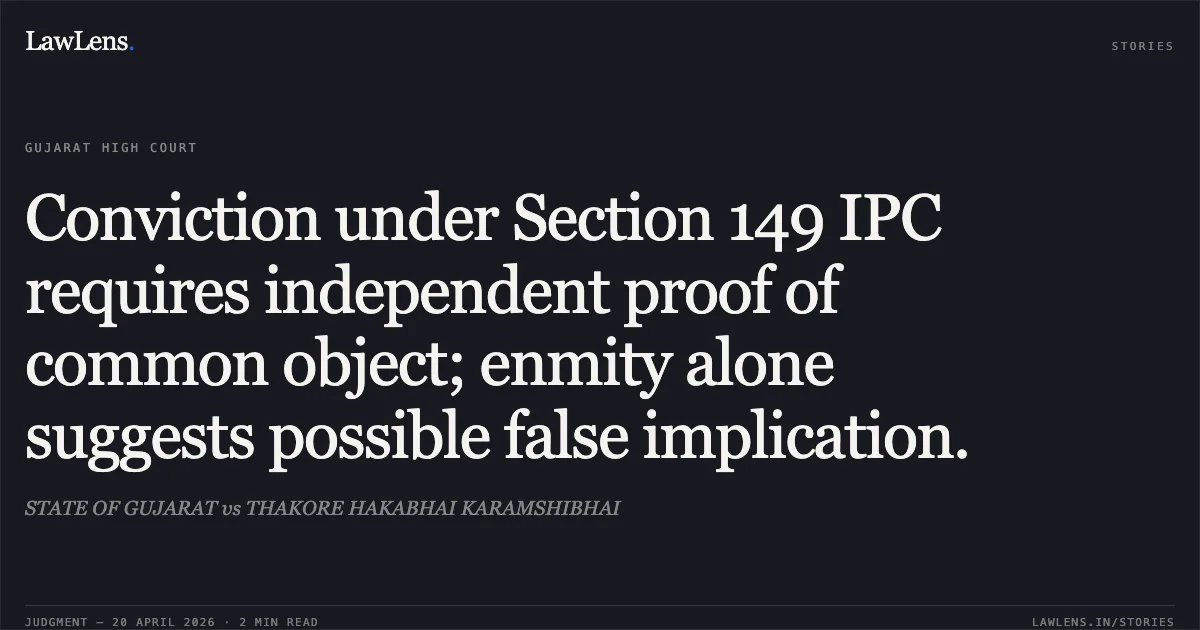
Source reference: p. 3-42. Whether the prosecution successfully established the existence of an "unlawful assembly" and "common object" under Section 149 of the IPC.
Source reference: p. 93. Whether the appellate court should interfere with an order of acquittal when the primary witnesses, including the complainant, turned hostile.
Source reference: p. 8-10Law Applied
The court primarily applied Section 302 (Murder) and Section 149 (Unlawful assembly) of the IPC.
Source reference: no citationIt relied on the principle from Babu Sahebagouda Rudragoudar v. State of Karnataka, establishing that an acquittal strengthens the presumption of innocence, creating a "double presumption".
Source reference: p. 6Jafarudheen v. State of Kerala was applied to emphasize that appellate courts must be slow to reverse acquittals unless the Trial Court's view is impossible.
Source reference: p. 6-7The court also invoked the doctrine that "enmity is a double-edged weapon," which can either provide motive or suggest false implication, as seen in Aslam @ Imran v. State of Madhya Pradesh.
Source reference: p. 10Reasoning
The High Court observed that the prosecution’s case was fundamentally weakened because the Investigating Officer (IO) died before he could be examined, leaving only his writer to testify to procedural aspects.
Source reference: p. 8Out of 18 witnesses, 8 turned hostile, including the complainant (PW-7), whose testimony the Court found did not inspire confidence regarding his presence at the scene.
Source reference: p. 8-9Regarding Section 149 IPC, the Court held that the prosecution failed to provide clinching evidence of a common object or specific overt acts by each member of the alleged assembly.
Source reference: p. 9Although the medical evidence confirmed a homicidal death, the Trial Court noted inconsistencies in the Post-Mortem report regarding the nature of injuries relative to the weapons used.
Source reference: p. 8The High Court concluded that since the material witnesses failed to support the recovery of weapons (panchnamas) and because prior enmity could equally suggest a motive for false implication, the Trial Court’s view was a "possible" and "reasonable" one that did not warrant reversal.
Source reference: p. 10-11Holding
The High Court dismissed the State’s appeal and confirmed the judgment of acquittal dated 10.08.1999.
The Court held that the prosecution failed to prove the charges beyond reasonable doubt and that there was no palpable error or perversity in the Trial Court’s reasoning.
Source reference: p. 11The bail bonds of the respondents were ordered to be discharged.
Source reference: p. 12Acts & Sections Cited
10 provisions across 2 statutes referred to in this judgment. Each provision opens on LawLens.
Indian Penal Code, 18607
Code of Criminal Procedure, 19733
Original Court PDF
STATE OF GUJARATvsTHAKORE HAKABHAI KARAMSHIBHAI
Click to open original judgment
Original judgment, available to read, download and summarize on LawLens.in