Facts
The Appellant (A1) was convicted by the Trial Court under Sections 307 and 326 read with Section 34 of the IPC for an incident occurring on March 23, 2013
Source reference: p. 1-2The prosecution alleged that A1 and A2 (who was later declared a proclaimed offender) assaulted PW12 over a monetary dispute involving his deceased son
Source reference: p. 7When PW12’s daughter (PW8) and son-in-law (PW9) intervened, A1 slashed their faces with a sharp object, causing permanent disfiguration
Source reference: p. 8-9A1 contended that the case was a false implication due to a loan dispute and pointed to a settlement between the victims and A2 in the interim
Source reference: p. 6, 18Issues
1. Whether there is any infirmity in the Trial Court's judgment of conviction under Section 307 and 326 IPC calling for appellate interference
Source reference: p. 7 / para. 142. Whether the act of the accused, committed without a clear intent to cause death but resulting in permanent facial disfigurement, squarely falls under Section 307 or Section 326 IPC
Source reference: p. 26-29 / para. 32-33Law Applied
The court applied Section 307 IPC (Attempt to Murder), requiring the concurrence of mens rea and actus reus where death is a probable consequence
Source reference: p. 27Section 326 IPC (Voluntarily causing grievous hurt by dangerous weapons), specifically identifying "permanent disfiguration of the face" as grievous hurt under Clause Sixthly of Section 320 IPC
Source reference: p. 28It relied on Abdul Sayeed v. State of M.P. regarding the high evidentiary value of injured witnesses
Source reference: p. 23Rakesh v. State of U.P. for the principle that non-recovery of the weapon is not fatal to conviction
Source reference: p. 30Section 222 of the Cr.P.C., which permits conviction for a minor cognate offence even if not specifically charged
Source reference: p. 31Reasoning
The court found the testimony of the injured witnesses (PW8 and PW9) to be reliable, noting that injuries provide an inbuilt guarantee of their presence at the scene
Source reference: p. 23The court observed that the incident was sparked by PW12 challenging the accused ("ab maar ke dikhao"), suggesting a lack of premeditated intent to murder
Source reference: p. 29While the injuries were "grievous" due to facial disfigurement under Section 320, they did not meet the high threshold of "intent or knowledge of causing death" required for Section 307
Source reference: p. 30The court dismissed the defense's reliance on the settlement with A2, noting that A2 had likely misled the court in separate proceedings and that the payment of compensation actually corroborated the occurrence of the assault
Source reference: p. 21-23Applying Section 222 Cr.P.C., the court determined it could convict for the minor cognate offence of Section 326 IPC
Source reference: p. 31-32Holding
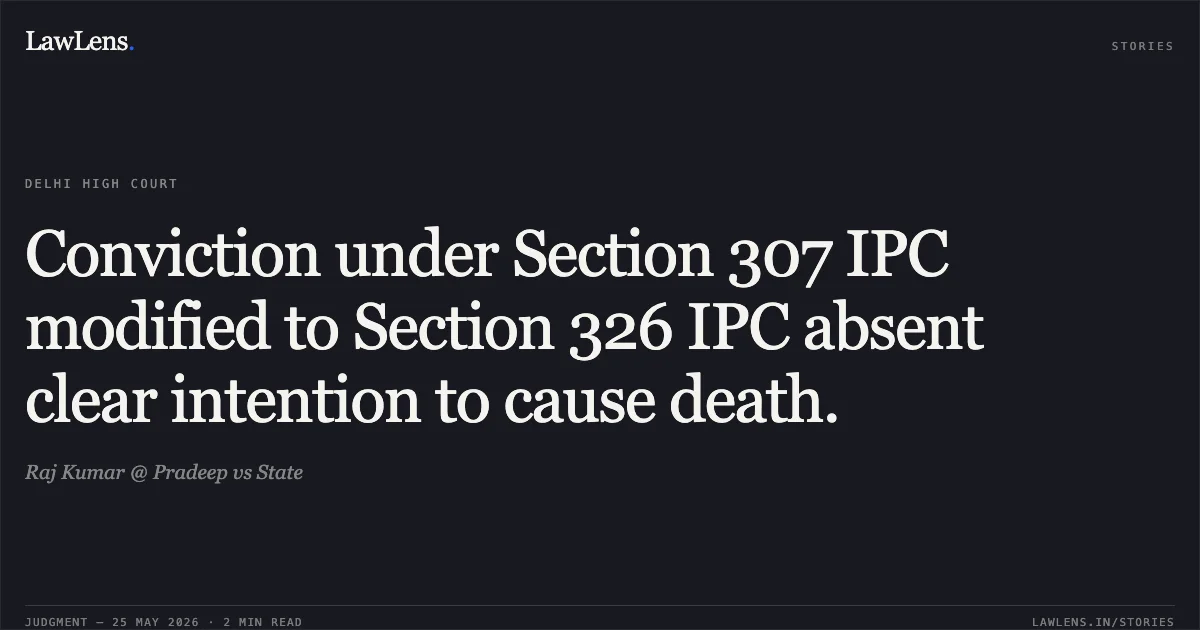
The court set aside the conviction and sentence under Section 307 IPC. Instead, the Appellant was found guilty under Section 326 read with Section 34 IPC for voluntarily causing grievous hurt with a sharp object
The appeal was partly allowed. The sentence was reduced from seven years to two years of rigorous imprisonment, maintaining the fine of ₹10,000
Source reference: p. 33Acts & Sections Cited
11 provisions across 2 statutes referred to in this judgment. Each provision opens on LawLens.
Code of Criminal Procedure, 19736
Indian Penal Code, 18605
Original Court PDF
Raj Kumar @ PradeepvsState
Click to open original judgment
Original judgment, available to read, download and summarize on LawLens.in


