Facts
On 17 November 1994 at approximately 7:00 p.m., the informant, Yogendra Prasad Kushwaha, alleged that the appellant abused him, caught his collar, and assaulted him twice with a knife following a dispute concerning the appellant’s goat damaging the informant’s cabbage crop.
Source reference: para. 2The informant’s fardbeyan was recorded at about 8:30 p.m., and Jamobazar P.S. Case No. 69 of 1994 was registered under Sections 341, 323, 504, 324 and 307 IPC.
Source reference: paras. 2–3The prosecution examined six witnesses, including the injured informant, his father, brother, cousin and a local hotel-keeper. The injury reports of the informant and P.W.1 were exhibited through an advocate’s clerk, but neither doctor was examined. The Investigating Officer was also not examined.
Source reference: paras. 4–7The trial court acquitted the appellant under Section 307 IPC but convicted him under Section 324 IPC and sentenced him to two years’ rigorous imprisonment.
Source reference: para. 10Issues
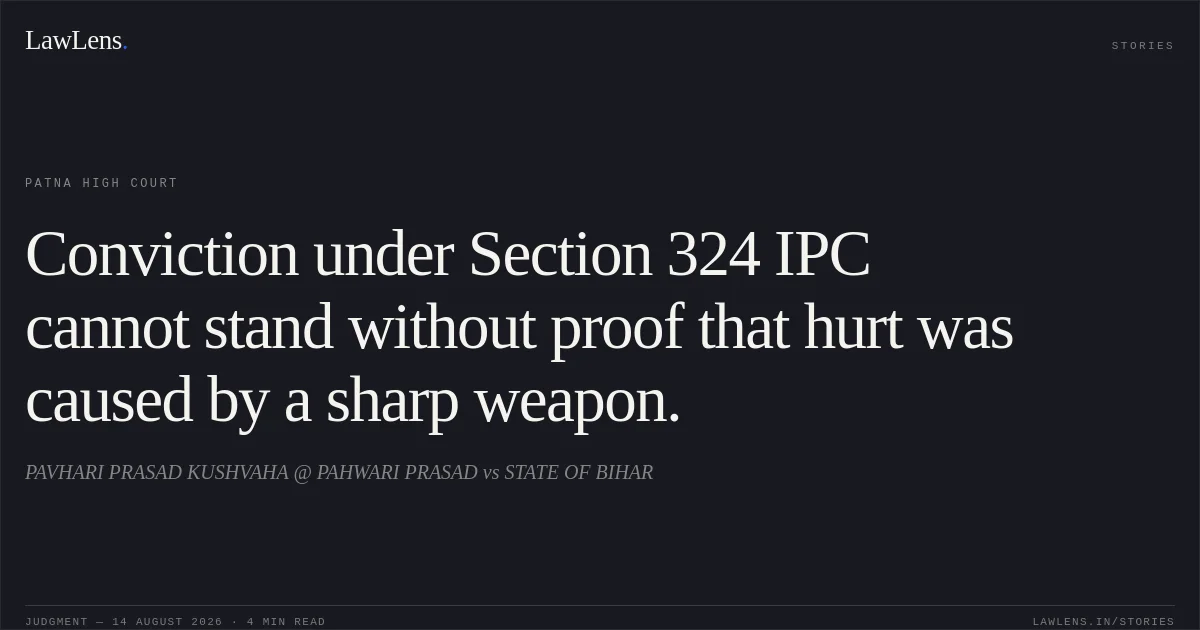
Whether the prosecution proved beyond reasonable doubt that the appellant voluntarily caused hurt to the informant by means of a knife so as to constitute an offence under Section 324 IPC?
Source reference: paras. 20–24Whether the injury reports could be relied upon when the doctors who prepared them were not examined and the reports were merely tendered through an advocate’s clerk?
Source reference: paras. 21–22Whether the non-seizure of the alleged knife and other material objects, and the non-examination of the Investigating Officer, caused prejudice to the appellant and weakened the prosecution case?
Source reference: paras. 25–26Whether the related and allegedly injured witnesses, in the absence of independent market witnesses and in light of the counter-version, provided reliable evidence sufficient to sustain conviction?
Source reference: para. 27Law Applied
Section 324 IPC requires proof of voluntarily causing hurt by an instrument used for shooting, stabbing or cutting, or by an instrument which, when used as a weapon of offence, is likely to cause death; the nature of the injury and the character of the weapon are therefore material ingredients.
Source reference: paras. 21–24The Court relied on Chandradeep @ Chandeep Sao v. State of Bihar, 2014 (2) PLJR 286, for the principle that medical evidence and proof of the weapon are significant in establishing the “means” element of Section 324 IPC.
Source reference: para. 22It also applied the principle that medical evidence is ordinarily corroborative, but a fundamental inconsistency or absence of legally proved medical evidence may undermine the prosecution case, as discussed in State of Uttarakhand v. Darshan Singh, (2020) 12 SCC 605, and Solanki Chimanbhai Ukabhai v. State of Gujarat, (1983) 2 SCC 174.
Source reference: para. 23Non-examination of the Investigating Officer is not invariably fatal, but it becomes material where demonstrable prejudice is caused, following Behari Prasad v. State of Bihar, (1996) 2 SCC 317, and Lahu Kamlakar Patil v. State of Maharashtra, (2013) 6 SCC 417.
Source reference: para. 26The Court further relied on Takhaji Hiraji v. Thakore Kubersing Chamansing, (2001) 6 SCC 145, regarding the adverse impact of withholding material independent witnesses, and Munna Lal v. State of Uttar Pradesh, (2023) 18 SCC 661, concerning the significance of failure to seize and produce the weapon where ocular evidence is otherwise doubtful.
Source reference: paras. 25, 27Reasoning
The Court held that the injury reports were not legally proved because the doctors were not examined and P.W.6, the advocate’s clerk, had no personal knowledge of their preparation or contents.
Source reference: para. 21Consequently, the prosecution lacked admissible medical evidence establishing the nature of the injuries or linking them to a sharp-cutting weapon, both of which were important for sustaining a conviction under Section 324 IPC.
Source reference: paras. 21–24The alleged knife, blood-stained clothes and belt were also neither seized nor produced, further weakening the prosecution’s account.
Source reference: para. 25The non-examination of the Investigating Officer caused demonstrable prejudice because material discrepancies concerning the place of occurrence, the alleged earlier statement of P.W.1, and the appellant’s wife’s counter-complaint could not be tested or explained.
Source reference: para. 26The ocular evidence was additionally treated with caution because the principal witnesses were related to the informant, no independent witness from the busy market was examined, and P.W.1’s alleged injuries were medically examined only three days later, with one injury attributed to a blunt object.
Source reference: para. 27Taken cumulatively, these infirmities created reasonable doubt which could not be overcome merely by relying on the prompt fardbeyan or the assertions of interested witnesses.
Source reference: paras. 28–29Holding
The Court answered the issues in favour of the appellant and held that the prosecution failed to prove the charge under Section 324 IPC beyond reasonable doubt.
The appeal was allowed, the judgment of conviction and order of sentence dated 20 February 2004 were set aside, and the appellant was acquitted of all charges.
Source reference: paras. 30–31As he was on bail, he was discharged from the liabilities of his bail bonds.
Source reference: paras. 32–33Pending interlocutory applications, if any, were disposed of, and the Court directed payment of ₹15,000 to the learned amicus curiae as consolidated fee.
Source reference: paras. 32–33Acts & Sections Cited
9 provisions across 2 statutes referred to in this judgment. Each provision opens on LawLens.
Indian Penal Code, 18606
Code of Criminal Procedure, 19733
Original Court PDF
PAVHARI PRASAD KUSHVAHA @ PAHWARI PRASADvsSTATE OF BIHAR
Click to open original judgment
Original judgment, available to read, download and summarize on LawLens.in