Facts
Jaswinder Singh, a Patwari, was alleged to have demanded ₹10,000 from Kulwant Singh for mutating property in favour of the legal heirs of Kulwant Singh’s deceased brother. The amount was allegedly settled at ₹9,500.
Source reference: paras. 7–7.3On the informant’s complaint, the Vigilance Bureau organised a trap using 19 phenolphthalein-treated currency notes of ₹500 each. The prosecution alleged that the informant paid the tainted money to the appellant on demand, after which the money was recovered and the appellant’s hand-wash turned pink.
Source reference: paras. 7–7.3The Special Judge convicted the appellant under Sections 7 and 13(2) of the Prevention of Corruption Act, 1988, and sentenced him to two years’ rigorous imprisonment and a fine of ₹10,000. The High Court affirmed the conviction and sentence.
Source reference: paras. 2–3, 7.5–7.6During the pendency of the appeal before the Supreme Court, the appellant died and his legal representatives were substituted.
Source reference: paras. 4–5At trial, the informant claimed that the appellant demanded and accepted the money; however, the shadow witness, Onkar Singh, had left the room when the payment allegedly occurred and did not witness either the payment or recovery. The official witness, Harnandan Singh, also did not see the payment, and the witnesses gave inconsistent accounts regarding whether the money was recovered from the appellant’s shirt or trouser pocket.
Source reference: paras. 16–20Issues
Whether the prosecution proved beyond reasonable doubt the appellant’s demand for illegal gratification, which is a necessary ingredient of offences under Sections 7 and 13 of the Prevention of Corruption Act, 1988
Source reference: paras. 13–14.3Whether the alleged acceptance and recovery of tainted currency, in the absence of reliable evidence of demand and acceptance, could sustain the appellant’s conviction
Source reference: paras. 15–15.2, 20–21Law Applied
The Court applied Sections 7 and 13(2) of the Prevention of Corruption Act, 1988, as applicable at the relevant time, concerning acceptance or obtainment of illegal gratification by a public servant and punishment for criminal misconduct.
Source reference: paras. 8–12Relying on P. Satyanarayana Murthy v. State of A.P., the Court held that proof of demand of illegal gratification is the gravamen of the offence and that mere recovery of tainted money, without proof of demand, is insufficient for conviction.
Source reference: para. 13The Constitution Bench decision in Neeraj Dutta v. State (Government of NCT of Delhi) established that proof of demand and acceptance is a sine qua non for conviction, although those facts may be proved through direct, documentary, or circumstantial evidence; mere acceptance or receipt, without proof of the bribe-giver’s offer or the public servant’s demand, does not by itself establish the offence.
Source reference: paras. 14–14.3The Court also relied on Aman Bhatia v. State, which reiterated that possession or recovery of tainted currency, absent proof of demand, is insufficient to establish offences under Sections 7 and 13(1)(d) of the Act.
Source reference: paras. 15–15.2Reasoning
Although the informant, PW-1, testified that the appellant had demanded and accepted ₹9,500, his account was not corroborated by the other material witnesses.
Source reference: paras. 17–20The shadow witness, PW-2, expressly stated that he had left the room when the alleged payment occurred and that neither the payment nor the recovery took place in his presence. He further stated that no member of the raiding party had seen the demand or acceptance. PW-4 likewise did not witness the payment.
Source reference: paras. 17–20The evidence also contained a material inconsistency regarding whether the currency was recovered from the appellant’s shirt pocket or trouser pocket.
Source reference: paras. 17–20Applying the principles in Satyanarayana Murthy, Neeraj Dutta and Aman Bhatia, the Court held that the prosecution had failed to establish, either directly or circumstantially, the foundational facts of demand and acceptance. The phenolphthalein reaction and alleged recovery could not independently cure that evidentiary failure.
Source reference: paras. 20–21Holding
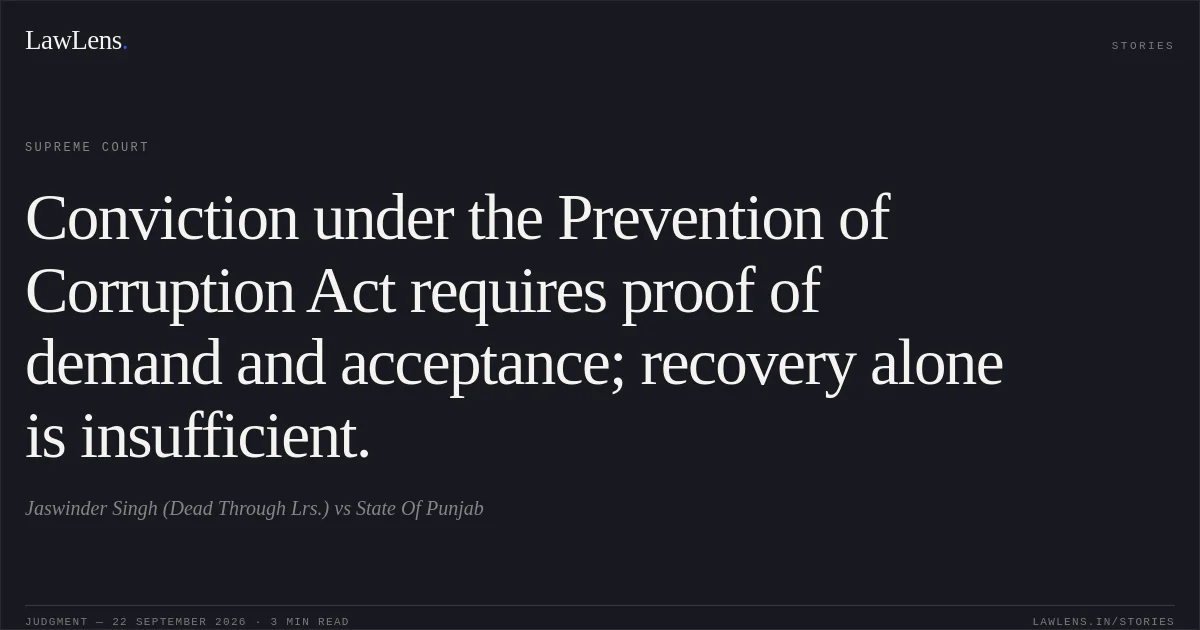
The Supreme Court held that the prosecution failed to prove the appellant’s demand for or acceptance of illegal gratification beyond reasonable doubt. Mere recovery of the tainted currency and the positive hand-wash test were insufficient to sustain the conviction.
The judgments of the Special Judge dated 25 February 2004 and the High Court dated 28 November 2013 were set aside. The charge against Jaswinder Singh under Sections 7 and 13(2) of the Prevention of Corruption Act was held not proved, and the appeal was allowed.
Source reference: paras. 22–23Acts & Sections Cited
5 provisions across 2 statutes referred to in this judgment. Each provision opens on LawLens.
Prevention of Corruption Act, 19883
Code of Criminal Procedure, 19732
Original Court PDF
Jaswinder Singh (Dead Through Lrs.)vsState Of Punjab
Click to open original judgment
Original judgment, available to read, download and summarize on LawLens.in