Facts
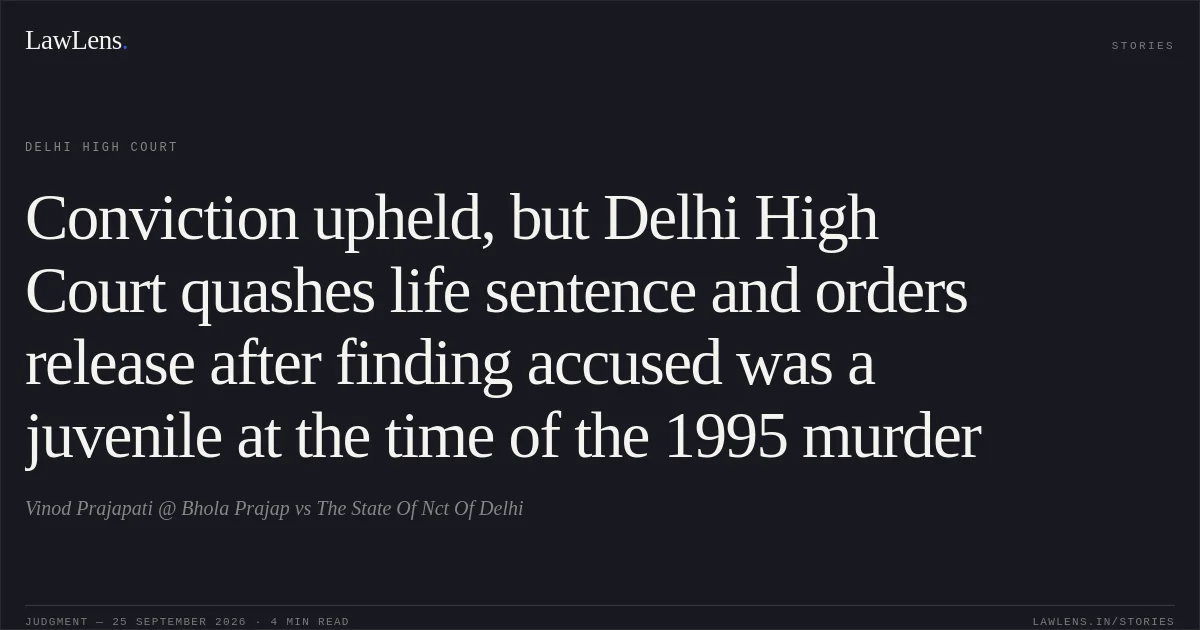
The appellant was convicted by the Additional Sessions Judge, Delhi, under Sections 394 and 302 IPC for the robbery and murder of Lado Devi on 1 December 1995.
Source reference: pp.1–2He was sentenced to five years’ rigorous imprisonment under Section 394 IPC and life imprisonment under Section 302 IPC, with the sentences to run concurrently.
Source reference: pp.1–2During the appeal, the appellant claimed that he was below eighteen years of age on the date of the offence and relied on an NIOS Secondary School Examination Mark-Sheet recording his date of birth as 4 October 1978.
Source reference: pp.2–4, 16The document was subsequently verified by NIOS and found genuine.
Source reference: pp.2–4, 16An earlier ossification examination conducted pursuant to the High Court’s order also assessed his age as between 22 and 25 years in January 2005, indicating that he was below eighteen on the date of the offence.
Source reference: pp.2–3, 16The appellant stated that he did not wish to challenge the conviction on merits, but the Court nevertheless examined the prosecution case before determining the appropriate relief.
Source reference: pp.5–7, 17–18Issues
Whether the appellant, being below eighteen years of age on the date of the offence committed in 1995, was entitled to the benefit of the Juvenile Justice (Care and Protection of Children) Act, 2000, notwithstanding his subsequent conviction and sentence?
Source reference: paras. 19–25; pp.7–11Whether the appellant’s age was established through the NIOS Secondary School Examination Certificate and/or the medical/ossification report in accordance with the applicable age-determination principles?
Source reference: paras. 26–35; pp.11–17Whether the finding of juvenility required the conviction itself to be set aside, or only the sentence to be rendered ineffective?
Source reference: paras. 36–38, 45–46; pp.17–21Whether the conviction was sustainable on the circumstantial evidence independently of the appellant’s plea of juvenility?
Source reference: paras. 38–45; pp.18–20Law Applied
The Court applied Sections 2(k), 2(l), 7-A, 15, 20 and 49 of the Juvenile Justice (Care and Protection of Children) Act, 2000, read with Rule 12 of the Juvenile Justice Rules, 2007.
Source reference: paras. 19–20, 27–29; pp.7–16Under these provisions, juvenility is determined with reference to the accused’s age on the date of the offence; a claim of juvenility may be raised at any stage, including after conviction; and the 2000 Act applies to pending trials, appeals and other proceedings relating to persons who were below eighteen when the offence was committed.
Source reference: paras. 19–20, 27–29; pp.7–16Section 25 of the Juvenile Justice Act, 2015, preserves pending proceedings under the earlier regime.
Source reference: paras. 21–24; pp.10–11Rule 12(3) prescribes a hierarchy for age determination, giving priority to a matriculation or equivalent certificate, followed by school and birth certificates, and only thereafter medical opinion.
Source reference: paras. 28–29; pp.13–16These authorities establish that juvenility claims must be assessed liberally on a preponderance of probability, that conviction is not automatically annulled upon a finding of juvenility, and that the sentence may be rendered ineffective where the statutory juvenile period has expired.
Source reference: paras. 19–24, 27–37; pp.7–18Reasoning
The Court held that the verified NIOS certificate, which recorded the appellant’s date of birth as 4 October 1978, established that he was 17 years, 1 month and 27 days old on 1 December 1995.
Source reference: paras. 28–33; pp.13–17Since the certificate was an equivalent secondary-school examination certificate falling within the first category under Rule 12(3)(a), it was entitled to primacy.
Source reference: paras. 28–33; pp.13–17The Court rejected the State’s objection that the certificate had been obtained after conviction, observing that, under the Juvenile Justice Act, 1986 then applicable, the relevant threshold for a male juvenile was sixteen years; therefore, recording an age just above sixteen on the date of the offence would not have conferred any apparent benefit on the appellant.
Source reference: paras. 28–33; pp.13–17The ossification report independently supported the conclusion that the appellant was below eighteen on the date of the offence, and the Court held that the State’s request for a fresh inquiry before the Juvenile Justice Board was unnecessary after the prolonged absence of any challenge to that report.
Source reference: paras. 32–35; pp.16–17The Court then examined the conviction on merits and found the circumstantial chain complete: the appellant was employed in the deceased’s house, remained there with the deceased when the family left, disappeared after the incident, the deceased was found murdered, property was missing, blood-stained clothes and his footwear were recovered, and he was later found working under an assumed name.
Source reference: paras. 39–45; pp.18–20These circumstances were held sufficient to sustain the conviction, but under Karan alias Fatiya, the finding of juvenility affected the enforceability of the sentence rather than the validity of the conviction.
Source reference: paras. 37, 45–46; pp.17–21Holding
The Court held that the appellant was a juvenile on the date of the offence and was entitled to the benefit of the Juvenile Justice Act, 2000, notwithstanding the 1995 date of occurrence and his subsequent conviction.
The conviction under Sections 302 and 394 IPC was sustained after independent scrutiny of the circumstantial evidence.
Source reference: para. 45; p.20However, considering the appellant’s juvenility, the period already undergone, his present age, and the maximum three-year period of detention contemplated under Section 15(1) of the 2000 Act, the Court quashed the sentences and directed that he be released forthwith, unless required in any other case.
Source reference: para. 46; pp.20–21The appeal consequently partially succeeded; the bail bonds and sureties were discharged, and copies of the judgment were directed to be sent to the Trial Court and the Jail Superintendent.
Source reference: paras. 47–49; p.21Acts & Sections Cited
7 provisions across 4 statutes referred to in this judgment. Each provision opens on LawLens.
Indian Penal Code, 18604
Juvenile Justice (Care and Protection of Children) Act, 2015.1
General Clauses Act, 18971
Code of Criminal Procedure, 19731
Original Court PDF
Vinod Prajapati @ Bhola PrajapvsThe State Of Nct Of Delhi
Click to open original judgment
Original judgment, available to read, download and summarize on LawLens.in