Facts
The informant, S.I. Chandra Bhushan Prasad Singh, received information on March 16, 2006, regarding an extremist group assault on villagers in Amhar and Bishunpura.
Source reference: p. 2The appellant was identified as part of the group led by Prithvi Dusadh that assaulted victims with sticks and gun butts.
Source reference: p. 2The appellant surrendered on June 7, 2006, and was subsequently charged under Sections 147, 148, 149, 307, and 323 of the IPC and Section 17 of the CLA Act.
Source reference: p. 3The trial court convicted the appellant for offences under Sections 323/149, 147, and 148 of the IPC, sentencing him to a maximum of two years R.I., while acquitting him of Section 307 and CLA Act charges.
Source reference: p. 1-2, 5Issues
1. Whether the judgment of conviction and order of sentence passed by the trial court are sustainable given the non-examination of the Investigating Officer and the Medical Officer.
Source reference: p. 4-52. Whether the sentence imposed should be modified considering the duration of the trial and the period of custody already undergone by the appellant.
Source reference: p. 4-5Law Applied
The court applied the Indian Penal Code (IPC) provisions: Section 147 (Punishment for rioting), Section 148 (Rioting, armed with deadly weapon), and Sections 323/149 (Voluntarily causing hurt in furtherance of common object).
Source reference: p. 1-2The court considered the evidentiary weight of oral testimony in the absence of corroborative medical evidence and the prejudicial effect of non-examining the Investigating Officer.
Source reference: p. 5The court exercised its appellate discretion regarding sentencing, weighing the nature of the offence against the "agony of trial" and the principle of proportionality in sentencing.
Source reference: p. 5Reasoning
The High Court observed that while the conviction was upheld on merits, there were significant procedural lapses in the prosecution's case, specifically the non-examination of the Investigating Officer (I.O.) and the Doctor.
Source reference: p. 5The Court noted that the lack of medical evidence meant there was no expert support for the oral testimony regarding injuries.
Source reference: p. 5Additionally, the non-examination of the I.O. was found to cause serious prejudice to the appellant’s defense.
Source reference: p. 5However, rather than overturning the conviction, the Court focused on the "quantum of sentence," noting that the appellant had already undergone more than 18 months of his two-year sentence and had been facing trial for nearly two decades (since 2006).
Source reference: p. 4-5Holding
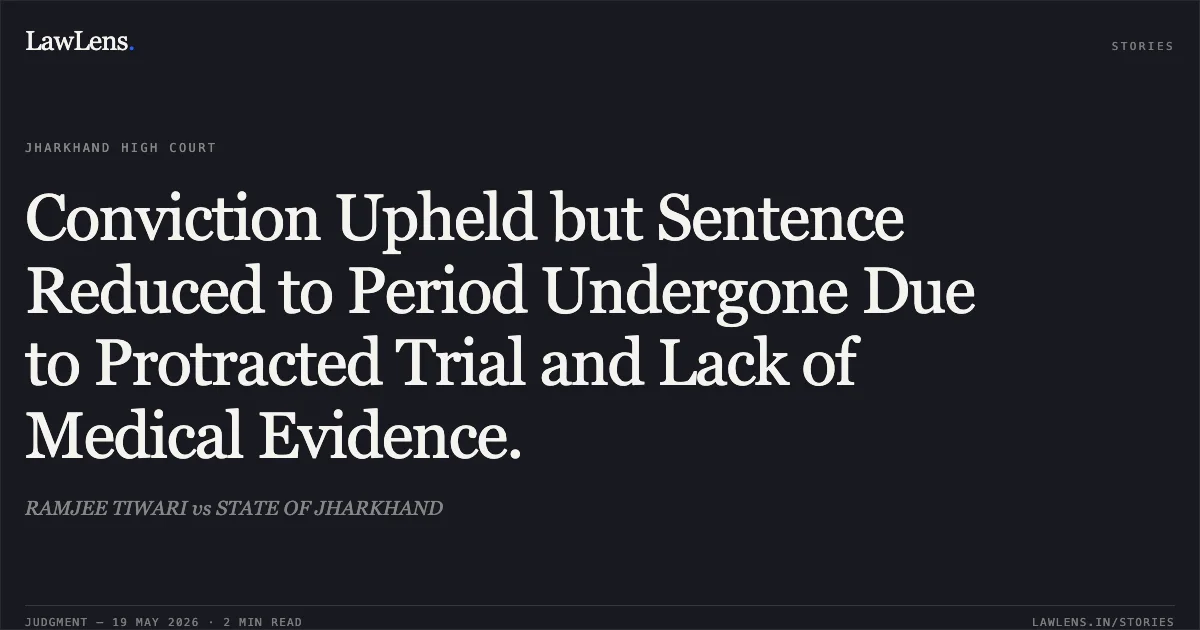
The High Court dismissed the appeal on merits but modified the sentence.
The Court held that given the lapse of nearly 20 years and the 18 months already served in custody, the sentence is reduced to the "period already undergone".
Source reference: p. 5The appellant was discharged from the liability of his bail bonds and sureties.
Source reference: p. 6Acts & Sections Cited
5 provisions across 1 statute referred to in this judgment. Each provision opens on LawLens.
Indian Penal Code, 18605
Original Court PDF
RAMJEE TIWARIvsSTATE OF JHARKHAND
Click to open original judgment
Original judgment, available to read, download and summarize on LawLens.in