Facts
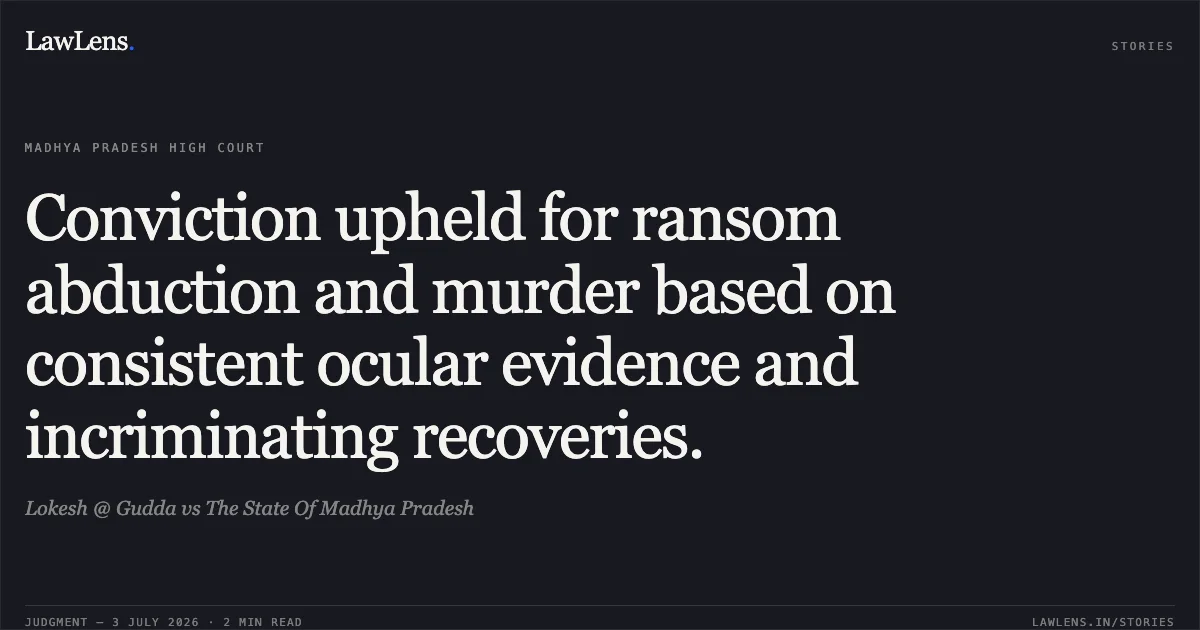
The appellant challenged a 2018 conviction by the Sessions Court for kidnapping for ransom and murder
Source reference: p. 1-2In February 2014, the complainant’s son was abducted, and multiple telephonic demands for a ransom of Rs. 10 lakhs were made to the father
Source reference: p. 2-3Following a police investigation and the apprehension of several suspects, it was revealed that the victim had been strangulated and his body concealed in a forest area
Source reference: p. 3Based on the information provided by the accused during interrogation, the police recovered the body and several incriminating items, including a vehicle and a weapon
Source reference: p. 3, 5While one co-accused was acquitted due to lack of evidence, the appellant and two others were sentenced to life imprisonment
Source reference: p. 1, 9Issues
1. Whether the prosecution successfully established the appellant's involvement in the conspiracy, abduction, and subsequent murder of the deceased beyond a reasonable doubt
Source reference: p. 4-52. Whether the recovery of the body and incriminating articles based on the appellant’s disclosures was sufficient to sustain the conviction
Source reference: p. 8-10Law Applied
The Court applied the Indian Penal Code (IPC), specifically Section 302 (Punishment for murder), Section 364-A (Kidnapping for ransom), Section 201 (Causing disappearance of evidence), and Section 120-B (Criminal conspiracy)
Source reference: p. 1The Court also invoked Section 25(1-B)(a) of the Arms Act regarding the illegal possession of a firearm
Source reference: p. 1-2The judgment relied on the principle of corroborative evidence, where the discovery of facts following a statement made by an accused person in custody serves as a vital component of the prosecution's case
Source reference: p. 8Reasoning
The Court examined the consistency between the medical evidence and the witness testimonies, noting that the autopsy confirmed death by homicidal strangulation, which aligned with the state’s theory of the crime
Source reference: p. 6The High Court found that the trial court correctly weighed the testimonies of the victim’s father and several police witnesses who detailed the ransom calls and the subsequent apprehension of the appellant
Source reference: p. 7Crucially, the Court noted that the appellant was found in possession of the vehicle used in the crime, and his disclosures led directly to the recovery of the victim's personal effects and the murder weapon
Source reference: p. 8-9The defense’s claims of false implication were rejected because the chain of circumstantial evidence—including the mobile records and the physical recovery of the body at the location specified by the accused—was deemed complete and unbreakable
Source reference: p. 9-10Holding
The Court answered both issues in the affirmative, holding that the prosecution had proved the charges of conspiracy, kidnapping, and murder through a meticulous combination of oral and documentary evidence
The High Court found no merit in the appeal and upheld the trial court's judgment of conviction and the resulting sentences of life imprisonment. The appeal was dismissed, and all pending applications were disposed of accordingly
Source reference: p. 10Acts & Sections Cited
4 provisions across 3 statutes referred to in this judgment. Each provision opens on LawLens.
Indian Penal Code, 18602
Arms Act, 19591
Code of Criminal Procedure, 19731
Original Court PDF
Lokesh @ GuddavsThe State Of Madhya Pradesh
Click to open original judgment
Original judgment, available to read, download and summarize on LawLens.in