Facts
The appellant-wife and respondent-husband were married on 18.05.2003 according to Hindu rites and customs and have one child.
Source reference: paras. 1–7They lived together until January 2019, after which they began residing separately due to matrimonial differences.
Source reference: paras. 1–7The wife instituted proceedings under Section 13(1)(i-a) and (i-b) of the Hindu Marriage Act, 1955, alleging cruelty and desertion.
Source reference: paras. 1–7The First Additional Principal Family Court, Raipur, dismissed her petition on 12.01.2024. She thereafter filed the present appeal under Section 19(1) of the Family Courts Act, 1984.
Source reference: paras. 1–7During the appeal, the parties participated in mediation and executed a settlement on 05.08.2026, agreeing to dissolve their marriage by mutual consent.
Source reference: paras. 8–9The wife agreed not to pursue any maintenance claim, while the husband agreed not to institute any suit against her.
Source reference: paras. 8–9Both parties subsequently appeared before the Court and affirmed that the settlement was voluntary and free from coercion, undue influence or fear.
Source reference: paras. 8–9An application under Section 13-B of the Hindu Marriage Act, 1955, along with an application for waiver of the six-month cooling-off period, was filed.
Source reference: paras. 10, 15Issues
Whether the parties’ contested matrimonial proceedings could be converted or disposed of at the appellate stage on the basis of their settlement and joint request for divorce by mutual consent under Section 13-B of the Hindu Marriage Act, 1955
Source reference: paras. 15–17Whether the statutory six-month period under Section 13-B(2) could be waived in the circumstances of the case
Source reference: paras. 13–17Whether the Family Court’s judgment dismissing the wife’s petition under Section 13(1)(i-a) and (i-b) should consequently be set aside
Source reference: para. 18Law Applied
Section 13-B(1) of the Hindu Marriage Act, 1955 permits divorce by mutual consent where the parties have lived separately for at least one year, have been unable to live together, and mutually agree to dissolve the marriage.
Source reference: para. 15Section 13-B(2) ordinarily requires the parties to make the second motion not earlier than six months and not later than eighteen months after presentation of the joint petition.
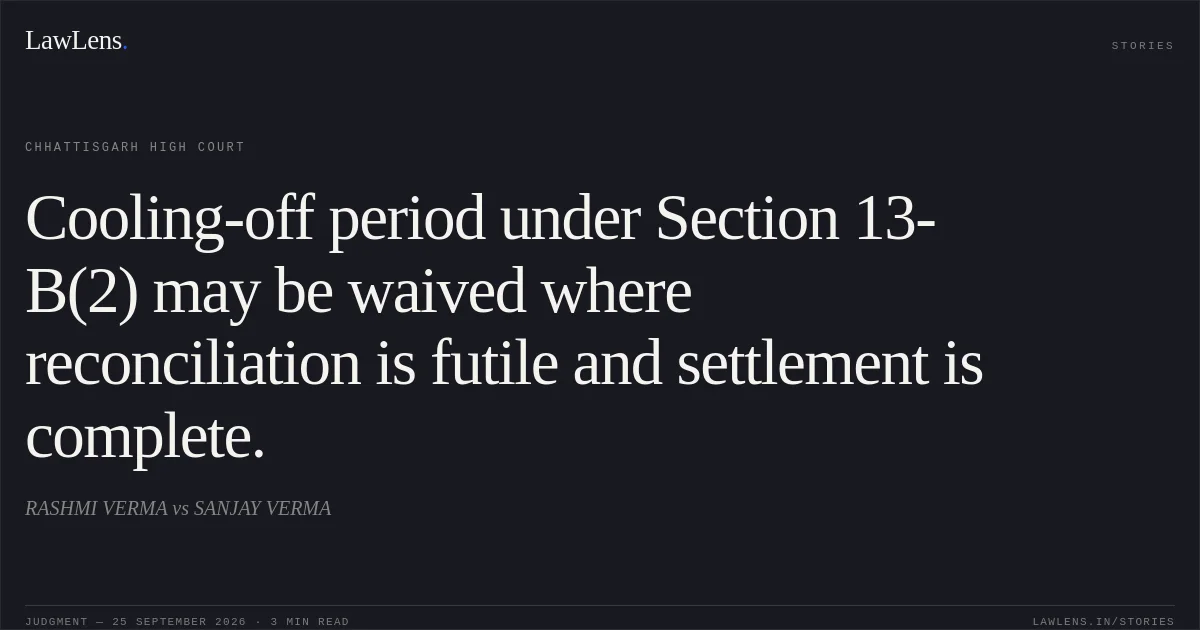
Source reference: para. 15Relying principally on Amardeep Singh v. Harveen Kaur, (2017) 8 SCC 746, the Court held that the six-month period is directory and may be waived where the parties have already lived separately for the requisite period, mediation and reconciliation efforts have failed, their disputes—including alimony, custody and other issues—have been genuinely settled, and prolonging the proceedings would only extend their agony.
Source reference: para. 14The Court also relied on Manish Verma v. Pooja Verma, 2022 SCC OnLine Chh 1434, Satish v. Namita, 2026 SCC OnLine Chh 460, Manoj Kedia v. Anu Kedia, FA(M) No. 16 of 2007, and Tadepalli Venkata Ramesh v. Immidisetty Anitha, MANU/AP/0928/2025, concerning conversion of contested matrimonial proceedings into proceedings based on mutual consent and waiver of the cooling-off period.
Source reference: paras. 11, 16Reasoning
The Court found that the parties had lived separately since 2019—approximately seven years by the time of consideration—and had contested the matrimonial proceedings since 25.02.2020.
Source reference: paras. 13, 17Their mediation was successful, and both parties personally confirmed before the Registrar (Judicial) that they accepted the settlement and no longer wished to continue the marriage, without coercion or undue influence.
Source reference: paras. 8–9Applying the principles in Amardeep Singh, the Court held that the purpose of the six-month period—to permit reconsideration and reconciliation—had already been substantially fulfilled because the parties had remained separated for a considerable period, reconciliation efforts had failed, and all material disputes had been settled.
Source reference: paras. 13–17Requiring them to wait for another six months would serve no useful purpose and would unnecessarily prolong their matrimonial dispute.
Source reference: paras. 13–17Holding
The Court allowed the application under Section 13-B and waived the six-month cooling-off period.
It set aside the Family Court’s judgment and decree dated 12.01.2024 and dissolved the marriage solemnized between the parties on 18.05.2003 by a decree of divorce by mutual consent.
Source reference: paras. 17–19The terms of the mediation settlement were made part of the decree.
Source reference: paras. 17–19The appeal was accordingly disposed of, with no order as to costs.
Source reference: paras. 17–19Acts & Sections Cited
4 provisions across 2 statutes referred to in this judgment. Each provision opens on LawLens.
Family Courts Act, 19842
Hindu Marriage Act, 19552
Original Court PDF
RASHMI VERMAvsSANJAY VERMA
Click to open original judgment
Original judgment, available to read, download and summarize on LawLens.in