Facts
Following the bifurcation of Bihar under the Bihar Reorganisation Act, 2000, assets and liabilities of five State-owned Corporations were to be apportioned between Bihar and Jharkhand
Source reference: para. 2For nearly 25 years, thousands of employees remained unpaid, leading to destitution and reported suicides
Source reference: para. 2-3Earlier interventions in Kapila Hingorani v. State of Bihar (2003) provided only partial relief
Source reference: para. 4In 2022, the petitioners sought a mandamus for the release of outstanding salaries and retiral dues
Source reference: para. 5The Supreme Court constituted a Committee headed by Justice (Retd.) Dinesh Maheshwari to investigate the financial liabilities and identify eligible employees
Source reference: para. 7-8The Committee submitted its final report on April 30, 2026, after achieving substantial progress in identifying 2,274 employees and facilitating payments to 2,017 of them
Source reference: para. 11-15Issues
1. Whether the States are liable for pay revisions and minimum wage increments not formally adopted by the Corporations before they became defunct?
Source reference: para. 20 / para. 22-252. Whether the non-payment of statutory dues like the Employees Provident Fund (EPF) can be excused due to administrative or financial incapacity?
Source reference: para. 273. Whether the delay in payment of lawful dues warrants the award of interest and compensation to the affected employees or their legal heirs?
Source reference: para. 30-34Law Applied
The Court primarily relied on Article 21 of the Constitution of India, emphasizing the right to livelihood and dignity
Source reference: para. 3It applied the statutory scheme of the Bihar Reorganisation Act, 2000 regarding the apportionment of liabilities between successor States
Source reference: para. 2Regarding retiral benefits, the Court invoked the principle that Provident Fund (PF) is a vested statutory right under the Employees’ Provident Fund and Miscellaneous Provisions Act, 1952, which cannot be defeated by the functional collapse of an entity
Source reference: para. 27-29It further applied the principle of restitution and fair recompense to justify the award of interest on delayed payments
Source reference: para. 35Reasoning
The Court analyzed the Justice Maheshwari Committee’s findings to resolve the stalemate. Regarding pay scales (Issue 3A), the Court agreed that since the defunct Corporations never formally adopted subsequent Pay Revision Commissions (PRCs), employees had no vested legal right to those higher scales
Source reference: para. 22-23For daily wagers (Issue 3B), the Court held that while the principle of "no work, no pay" applies, the States’ humanitarian gesture of paying 1992-level minimum wages until retirement was an equitable arrangement that did not require further enhancement
Source reference: para. 25However, the Court distinguished statutory dues like EPF (Issue 3C) from discretionary wages, ruling that the State must directly satisfy both employer and employee contributions plus statutory interest where accounts are untraceable
Source reference: para. 28-29The Court linked the prolonged delay to a violation of Article 21, thereby validating the Committee's recommendation for interest at 7.5% on salary arrears and 12% on PF dues as restitution for the "extravagant" delay
Source reference: para. 33-35Holding
The Court accepted the Committee’s report as an integral part of its order. It held that: (i) inter-state liabilities are fixed as per the Union's 2023 affidavit; (ii) pay revisions are limited to those adopted prior to the corporations becoming defunct; and (iii) EPF dues must be paid directly to employees or heirs following the Committee’s structured formula
The Court awarded an additional honorarium of Rs. 35 lakhs to the Committee Chair. Residual issues regarding lump-sum compensation for deaths, verification of "untraceable" employees, and final interest calculations were reserved for further adjudication on September 1, 2026
Source reference: para. 40, para. 38, para. 41-42Acts & Sections Cited
2 provisions across 2 statutes referred to in this judgment. Linked provisions open on LawLens.
Bihar Reorganisation Act, 20001
Employees’ Provident Funds And Miscellaneous Provisions Act, 19521
Original Court PDF
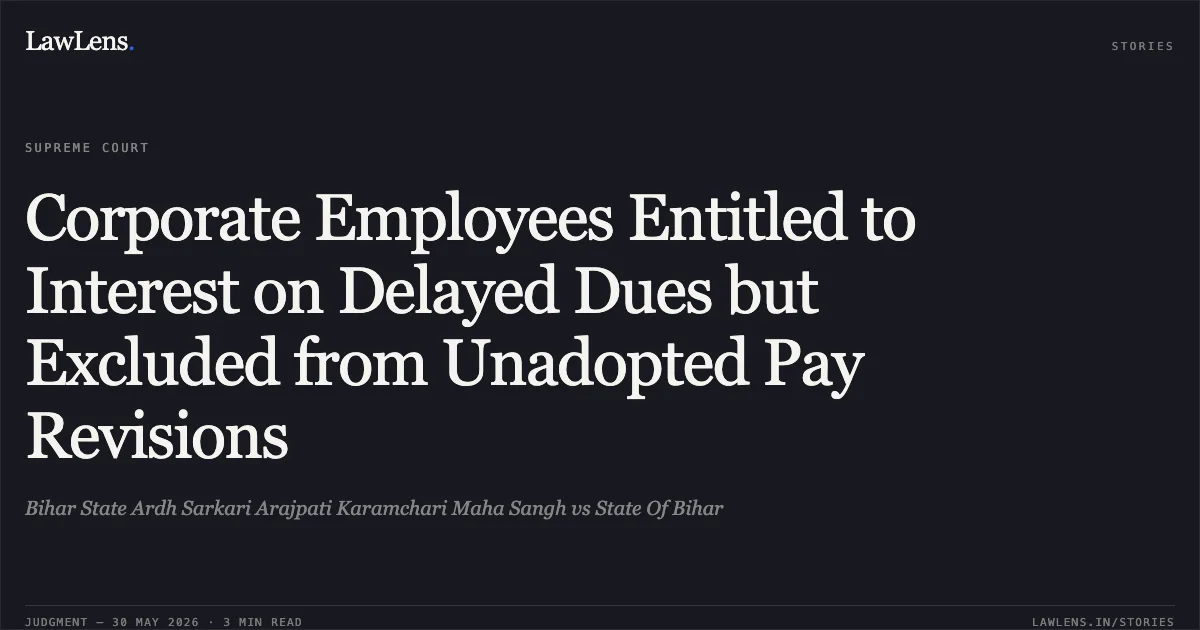
Bihar State Ardh Sarkari Arajpati Karamchari Maha SanghvsState Of Bihar
Click to open original judgment
Original judgment, available to read, download and summarize on LawLens.in