Facts
The petitioner instituted Title Suit No. 19/2023 for declaration of title and permanent injunction regarding 3 Bighas of land (Schedule-T)
Source reference: p.2The respondent filed a written statement and a counter-claim seeking title and injunction over Schedules T, U, V, and W
Source reference: p.2On 19.09.2025, the petitioner withdrew the original suit with liberty to file afresh, but the Trial Court directed the counter-claim to proceed independently under Order VIII Rule 6A and 6D of the CPC
Source reference: p.2-3Subsequently, the respondent sought a temporary injunction to protect his possession, which was granted by the Trial Court on 29.01.2024
Source reference: p.3This order was affirmed by the Appellate Court in Misc. Appeal No. 01/2024 on 20.08.2024
Source reference: p.2-3The petitioner challenged these concurrent findings under Article 227 of the Constitution, arguing that the counter-claim could not encompass properties (Schedules U, V, and W) beyond the scope of the original suit
Source reference: p.3Issues
1. Whether a counter-claim remains maintainable and can include additional properties/causes of action after the withdrawal of the original suit
Source reference: p.4-52. Whether the concurrent findings of the lower courts granting temporary injunction warrant interference under supervisory jurisdiction
Source reference: p.6Law Applied
The Court applied Order VIII Rule 6A of the CPC, which stipulates that a counter-claim has the effect of a cross-suit and allows a defendant to raise any cause of action against the plaintiff accruing before or after the suit
Source reference: p.4It further relied on Order VIII Rule 6D of the CPC, which ensures that a counter-claim proceeds independently even if the original suit is discontinued or dismissed
Source reference: p.4The Court followed the precedent in Jag Mohan Chawla v. Dera Radha Swami Satsang (1996) 4 SCC 699, which establishes the wide amplitude and independent nature of counter-claims
Source reference: p.3-5Regarding injunctions, the Court applied the three-pronged test (prima facie case, balance of convenience, and irreparable injury) from Dalpat Kumar v. Prahlad Singh (1992) 1 SCC 719
Source reference: p.6The principle of limited appellate interference in discretionary orders from Wander Ltd. v. Antox India P. Ltd. 1990 (Supp) SCC 727
Source reference: p.6Reasoning
The Court reasoned that under Order VIII Rule 6A and 6D, a counter-claim is a substantive, independent proceeding that survives the withdrawal of the main suit
Source reference: p.4-5It rejected the petitioner’s contention that the counter-claim was restricted to the 3 Bighas mentioned in the original suit, clarifying that a counter-claim is not strictly confined to the subject matter of the original claim so long as it involves a dispute between the same parties
Source reference: p.5The Court observed that the additional schedules (U, V, and W) were sufficiently connected to the overarching title dispute
Source reference: p.5On the merits of the injunction, the Court noted that both lower courts had recorded categorical findings of fact regarding the respondent’s possession and the existence of a triable issue of title
Source reference: p.5-6Under Article 227, the High Court’s role is supervisory; since the lower courts did not act arbitrarily or perversely, and correctly applied the settled parameters for interlocutory relief, no jurisdictional error was found
Source reference: p.6Holding
The High Court dismissed the petition, affirming the temporary injunction in favor of the respondent
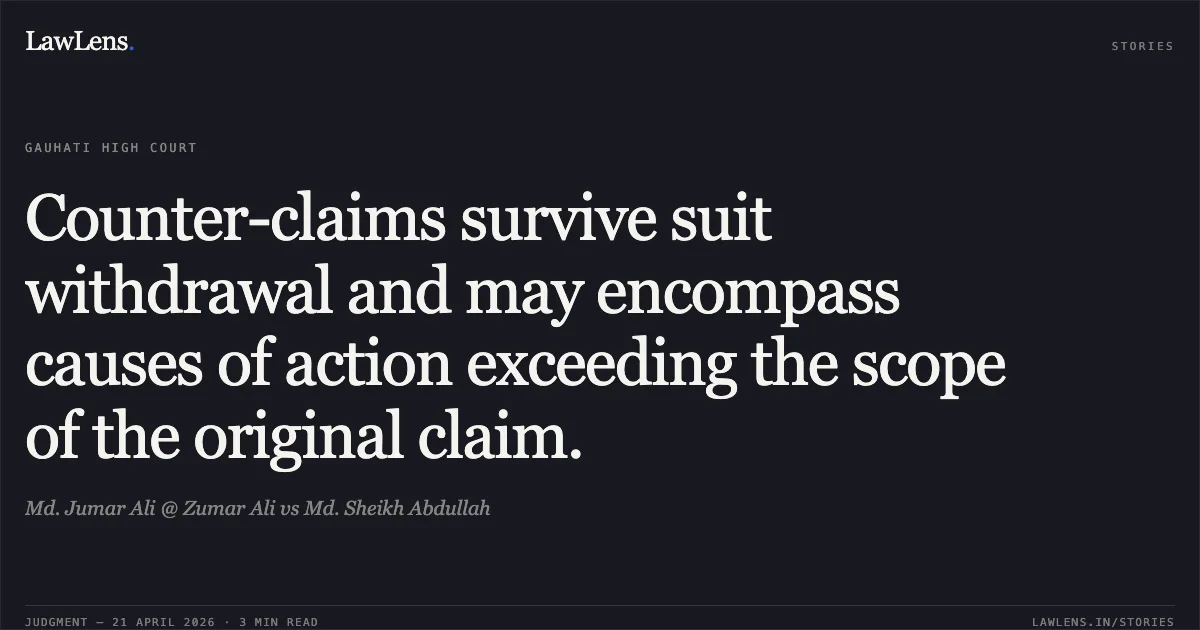
It held that a counter-claim possesses an independent character and can encompass a wider scope than the original suit, surviving even after the suit's withdrawal
Source reference: p.4-5The Court vacated any existing interim stay and directed the Trial Court to decide the counter-claim on its own merits without being influenced by the observations made in the injunction proceedings
Source reference: p.6-7Acts & Sections Cited
3 provisions across 1 statute referred to in this judgment. Each provision opens on LawLens.
Code of Civil Procedure, 19083
Original Court PDF
Md. Jumar Ali @ Zumar AlivsMd. Sheikh Abdullah
Click to open original judgment
Original judgment, available to read, download and summarize on LawLens.in


