Facts
The appellant (husband) and respondent (wife) married in 1996 and had two children
Source reference: p. 3Following domestic disputes and a case filed under the Domestic Violence Act, 2005, the parties entered into a settlement to dissolve their marriage by mutual consent under Section 13B of the Hindu Marriage Act, 1955
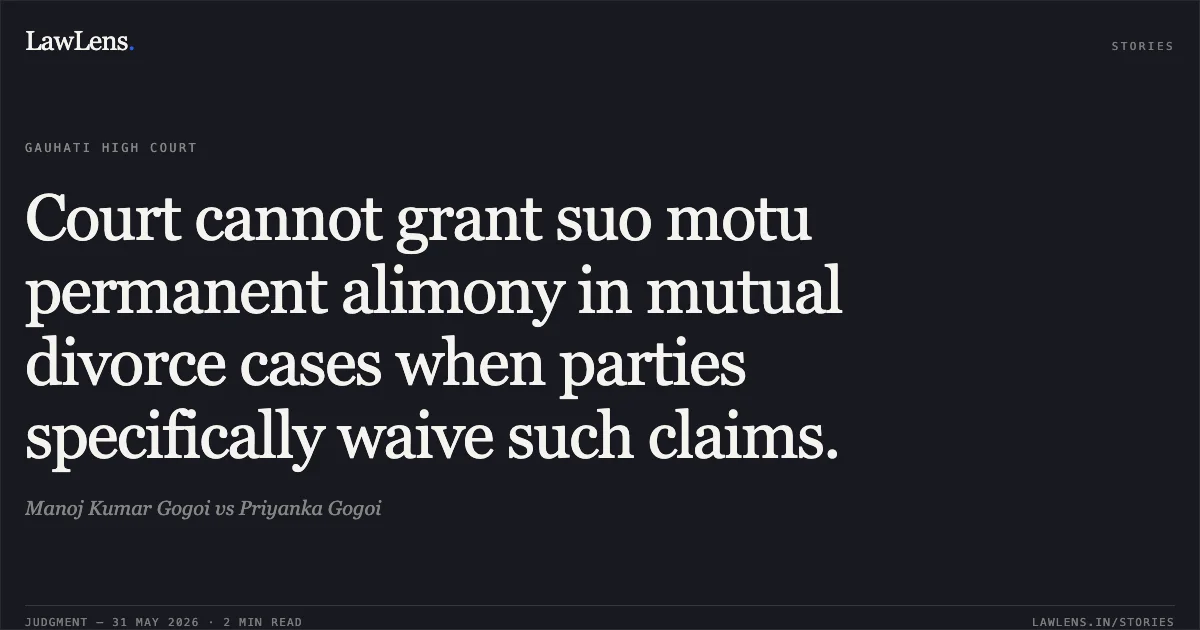
Source reference: p. 3-4In their joint petition and supporting affidavits before the Trial Court, both parties explicitly averred that they would not raise any demand for interim maintenance or permanent alimony
Source reference: p. 4-5On 03.06.2023, the District Judge, Sivasagar, granted the divorce but suo motu directed the appellant to pay ₹10,00,000 as permanent alimony to the respondent
Source reference: p. 4The appellant challenged this specific direction before the Gauhati High Court
Source reference: p. 2Issues
1. Whether the Trial Court was justified in granting permanent alimony suo motu in a decree of divorce by mutual consent when both parties had specifically waived such claims in their pleadings and affidavits
Source reference: p. 82. Whether the conduct of the respondent, specifically an alleged admission of an illicit relationship, affects the entitlement to permanent alimony under Section 25 of the Hindu Marriage Act
Source reference: p. 9Law Applied
Section 25 of the Hindu Marriage Act, 1955, which governs permanent alimony and maintenance. The provision dictates that alimony is granted "on application made to it for the purpose" and requires the court to have regard for the income of both parties, the conduct of the parties, and other circumstances
Source reference: p. 7-8Joseph Shine v. Union of India (2019) regarding the impact of conduct on civil rights following the decriminalization of adultery
Source reference: p. 6Reasoning
The High Court observed that Section 25 explicitly requires an "application" for the grant of alimony. While noting that an oral application might suffice in appropriate cases, the court highlighted that in this instance, there was a categorical written agreement and joint affidavit stating neither party would seek alimony
Source reference: p. 8-9The Trial Court’s justification—"considering the entirety of facts and future of petitioner No. 2"—was deemed insufficient to override the express waiver by the parties
Source reference: p. 9The Court noted that under Section 25, the "conduct of the parties" must be considered; the respondent's admission of an illicit affair, coupled with the absence of a claim for alimony, rendered the suo motu direction unjustified
Source reference: p. 9The Court held that a Trial Court cannot impose alimony in a mutual consent divorce if the parties have mutually and specifically agreed to forego it
Source reference: p. 9Holding
The High Court held that the Trial Court's direction for the appellant to pay ₹10,00,000 as permanent alimony was not justified given the specific terms of the mutual divorce petition
The Court set aside the direction regarding the payment of alimony while keeping the decree of dissolution of marriage intact
Source reference: p. 10Acts & Sections Cited
2 provisions across 1 statute referred to in this judgment. Each provision opens on LawLens.
Hindu Marriage Act, 19552
Original Court PDF
Manoj Kumar GogoivsPriyanka Gogoi
Click to open original judgment
Original judgment, available to read, download and summarize on LawLens.in