Facts
The Plaintiff/Respondent entered into an Agreement to Sell (ATS) with the Defendant/Appellant (owner) on 23.09.2011 for a property in Laxmi Nagar for ₹61,00,000
Source reference: p.2Disputes arose regarding title documents, leading to a fresh ATS on 07.08.2013 with a revised consideration of ₹79,00,000, acknowledging a previous payment of ₹17,00,000
Source reference: p.3, 22The Plaintiff failed to prove his readiness and willingness to pay the balance by 05.09.2013
Source reference: p.3-4, 10The Trial Court dismissed the Plaintiff’s suit for Specific Performance but suo motu ordered the Defendant to refund the ₹17,00,000 earnest money with 8% interest
Source reference: p.1-2, 11The Defendant appealed this refund order and the finding on limitation
Source reference: p.11-12Issues
1. Whether the suit was barred by the law of limitation under Article 54 of the Limitation Act, 1963
Source reference: Issue 3, p.9; para 722. Whether the Court can grant a refund of earnest money under Section 22 of the Specific Relief Act, 1963, in the absence of a specific prayer in the plaint
Source reference: para 52-533. Whether the principle of equity and "broad justice" can override express statutory provisions regarding refund of earnest money
Source reference: para 92, 104Law Applied
Section 62 of the Indian Contract Act, 1872 regarding Novation, where a new contract substituted for an old one discharges the original
Source reference: para 84-85Article 54 of the Limitation Act, 1963, setting a three-year window from the date fixed for performance
Source reference: para 88Section 22 of the Specific Relief Act, 1963, which mandates that no relief for refund of earnest money shall be granted unless "specifically claimed," though it allows for amendment at any stage
Source reference: para 55-57Precedents included Desh Raj v. Rohtash Singh (2023) and K.R. Suresh v. R. Poornima (2025), establishing that a prayer for refund is a sine qua non for such a decree.
Source reference: para 58, 61Reasoning
The High Court first determined that the 2013 Agreement was a novation because it fundamentally altered the price and terms without referencing the 2011 Agreement; thus, the suit filed in 2016 was within the three-year limit from the 2013 performance date
Source reference: para 82, 87, 89Regarding the refund, the Court noted that the Plaintiff’s prayer only sought Specific Performance and Permanent Injunction, with no alternative prayer for refund
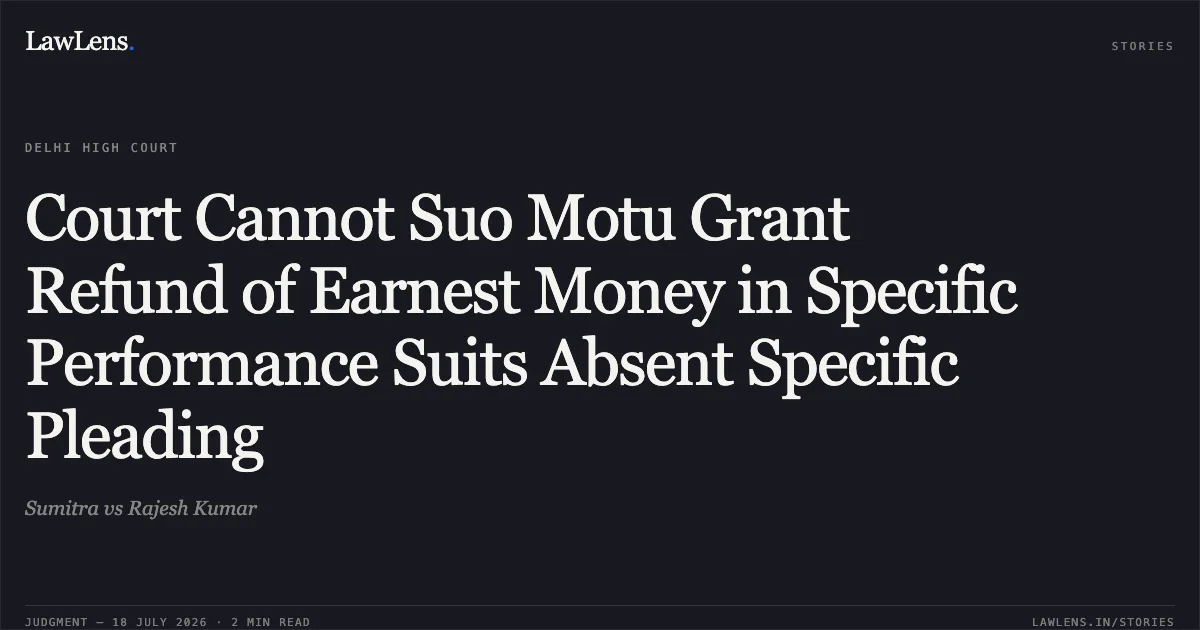
Source reference: para 54, 67Applying Desh Raj and K.R. Suresh, the Court held that Section 22(2) of the SRA is an absolute statutory bar that prevents courts from granting refund suo motu
Source reference: para 59, 65The Court rejected the Trial Court's use of "equity" to order a refund, reasoning that equity follows the law and cannot override the express statutory requirement of Section 22(2)
Source reference: para 98, 108Since the Plaintiff never amended his plaint to include a refund claim, even at the appellate stage, the relief was legally impermissible
Source reference: para 67-68Holding
The Court allowed the appeal and set aside the refund order
The suit was within limitation due to the novation of the contract
Source reference: para 89A decree for refund of earnest money cannot be granted unless specifically pleaded in the plaint as per Section 22(2) of the SRA
Source reference: para 107General prayers for "any other relief" or equitable considerations of "unjust enrichment" cannot bypass the mandatory requirement of a specific prayer for refund. The suit was dismissed in its entirety.
Source reference: para 64, 108, 110Acts & Sections Cited
11 provisions across 5 statutes referred to in this judgment. Each provision opens on LawLens.
Code of Civil Procedure, 19083
Specific Relief Act, 19635
Code of Criminal Procedure, 19731
Limitation Act, 19631
Indian Contract Act, 18721
Original Court PDF
SumitravsRajesh Kumar
Click to open original judgment
Original judgment, available to read, download and summarize on LawLens.in


![Subsequent exoneration does not retrospectively invalidate a finalized promotion select list.. UNNIKRISHNAN M vs M/o Environment And Forests. CAT - ['Ernakulam']. LawLens](/stories/thumbnails/subsequent-exoneration-does-not-retrospectively-invalidate-a-finalized-promotion-select-li-ce80a0e84f2f4887857271e8b4341c42.webp)