01Facts
The petitioner-plaintiff instituted a suit for permanent injunction against the respondents in O.S. No.290/2022 before the I Additional Civil Judge and JMFC, Malavalli, and filed an application for temporary injunction.
¶ 1–2While the application was pending, the Trial Court visited the suit schedule property on 18 July 2022, before recording evidence, and prepared a memorandum of facts concerning the property and its possession.
¶ 1–2, 8The Trial Court thereafter heard arguments on the temporary-injunction application and rejected it.
The petitioner challenged the inspection proceedings and memorandum of facts under Article 227 of the Constitution, contending that the inspection was premature and that the memorandum would prejudice the determination of possession.
¶ 2, 8The respondents defended the inspection as permissible under Order XVIII Rule 18 of the Code of Civil Procedure, 1908 (“CPC”), and argued that the writ petition was premature.
¶ 302Issues
i.Whether the Trial Court could exercise its power under Order XVIII Rule 18 CPC and conduct a local inspection before recording evidence, particularly while deciding an application for temporary injunction?
¶ 5, 8–10ii.Whether the memorandum of facts prepared during the inspection was liable to be set aside where it recorded observations and inquiries concerning possession of the suit property?
¶ 10–1103Law Applied
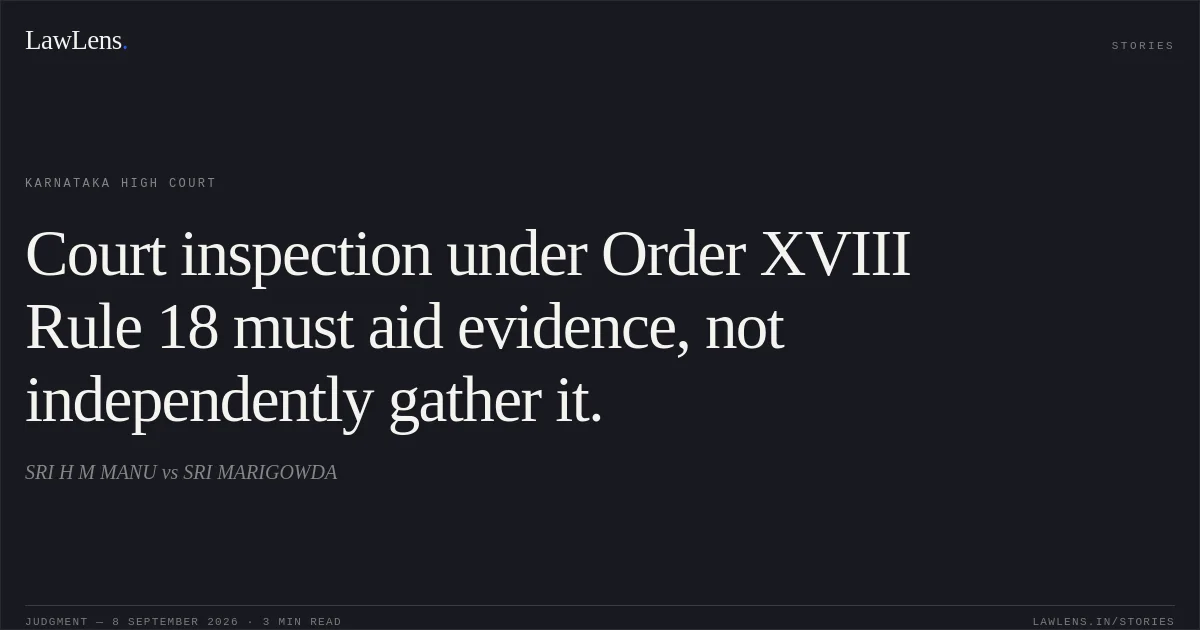
The Court applied Order XVIII Rule 18 CPC, which empowers a court, at any stage of a suit, to inspect property or things concerning which a question may arise and requires the court to record a memorandum of relevant facts observed during inspection.
¶ 5The power may be exercised suo motu or on a party’s request, but it must be used sparingly and primarily to assist the court in understanding and appreciating evidence already placed on record, not to collect independent evidence or determine the truth of competing testimony.
¶ 7(a)–(f)The memorandum cannot constitute the sole basis for deciding the dispute and cannot substitute for evidence, since the parties cannot cross-examine the presiding judge regarding the observations.
¶ 7(h)–(j)The Court relied on Ugamsingh v. Kesrimal, AIR 1971 SC 2540; B.T. Krishnappa v. Principal Munsiff, AIR 1980 Kar 106; Shree Shree Vishwothama Theertha Swamigal v. H. Balaraj, ILR 2007 Kar 3856; Shrikant v. Subhas, ILR 2016 Kar 297; Sannagoundara Siddappa v. Mahadevappa, AIR 1964 Mys 214; Binny Ltd. v. H.K. Madiah, MANU/KA/0284/1986; and S.J. Raman Photo Studio v. A.K.M. Noore, MANU/TN/0349/1986, for the principle that local inspection is ordinarily intended to facilitate appreciation of evidence and must not convert the court into an unofficial investigator.
¶ 6Provisions in the judgment · 1 · Linked ones open on LawLens
Code of Criminal Procedure, 1973 Section 310
04Reasoning
Although Order XVIII Rule 18 CPC uses the expression “at any stage of a suit,” the Court held that the power must be exercised consistently with its purpose.
¶ 8–9In the present case, the Trial Court conducted the inspection before any evidence had been recorded and while considering the temporary-injunction application.
¶ 8–9The memorandum did not merely record neutral physical features; it referred to persons present at the spot and included questions regarding who was in possession of the property.
¶ 10This amounted to a premature attempt to ascertain a disputed issue through local inspection rather than through pleadings and admissible evidence.
The inspection therefore risked forming a prior impression on possession and prejudicing the petitioner.
Although the respondents were correct that a memorandum ordinarily may not be challenged in isolation before it is relied upon in an order, the peculiar circumstances justified interference because allowing the memorandum to remain on record would itself cause prejudice.
¶ 1105Holding
The Court answered the issues in favour of the petitioner.
It held that the Trial Court had committed a grave error by conducting the local inspection before recording evidence and by recording observations and inquiries concerning possession while deciding the temporary-injunction application.
¶ 10The writ petition was allowed, and the proceedings dated 18 July 2022 recording the memorandum of facts in O.S. No.290/2022 were set aside.
¶ 12No order as to costs was made.
¶ 12Original Court PDF
SRI H M MANUvsSRI MARIGOWDA
Click to open original judgment
Original judgment, available to read, download and summarize on LawLens.in