01Facts
Petitioner No. 1 (formerly Morarjee Brembana Ltd.) issued a work order to Respondent No. 3 (D.C. Weaving Mils Pvt. Ltd.) for weaving fabrics
¶ 3Following a dispute, Respondent No. 2 (MSME Facilitation Council) passed an award on 20/03/2012, directing the Petitioner to pay Rs. 13,44,32,898/-
¶ 3The Petitioner challenged this via a Writ Petition.
¶ 4The High Court initially directed a 75% deposit for a stay, which the Supreme Court later modified to a 60% bank guarantee
¶ 4The Supreme Court subsequently dismissed the appeal, upheld the deposit condition, and directed the Registry to encash the bank guarantee
¶ 4-7Meanwhile, on 09/02/2024, the National Company Law Tribunal (NCLT) initiated Corporate Insolvency Resolution Process (CIRP) against Petitioner No. 1 and declared a moratorium under Section 14 of the Insolvency and Bankruptcy Code (IBC)
¶ 8A Resolution Professional (RP) was appointed
¶ 8Both the RP and Respondent No. 3 filed applications (CAW Nos. 2413/2025 and 782/2025) seeking withdrawal of the deposited amount
¶ 902Issues
i.1. Whether the amount deposited in Court (derived from the encashment of a bank guarantee) constitutes an asset of the Corporate Debtor or belongs to the decree-holder (Respondent No. 3) during the pendency of a moratorium under the IBC
¶ 10ii.2. Whether the Writ Petition is maintainable in light of the alternative remedy under Section 19 of the MSME Act and the intervening CIRP proceedings
¶ 2203Law Applied
The Court applied Section 14 of the IBC, which imposes a moratorium on the continuation or institution of suits and execution of judgments against a corporate debtor
¶ 8It considered Section 3(10) of the IBC, which defines a 'creditor' to include a 'decree holder'
¶ 18The Court distinguished the principle from Palladian Hotels Private Limited v. Hotel Horizon Private Limited, noting that while a bank guarantee is an independent contract, its encashment as a court-ordered security transforms the proceeds into an asset of the debtor
¶ 13-15It relied on Siti Networks Ltd. v. Rajiv Suri, establishing that money deposited in Court as security prior to CIRP remains an asset of the corporate debtor as it does not constitute a transfer of title
¶ 20Finally, the Court noted Section 19 of the MSME Development Act, 2006, which mandates a 75% pre-deposit for challenging an award
¶ 5Provisions in the judgment · 4 · Linked ones open on LawLens
Micro, Small and Medium Enterprises Development Act, 2006 Section 19
Insolvency and Bankruptcy Code, 2016. Section 3Section 7Section 14
04Reasoning
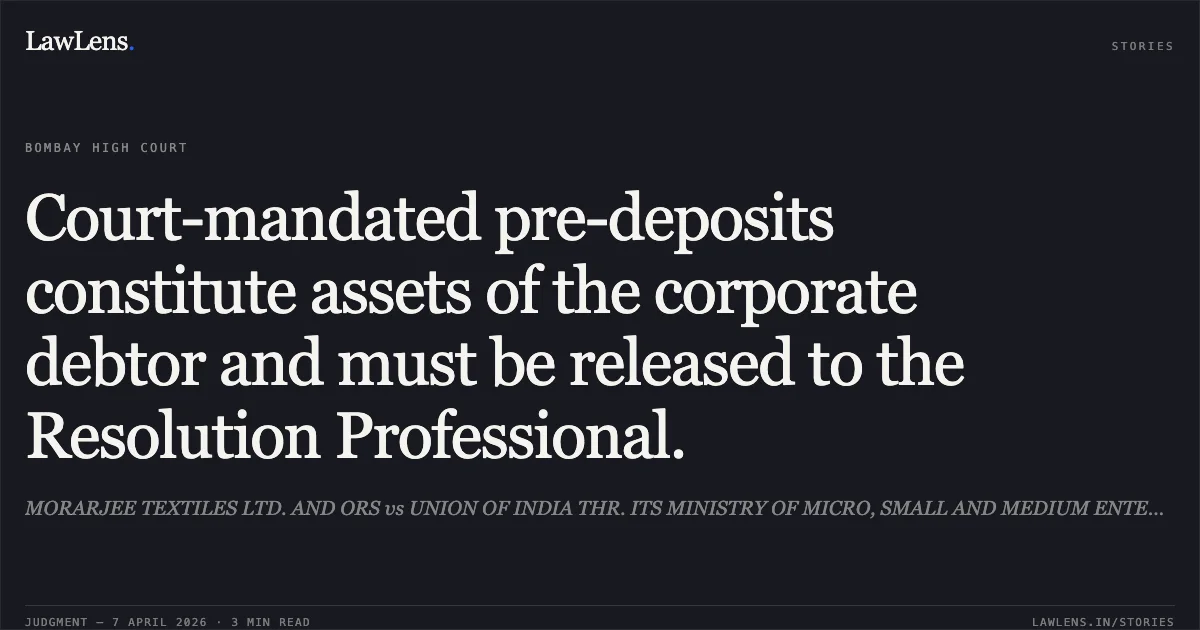
The Court reasoned that the amount deposited in the Court was not a final payment to Respondent No. 3 but a pre-condition (security) for entertaining the Writ Petition and staying the award
¶ 11, 19Although Respondent No. 3 argued that bank guarantees are independent of moratoriums, the Court held that since the Supreme Court directed encashment specifically to satisfy the High Court’s pre-deposit order, the resulting funds are assets of the Corporate Debtor
¶ 16, 19, 21The Court emphasized that Respondent No. 3, as a decree-holder, falls under the definition of a 'creditor' under Section 3(10) of the IBC and has already submitted its claim to the RP, thus submitting to the CIRP jurisdiction
¶ 17, 18The Court further observed that the Writ Petition was a means to circumvent the statutory pre-deposit under Section 19 of the MSME Act, and the commencement of CIRP now prohibits the continuation of such proceedings under Section 14(1) of the IBC
¶ 2205Holding
The Court held that the deposited amount is an asset of the Corporate Debtor and must be controlled by the RP for the benefit of all creditors under the IBC
¶ 21The Court dismissed the Writ Petition, noting the availability of an alternative remedy and the legal bar created by the CIRP
¶ 22The Registry was directed to release the deposited amount, with accrued interest, to the RP
¶ 23The application of the RP (CAW 2413/2025) was partly allowed, while Respondent No. 3's application (CAW 782/2025) was rejected
¶ 23Release of funds was stayed for four weeks to allow Respondent No. 3 to approach the Supreme Court
¶ 24Connected petitions (WP Nos. 3075, 3076, and 3078 of 2012) were dismissed for non-prosecution
p. 21Original Court PDF
MORARJEE TEXTILES LTD. AND ORSvsUNION OF INDIA THR. ITS MINISTRY OF MICRO, SMALL AND MEDIUM ENTERPRISES AND ORS
Click to open original judgment
Original judgment, available to read, download and summarize on LawLens.in