Facts
The applicant was convicted by the Additional Chief Metropolitan Magistrate, Ahmedabad, in Criminal Case No. 2287/2003 for offences under Sections 498(A), 324, and 114 of the IPC.
Source reference: p. 1He was sentenced to one year of rigorous imprisonment and a fine for each primary offence.
Source reference: p. 1-2The applicant challenged this via Criminal Appeal No. 70/2016, which was dismissed by the Additional Sessions Judge on 27.03.2017, confirming the conviction.
Source reference: p. 2During the pendency of the revision, the applicant requested the benefit of probation, noting that 23 years had passed since the incident and that he was under 26 at the time of the offence.
Source reference: p. 2Issues
1. Whether there exists any glaring defect in procedure, manifest error of law, or miscarriage of justice in the concurrent findings of the lower courts to warrant interference under revisional jurisdiction.
Source reference: p. 3, para 42. Whether the applicant is entitled to the benefit of probation under the Probation of Offenders Act based on his conduct and the reformative approach of penology.
Source reference: p. 3, para 5Law Applied
The court primarily applied Section 397 read with Section 401 of the Code of Criminal Procedure (CrPC) regarding the limited scope of revisional jurisdiction, which prohibits reappreciation of evidence unless there is perversity or a manifest error of law as per Amit Kapoor v. Ramesh Chander (2012) 9 SCC 460.
Source reference: p. 3Reformative principles of penology embodied in Section 360 of the CrPC and Section 4 of the Probation of Offenders Act, which allow for the release of offenders on probation of good conduct to facilitate rehabilitation.
Source reference: p. 3-4Reasoning
The High Court observed that the concurrent findings of the lower courts did not suffer from any glaring defect or perversity; thus, as a revisional court, it declined to act as an appellate court to reappreciate evidence.
Source reference: p. 3The Court noted that the applicant was young at the time of the incident, had no subsequent criminal record over the intervening 23 years, and was now settled with a family and a job.
Source reference: p. 2A report from the Chief Probation Officer confirmed the applicant's good conduct and recommended probation; consequently, the court determined that the interests of justice and societal rehabilitation would be better served by granting probation rather than enforcing the custodial sentence.
Source reference: p. 2-3Holding
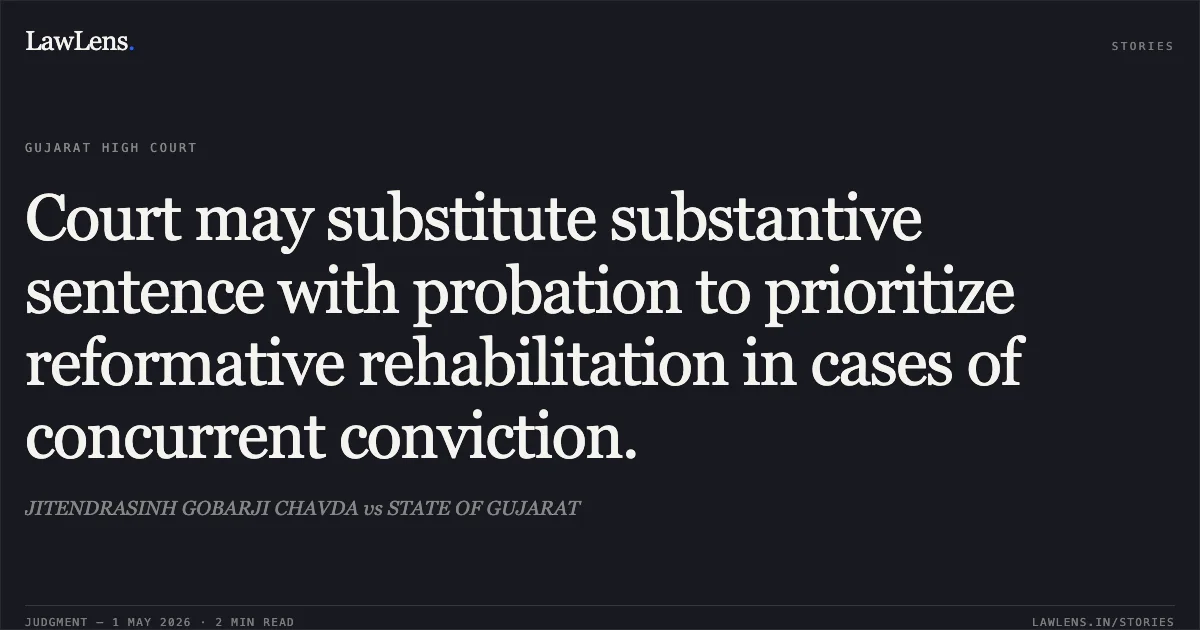
The Court dismissed the challenge against the conviction but modified the sentence, directing the applicant to be released on probation of good conduct under Section 4 of the Probation of Offenders Act for a period of one year.
The applicant must execute a bond of Rs. 20,000/- with one surety, maintain peace, and appear for sentencing if called upon during the probation period; the Revision Application was disposed of with directions to the trial court to accept the bond within 15 days.
Source reference: p. 4Acts & Sections Cited
6 provisions across 3 statutes referred to in this judgment. Each provision opens on LawLens.
Code of Criminal Procedure, 19733
Indian Penal Code, 18602
Probation of Offenders Act, 19581
Original Court PDF
JITENDRASINH GOBARJI CHAVDAvsSTATE OF GUJARAT
Click to open original judgment
Original judgment, available to read, download and summarize on LawLens.in