Facts
An FIR was registered against the petitioner under Sections 406/420/506/120-B IPC pursuant to allegations that he and co-accused had cheated the complainants in connection with the proposed sale of land.
Source reference: para. 6During investigation, the parties entered into a mediation settlement dated 26.10.2023 under which the petitioner agreed to pay ₹80 lakhs to the complainants.
Source reference: para. 7On the basis of the settlement, the petitioner was granted anticipatory bail on 08.11.2023, subject to specified conditions, including cooperation with the investigation and non-interference with witnesses.
Source reference: p. 5–6; para. 8A cheque for ₹20 lakhs issued pursuant to the settlement was dishonoured, and an application for cancellation of bail was subsequently withdrawn on 25.09.2024 after the petitioner undertook to settle the dispute.
Source reference: p. 6–7; paras. 9–10After filing of the chargesheet, the petitioner was admitted to regular bail by the Chief Judicial Magistrate on 01.02.2025, subject to his appearing before the Court whenever directed and attending each hearing.
Source reference: p. 7–8; para. 12During the pendency of the complainants’ renewed bail-cancellation application, the petitioner appeared through video conference on 08.06.2026 and undertook to execute registered sale deeds for specified portions of land by stipulated dates. He failed to honour that undertaking.
Source reference: p. 8–9; paras. 14–16He also failed to appear personally despite directions of the Trial Court, resulting in issuance of non-bailable warrants on 21.07.2026.
Source reference: p. 9; para. 17By order dated 27.07.2026, the Principal District & Sessions Judge cancelled the petitioner’s bail, holding that he had abused the process of law, breached his undertakings, violated the requirement of personal appearance, and had obtained bail on a settlement which he had no intention of honouring.
Source reference: p. 2–3; paras. 3–4, 18–19Issues
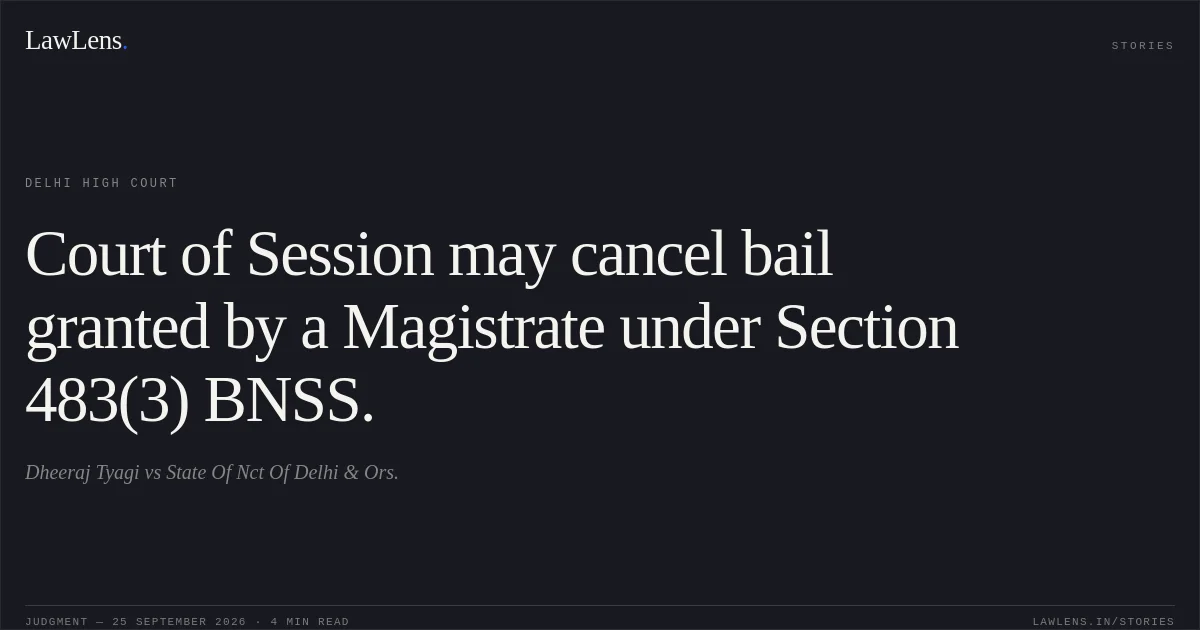
Whether the Court of Session had jurisdiction under Section 483(3) BNSS, corresponding to Section 439(2) CrPC, to cancel bail granted by the Magistrate under Section 480(5) BNSS, corresponding to Section 437(5) CrPC?
Source reference: p. 10–13; paras. 20–30Whether cancellation of bail on account of the petitioner’s failure to honour the mediated settlement and subsequent undertakings amounted impermissibly to using bail proceedings as a mechanism for recovery of money?
Source reference: p. 13–15; paras. 34–38Whether the petitioner had established grounds for interference under the High Court’s inherent jurisdiction under Section 528 BNSS?
Source reference: p. 15; paras. 39–42Law Applied
Section 480(5) BNSS, corresponding to Section 437(5) CrPC, empowers the Court which granted bail under Section 480 to direct the re-arrest of the accused, while Section 483(3) BNSS, corresponding to Section 439(2) CrPC, independently empowers the High Court or Court of Session to direct the arrest and committal to custody of any person released on bail, regardless of which court granted the bail.
Source reference: p. 10–13; paras. 23–29The Court relied on Rameshbhai Lallubhai Luni v. Devraj Bhalabhai, 1987 SCC OnLine Guj 76, and Gurcharan Singh v. State (Delhi Administration), (1978) 1 SCC 118, for the concurrent and superior jurisdiction of the High Court and Court of Session under Section 439(2) CrPC.
Source reference: p. 10–12; paras. 25–26It also referred to Yogesh Kumar Garg v. State of U.P., 2024 SCC OnLine All 8092, and Abhimanue v. State of Kerala, 2025 SCC OnLine SC 2037, concerning the maintainability of bail-cancellation proceedings before the High Court.
Source reference: p. 12–13; paras. 27–28Although mere non-payment under a settlement is not, by itself, sufficient to cancel bail or convert bail proceedings into recovery proceedings, deliberate breach of undertakings, misuse of liberty, evasion of court proceedings, and violation of bail conditions may justify cancellation.
Source reference: p. 13–15; paras. 34–38Section 528 BNSS is to be exercised sparingly to prevent abuse of process or secure the ends of justice.
Source reference: p. 15; para. 39Reasoning
The Court rejected the petitioner’s jurisdictional objection. Section 480(5) BNSS does not restrict the independent and broader power conferred on the Court of Session under Section 483(3) BNSS. Since the Court of Session is superior to the CJM, it was competent to entertain the complainants’ application for cancellation of bail granted by the Magistrate.
Source reference: p. 13; para. 30The Court further held that the petitioner’s regular bail dated 01.02.2025 flowed from the liberty originally granted on the basis of the mediated settlement dated 26.10.2023; the subsequent bail order did not eliminate the consequences of breaching the basis and conditions of that liberty.
Source reference: p. 13; paras. 31–33The cancellation was not based merely on non-payment of ₹80 lakhs. The petitioner had issued a dishonoured cheque, failed to honour an undertaking given on 25.09.2024, failed to execute the land documents promised before the Court on 08.06.2026, and failed to appear personally despite specific directions, leading to non-bailable warrants.
Source reference: p. 14–15; para. 36These cumulative circumstances demonstrated repeated breach of court undertakings and misuse of the liberty granted. The finding that the petitioner had entered into the settlement without intending to honour it was neither perverse nor based on irrelevant considerations.
Source reference: p. 15; para. 38Consequently, the case involved abuse of the process of law and not merely an attempt to recover settlement money through bail proceedings.
Source reference: p. 14–15; paras. 35–40Holding
The High Court held that the Principal District & Sessions Judge had jurisdiction under Section 483(3) BNSS to cancel bail granted by the Magistrate.
It further held that the petitioner’s repeated breach of settlement-related undertakings, failure to comply with court directions, non-appearance, and resulting issuance of non-bailable warrants justified cancellation of bail; the order was not founded on non-payment alone.
Source reference: p. 13–15; paras. 35–38No ground for exercise of jurisdiction under Section 528 BNSS was made out.
Source reference: p. 15; paras. 39–42The petition was accordingly dismissed, and the impugned order cancelling bail and directing execution of the non-bailable warrants was left undisturbed.
Source reference: p. 15; paras. 39–42Acts & Sections Cited
10 provisions across 3 statutes referred to in this judgment. Each provision opens on LawLens.
Bharatiya Nagarik Suraksha Sanhita, 20233
Indian Penal Code, 18603
Code of Criminal Procedure, 19734
Original Court PDF
Dheeraj TyagivsState Of Nct Of Delhi & Ors.
Click to open original judgment
Original judgment, available to read, download and summarize on LawLens.in