Facts
Ramesh Kumar (applicant in OA No. 816/2016) was initially appointed as a Bearer on an ad-hoc basis in the Departmental Canteen on May 10, 1993, for 80 days, with services extended until October 19, 1994, then discontinued.
Source reference: p.3, p.4, p.8Buddhi Prakash Verma (applicant in OA No. 817/2016) was similarly employed as a Wash Boy.
Source reference: p.2Against the discontinuation of services, Ramesh Kumar filed O.A. No. 543/1994, and the Tribunal directed his regularization on November 16, 2000.
Source reference: p.3, p.4The Union of India challenged this order in D.B. Civil Writ Petition No. 1245/2001 before the Hon'ble High Court of Rajasthan.
Source reference: p.3, p.5Due to a Contempt Petition (No. 11/2001) filed by the applicant for non-implementation of the Tribunal's order, an offer of appointment was issued on March 1, 2002, to Ramesh Kumar as a Bearer, Group 'D', provisionally, subject to the outcome of the writ petition.
Source reference: p.5He joined on March 8, 2002.
Source reference: p.6On October 4, 2013, the high court set aside the Tribunal's regularization order, noting that Ramesh Kumar was not in service as of October 1, 1991, to be eligible for regularization under DoPT Circular dated March 20, 1997.
Source reference: p.3, p.6, p.16The high court, however, directed the respondents to "sympathetically consider" his continuance in service, noting his satisfactory service, but with the caveat that it should not be cited as a precedent and if there was no other legal impediment.
Source reference: p.3, p.6, p.15-18The respondents subsequently terminated his services via notice dated October 28, 2016.
Source reference: p.3, p.8The applicants challenged this termination by filing the present O.A.s, which were heard together due to common facts and questions of law.
Source reference: p.3, p.8An interim order dated November 24, 2016, by the Tribunal kept the termination notice in abeyance, leading to the applicants' continued service until 2026.
Source reference: p.9The respondents argued that the Canteen is non-statutory, the appointments were ad-hoc without proper procedure, and the department does not require their services, with post abolishment indicated by OM F. No. 7(1)/E.Coord-1/2017 dated January 5, 2024.
Source reference: p.4, p.10, p.11Issues
1. Whether the termination notice dated October 28, 2016, issued to the applicants by the respondents is liable to be quashed and set aside.
Source reference: p.32. Whether the applicants are entitled to regularization of their services and consequential benefits.
Source reference: p.3Law Applied
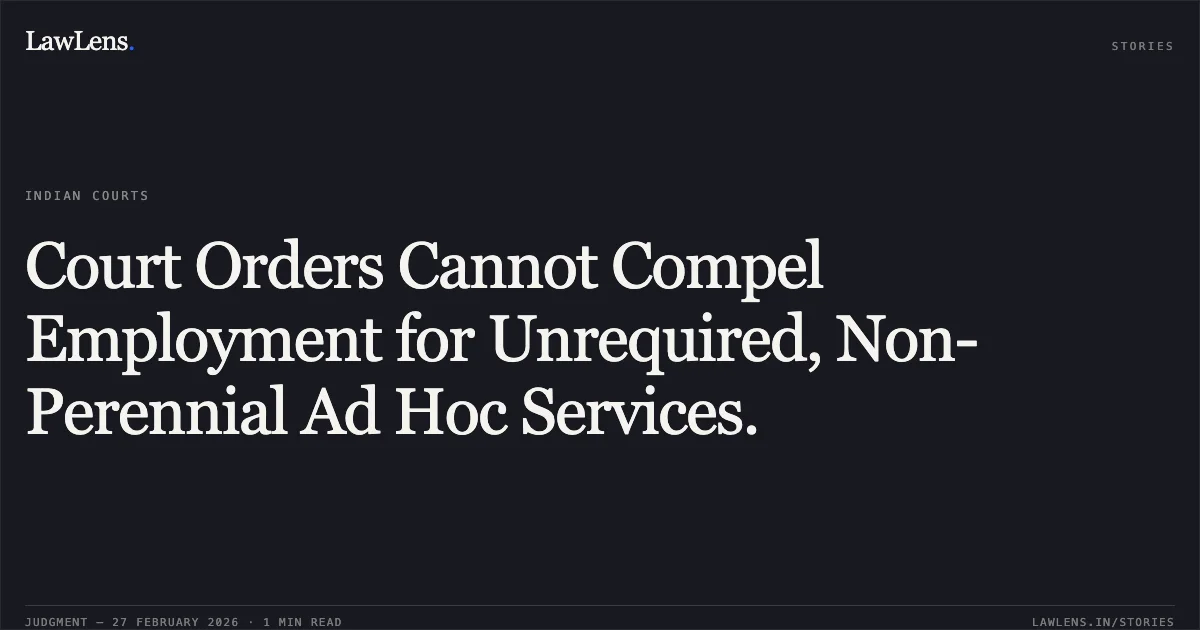
The court primarily applied the principle that regularization is generally not permissible for ad-hoc appointments made without proper procedure, especially when appointments are not on sanctioned posts and the work is not of a perennial nature.
Source reference: p.4, p.9, p.11, p.12, p.19, p.20It relied on DoPT OMs dated January 29, 1992, and March 20, 1997, which stipulated that only employees working in Canteens as of October 1, 1991, were eligible for regularization.
Source reference: p.4, p.6, p.17The court also referred to the Supreme Court judgment in *Union of India & Ors. vs. Bishmber Dutt* (Civil Appeal Nos. 14528-530 of 1996), holding that directions to regularize service are illegal if appointments are not on a regular basis according to rules.
Source reference: p.4, p.5Furthermore, it emphasized the Constitutional Bench ruling in *Secretary, State of Karnataka & Ors. vs. Umadevi & Ors.* (AIR 2006 SC 1806), which limited regularization as a one-time measure for irregular (not illegal) appointments of qualified persons in sanctioned vacant posts who have worked for ten years or more without court intervention.
Source reference: p.18, p.19The court distinguished cases where regularization was granted based on "inherently perennial nature of work" (*Jaggo vs. Union of India & Ors.*, Civil Appeal of 2024, and *Dharam Singh & Ors. vs. State of U.P. & Anr.*, Civil Appeal No(s) 8558/2018), noting that this principle was not applicable to the instant case.
Source reference: p.12, p.13, p.14, p.19Reasoning
The court analyzed the applicants' claims for regularization and the quashing of their termination notice.
Source reference: no citationIt found that the initial appointments were purely ad-hoc, for definite periods, and made without following proper selection procedures or through employment exchanges.
Source reference: p.4, p.12Crucially, the applicants did not meet the eligibility criteria for regularization under DoPT OMs, as they were employed after the cut-off date of October 1, 1991.
Source reference: p.4, p.6, p.17The High Court had already rejected their claim for regularization on merits and law by setting aside the Tribunal's earlier order.
Source reference: p.6, p.16, p.17The court stressed that the applicants' long service tenure beyond the initial ad-hoc period was solely due to interim judicial orders, not because the department inherently required their services continuously.
Source reference: p.9, p.19It highlighted that the departmental Canteen was non-statutory, and the work performed by the applicants was neither perennial nor fundamental to the functioning of the Customs and Central Excise Department.
Source reference: p.11, p.12, p.19The court rejected the argument that indefinite continuation in service due to judicial intervention creates a right to regularization, distinguishing it from cases where the employer voluntarily retained services for extended periods.
Source reference: p.9, p.10Applying the *Umadevi* dictum, the court noted that regularization as a one-time measure applies to employees who worked for years without court intervention in duly sanctioned posts, which was not the situation here.
Source reference: p.18, p.19The "sympathetic consideration" suggested by the high court did not vest any legal right for regularization if there were legal impediments, as was the case here.
Source reference: p.15, p.18Holding
The Tribunal dismissed both Original Applications.
It held that the termination notice dated October 28, 2016, issued to the applicants was valid and their services were not liable to be regularized.
Source reference: p.20The court concluded that the applicants' claim for regularization had already been considered and rejected on its merits and law by the Hon'ble High Court of Rajasthan.
Source reference: p.16, p.18Their continued service was solely due to judicial orders, and the job was not of a perennial nature in a non-statutory canteen, thus falling outside the scope of precedents allowing regularization.
Source reference: p.9, p.10, p.12, p.19No costs were awarded.
Source reference: p.21Original Court PDF
Ramesh Kumarvs.Union of India and Others (O.A. No. 816/2016) and Buddhi Prakash Vermavs.Union of India and Others (O.A. No. 817/2016)
Click to open original judgment
Original judgment, available to read, download and summarize on LawLens.in