Facts
The Petitioner, a seventeen-year-old minor, was allegedly sexually assaulted and raped by her fufa (paternal uncle-by-marriage) on March 22, 2026.
Source reference: para. 1, 4, 5Due to death threats from the perpetrator, she remained silent until her menstrual cycle stopped.
Source reference: para. 5An FIR was registered on July 7, 2026, after a medical examination confirmed pregnancy.
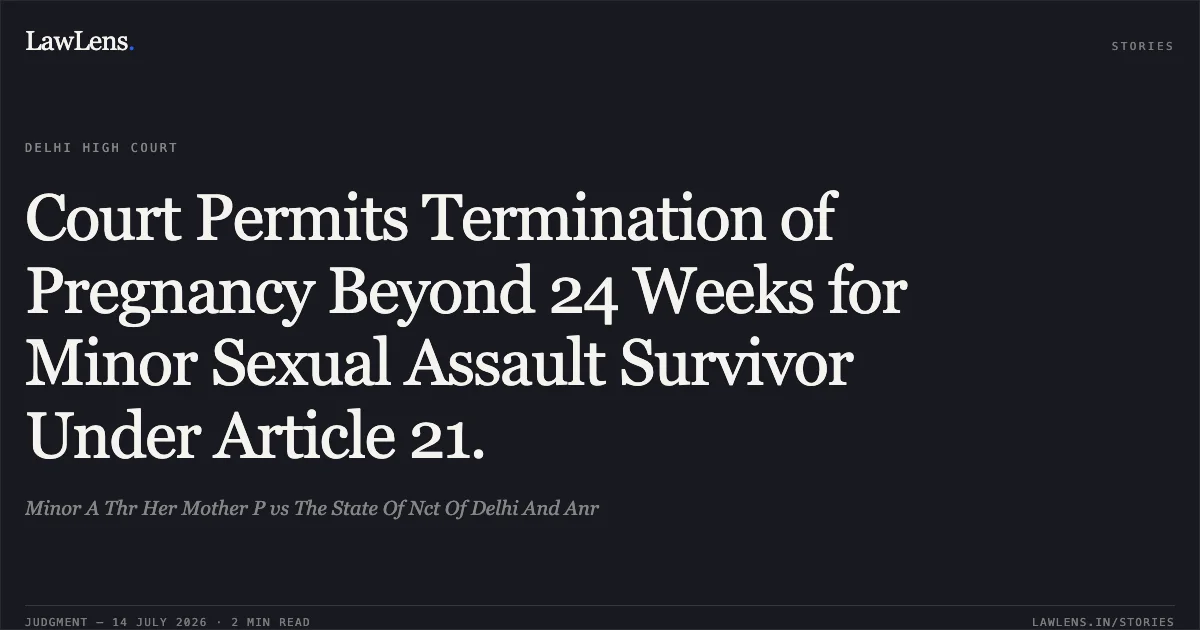
Source reference: para. 6, 8The victim and her mother sought a writ for the termination of the pregnancy, which was calculated to be at 25 weeks and 5 days of gestation—beyond the statutory 24-week limit.
Source reference: para. 7, 11, 15A Medical Board constituted at GTB Hospital assessed the victim as "physically fit" for the procedure and unanimously recommended the termination.
Source reference: para. 14, 15Issues
1. Whether the court should exercise its extraordinary jurisdiction under Article 21 to permit the termination of a pregnancy exceeding the 24-week statutory limit in a case involving a minor sexual assault survivor.
Source reference: para. 20, 212. Whether the continuance of the pregnancy constitutes a "grave injury" to the mental health of the minor victim.
Source reference: para. 18, 19Law Applied
Section 3 of the Medical Termination of Pregnancy (MTP) Act, 1971, specifically Explanation 2, which mandates a legal presumption that pregnancy caused by rape constitutes a "grave injury to the mental health of the pregnant woman".
Source reference: para. 18, 19Constitutional principles under Article 21 regarding reproductive choices and bodily autonomy as affirmed in Suchita Srivastava v. Chandigarh Admn.
Source reference: para. 28Precedents like A (Mother of X) v. State of Maharashtra and Venkatalakshmi v. State of Karnataka, where the Supreme Court permitted terminations beyond 24 weeks for rape survivors to prevent severe mental trauma.
Source reference: para. 21, 22Reasoning
The court reasoned that while the MTP Act generally prohibits termination beyond 24 weeks absent fetal abnormalities, the extraordinary jurisdiction of Constitutional Courts can be invoked to protect the victim’s right to life and mental well-being.
Source reference: para. 20, 21The court observed that the pregnancy was a direct consequence of a forcible sexual assault, which per Explanation 2 of Section 3 of the MTP Act, creates an irrebuttable presumption of "grave injury" to mental health.
Source reference: para. 18, 19, 28The court verified the "physical fitness" of the minor through the Medical Board’s report and personally interacted with the petitioner’s mother and the victim via video link to confirm their "unwavering" desire to terminate.
Source reference: para. 15, 16, 17, 27It concluded that forcing a minor to carry a pregnancy resulting from rape would exacerbate her trauma and violate her fundamental rights under Article 21.
Source reference: para. 28Holding
The court held that the victim’s mental health and reproductive autonomy outweighed the gestational age limit.
The Court allowed the petition and directed GTB Hospital to carry out the medical termination of the pregnancy at the earliest; preserve fetal tissue for DNA/investigative purposes; ensure the State bears all medical expenses; and provide assistance/adoption protocols should the child be born alive.
Source reference: para. 29The petition was disposed of with dasti (immediate) service of the order.
Source reference: para. 30, 31Acts & Sections Cited
1 provisions across 1 statute referred to in this judgment. Each provision opens on LawLens.
Medical Termination of Pregnancy Act, 19711
Original Court PDF
Minor A Thr Her Mother PvsThe State Of Nct Of Delhi And Anr
Click to open original judgment
Original judgment, available to read, download and summarize on LawLens.in


