Facts
The petitioner and the fourth respondent entered into an agreement for sale dated 7 January 2025, under which the petitioner agreed to sell property for ₹7.21 crore.
Source reference: p.2–3The fourth respondent paid ₹3.50 crore; the petitioner stated that he had transferred ₹50 lakh to the fourth respondent’s wife.
Source reference: p.2–3After a dispute arose over performance of the agreement, the fourth respondent complained to the police, and the Sub-Inspector issued the petitioner a summons to attend an enquiry on 26 September 2026.
Source reference: p.2–3The petitioner sought to quash the summons and restrain the police from interfering in what he characterised as a civil dispute.
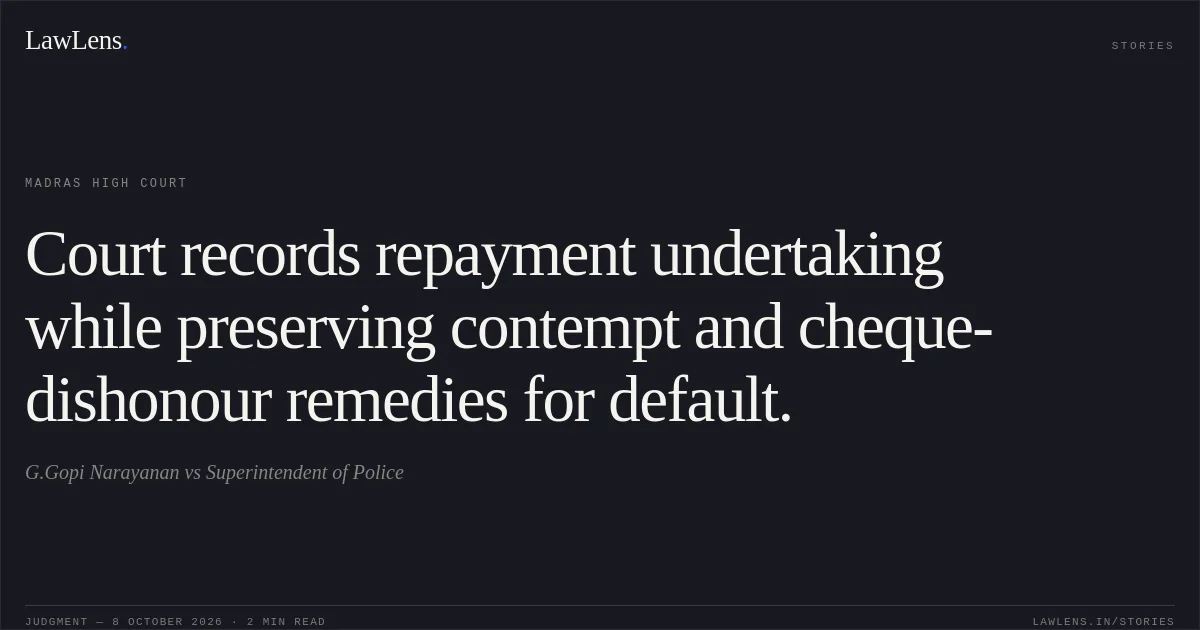
Source reference: p.2During the proceedings, the petitioner offered to repay the amount received, and the Court recorded an undertaking supported by a demand draft for ₹1 crore and a cheque for ₹2 crore.
Source reference: p.4–8Issues
1. Whether the police summons issued following the fourth respondent’s complaint should be quashed as illegal, arbitrary, or without jurisdiction
Source reference: p.22. Whether the police should be directed not to interfere in the parties’ dispute concerning the agreement for sale, except in accordance with law
Source reference: p.2Law Applied
The petition invoked the High Court’s jurisdiction under Article 226, but the Court disposed of the matter by recording the petitioner’s repayment undertaking rather than deciding the challenge on its merits.
Source reference: p.2, 8The Court stated that, if the undertaking were breached, the fourth respondent could initiate contempt proceedings, without prejudice to any right to proceed under Section 138 of the Negotiable Instruments Act if the cheque were dishonoured.
Source reference: p.8Reasoning
The police stated that the summons was for enquiry and that they would not interfere if the matter proved to be civil.
Source reference: p.4Rather than determine whether the dispute was civil or criminal, or rule on the legality of the summons, the Court recorded the petitioner’s undertaking to repay the amount, together with the tender of the demand draft and cheque.
Source reference: p.5–8It preserved the fourth respondent’s potential remedies if the undertaking was breached or the cheque dishonoured, and left questions of interest and return of the parent documents for separate consideration.
Source reference: p.8Holding
The Court disposed of the writ petition after recording the undertaking; it did not expressly quash the summons or grant the requested direction restraining police interference.
The fourth respondent was permitted to pursue contempt proceedings for breach of the undertaking and, if the cheque was dishonoured, proceedings under Section 138 of the Negotiable Instruments Act, without prejudice to one another.
Source reference: p.8The question of interest and return of the parent documents was left open for separate consideration; no costs were ordered.
Source reference: p.8Acts & Sections Cited
1 provisions across 1 statute referred to in this judgment. Each provision opens on LawLens.
Negotiable Instruments Act, 18811
Original Court PDF
G.Gopi NarayananvsSuperintendent of Police
Click to open original judgment
Original judgment, available to read, download and summarize on LawLens.in