Facts
The Plaintiffs, part of the Mahindra Group, are registered owners of the well-known trademark "MAHINDRA"
Source reference: p. 3, para. 2They filed an infringement suit against Defendants 1–4 and 10–12, who were using the "MAHINDRA" mark and various infringing domain names to provide packing and moving services
Source reference: p. 5, para. 4Defendants 5–9 are intermediaries (DoT, Google, GoDaddy)
Source reference: p. 5, para. 4Ex-parte ad-interim injunctions were previously granted, and the intermediaries filed compliance reports confirming the blocking of the infringing websites
Source reference: p. 6–9, para. 5–9While the suit was ready for final disposal, the Plaintiffs sought a "dynamic injunction" to implead future mirror, redirect, or alphanumeric websites through applications to the Joint Registrar (Judicial) post-decree, without filing fresh suits
Source reference: p. 10, para. 11Issues
1. Whether a plaintiff is entitled to implead alleged infringers via an application post-decree without having sought such a specific prayer in the suit
Source reference: p. 10, para. 122. Whether a Court can, under Section 151 of the CPC, extend a dynamic injunction to mirror/redirect websites by empowering the Joint Registrar to pass impleadment and injunction orders after the final judgment has been pronounced and the Court has become functus officio
Source reference: p. 10, para. 12Law Applied
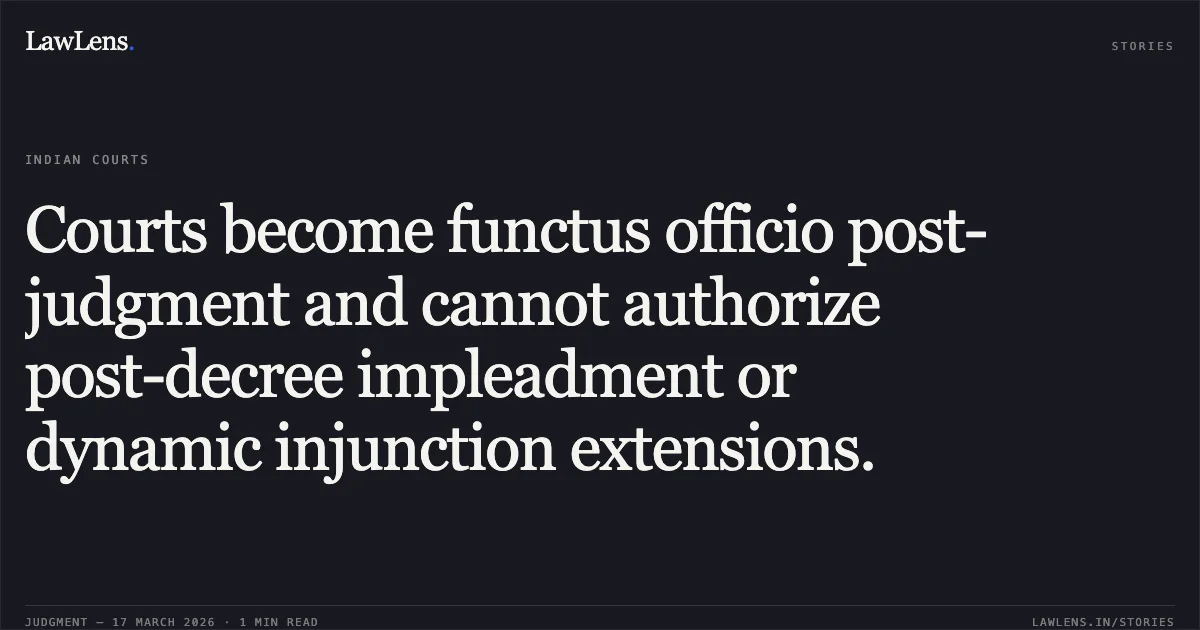
The Court applied the doctrine of functus officio, which dictates that once a Judge renders a decision and signs the judgment under Order XX, Rule 3 of the CPC, they lack jurisdiction to revisit, amend, or reverse it, except for the correction of clerical/arithmetical errors under Section 152 or through a review under Order XLVII
Source reference: p. 17, para. 19(ii); p. 18, para. 106It relied on Dwaraka Das v. State of M.P. and State Bank of India v. S.N. Goyal, which establish that Section 151 cannot be used to pass effective judicial orders after a judgment.
Source reference: p. 16, para. 6; p. 17, para. 28The court distinguished the dynamic injunction procedure established in UTV Software Communication Ltd. v. 1337X.To
Source reference: p. 12, para. 99Reasoning
The Court reasoned that once a final judgment is pronounced, the litigation attains finality, and the Court is denuded of its power to introduce new issues or parties
Source reference: p. 15, para. 18The Plaintiffs' request to empower a Joint Registrar to implead third parties and extend injunctions post-decree was deemed legally untenable because a delegate (the Joint Registrar) cannot exercise powers that the delegator (the Court) no longer possesses after becoming functus officio
Source reference: p. 28, para. 21; p. 29, para. 25Furthermore, the Court noted that interim injunctions merge into the final decree and do not exist independently for future extension by an administrative officer
Source reference: p. 29, para. 24While acknowledging the technological menace of mirror websites, the Court held that such "moulding of relief" cannot bypass the express prohibitions of the CPC
Source reference: p. 31, para. 28The Court respectfully diverged from the UTV Software precedent, noting that the specific Supreme Court rulings on functus officio were not brought to that Bench's notice
Source reference: p. 30, para. 26Holding
The Court decreed the suit in favor of the Plaintiffs, granting a permanent injunction against the existing Defendants and confirming the blocking of the identified infringing domain names
However, it rejected the prayer for liberty to implead mirror/redirect websites via the Joint Registrar post-decree, holding that such a procedure violates the doctrine of finality and the limits of the Court's jurisdiction post-judgment
Source reference: p. 31–32, para. 30The Court advised the Legislature and Central Government to amend the CPC or IT Rules to address the challenges of dynamic injunctions in the digital age
Source reference: p. 31, para. 29Acts & Sections Cited
8 provisions across 3 statutes referred to in this judgment. Each provision opens on LawLens.
Delhi High Court Act, 19661
Code of Civil Procedure, 19086
Code of Criminal Procedure, 19731
Original Court PDF
Mahindra And Mahindra Limited & Anr.vsDiksha Sharma Proprietor Of Mahidnra Packers Movers & Ors.
Click to open original judgment
Original judgment, available to read, download and summarize on LawLens.in


![Subsequent exoneration does not retrospectively invalidate a finalized promotion select list.. UNNIKRISHNAN M vs M/o Environment And Forests. CAT - ['Ernakulam']. LawLens](/stories/thumbnails/subsequent-exoneration-does-not-retrospectively-invalidate-a-finalized-promotion-select-li-ce80a0e84f2f4887857271e8b4341c42.webp)