Facts
The respondents are employees of the Indian Audit and Accounts Department (IA&AD) under the Comptroller & Auditor General of India (CAGI).
Source reference: p. 3, para. 1Following a 2025 Deputation Policy, the respondents were repatriated to their parent cadres after completing seven years on deputation, leading to spousal separation.
Source reference: p. 3, para. 2The Central Administrative Tribunal (CAT), by judgment dated 15 April 2026, disapproved of the 2025 Policy, directed its reconsideration along specific lines, and allowed the respondents to remain in their current postings pending such review.
Source reference: p. 3, para. 4During the pendency of the writ, the respondents rejoined their parent postings.
Source reference: p. 4, para. 5Issues
1. Whether the Central Administrative Tribunal (CAT) erred in disapproving the 2025 Deputation Policy and directing its reconsideration despite a contrary ruling by the Jharkhand High Court.
Source reference: p. 9-10, para. 15-182. Whether the Tribunal exceeded its jurisdiction by directing the Executive to modify a policy along specific judicial lines.
Source reference: p. 11, para. 20Law Applied
Transfer is an incident of service and an employee has no fundamental or indefeasible right to a posting of their choice.
Source reference: p. 6, para. 14/19Spousal posting policies are subject to administrative exigencies as held in SK Nausad Rahaman v. Union of India.
Source reference: p. 6, para. 19While spousal co-location is desirable, it is not an absolute right if it conflicts with administrative needs as per Bank of India v. Jagjit Singh Mehta.
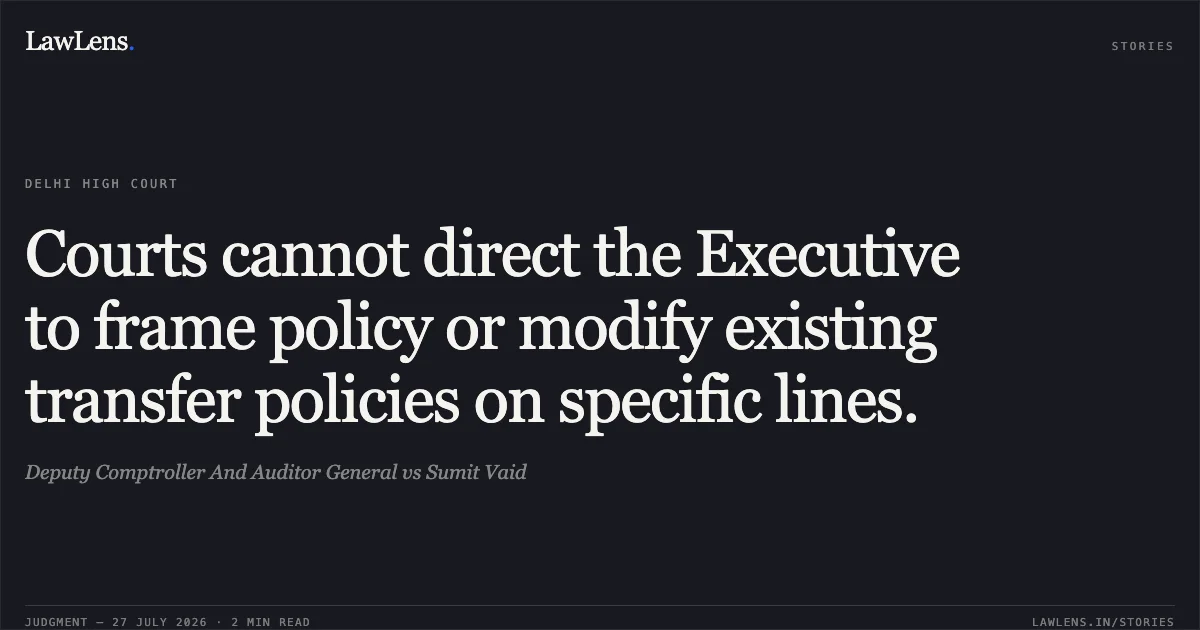
Source reference: p. 7, para. 19The doctrine of judicial restraint prohibits courts from directing the executive to frame or modify policies in a specific manner as laid down in Union of India v. K. Pushpavanam.
Source reference: p. 11, para. 20Reasoning
The Court noted that the validity of the same 2025 Policy had already been upheld by the Jharkhand High Court in Adwin Vinifred Tirkey v. Union of India, which the Tribunal improperly ignored by claiming the factual matrix was "materially distinguishable" without providing cogent reasons.
Source reference: p. 9-10, para. 15-17The Court emphasized that the Tribunal, being hierarchically lower than a High Court, cannot rule contrary to High Court precedents.
Source reference: p. 10, para. 17The Court analyzed the Tribunal’s directions to refame the policy using "DoPT guidelines" and "transparent mechanisms" as a jurisdictional overreach, stating that the judiciary cannot dictate the lines on which executive policy must be reconsidered.
Source reference: p. 11, para. 20Since the respondents had already rejoined their parent cadres, the status quo order was rendered moot.
Source reference: p. 12, para. 24Holding
The High Court allowed the writ petitions and set aside the Tribunal’s judgment.
It held that the 2025 Policy does not require reconsideration and affirmed the Jharkhand High Court's view.
Source reference: p. 10, para. 18; p. 11, para. 22The Court granted the respondents liberty to represent their cases to the Petitioner seeking benefits of the DOPT OM dated 30 September 2009 regarding spousal postings, to be considered by the Petitioner in accordance with law.
Source reference: p. 12, para. 28The direction for the respondents to remain in Delhi was quashed as they had already been repatriated.
Source reference: p. 12, para. 25Acts & Sections Cited
2 provisions across 2 statutes referred to in this judgment. Each provision opens on LawLens.
Code of Civil Procedure, 19081
Administrative Tribunals Act, 19851
Original Court PDF
Deputy Comptroller And Auditor GeneralvsSumit Vaid
Click to open original judgment
Original judgment, available to read, download and summarize on LawLens.in