Facts
The parties entered into logistics agreements in April 2017, each containing an arbitration clause.
Source reference: p.1–3After Asahi terminated the agreements by email on 12 September 2018, Advantage invoked arbitration.
Source reference: p.1–3The arbitrator awarded, among other sums, Rs. 14,32,785 for 30 days’ notice-period damages, calculated using the claimant’s average monthly turnover and an estimated profit rate of 12.02%.
Source reference: p.1–3Asahi’s application under Section 34 of the Arbitration and Conciliation Act, 1996 was rejected by the Single Judge.
Source reference: p.3–5In its appeal under Section 37, Asahi challenged the notice-period award, contending that loss of profit had not been pleaded or proved and that the profit rate was based on material introduced after evidence had closed.
Source reference: p.3–5Issues
1. Whether the Single Judge was justified in rejecting the Section 34 challenge to the arbitrator’s award of 30 days’ damages, calculated by reference to estimated profits, despite the appellant’s objections concerning pleading and evidence.
Source reference: p.5–72. Whether the arbitrator’s estimate of a 12.02% profit rate warranted interference under Sections 34 or 37 of the Act.
Source reference: p.6–7Law Applied
Sections 34 and 37 of the Arbitration and Conciliation Act, 1996 limit judicial interference with arbitral awards; an appellate court under Section 37 does not reassess the award as if exercising an ordinary appeal on facts.
Source reference: p.5–7The Court referred to A.T. Brij Paul Singh v. State of Gujarat, (1984) 4 SCC 59, cited for the proposition that a reasonable rate of profit may be used to assess damages.
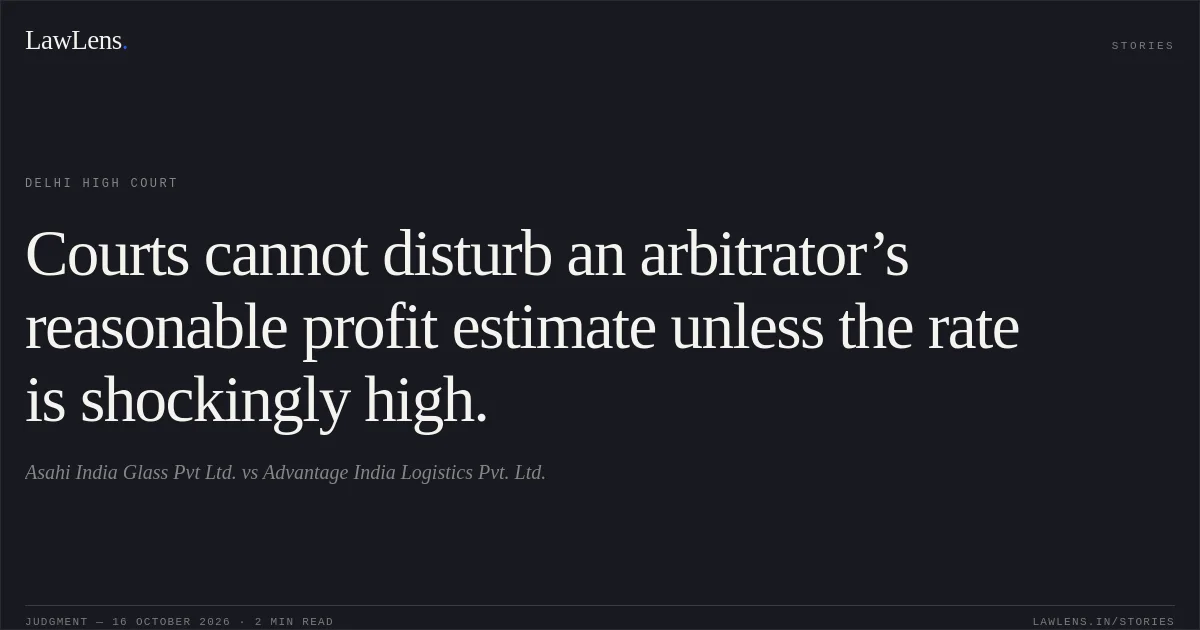
Source reference: p.5It held that an arbitrator’s estimate of profit, based on the circumstances and nature of the contract, is not open to interference merely because it is an estimate; interference is unwarranted unless the rate is “shockingly high”.
Source reference: p.7Reasoning
The Court viewed the claimant’s claim for damages following wrongful termination as broad enough to support compensation for the 30-day notice period, even though the claimant had sought damages for the remaining contract term.
Source reference: p.6–7The arbitrator had rejected that larger claim and confined compensation to the notice period after finding that termination required 30 days’ notice.
Source reference: p.6–7The monthly turnover figure was supported by evidence, while the profit rate was an estimate.
Source reference: p.6–7In light of the limited review under Sections 34 and 37, and absent a finding that the estimated rate was arbitrary or shockingly high, the Court found no basis to interfere.
Source reference: p.6–7It also rejected the argument that post-termination invoices established continued performance, observing that they could relate to earlier work.
Source reference: p.6–7Holding
The Court held that the Single Judge was justified in dismissing the Section 34 application and found no ground for interference under Section 37.
The appeal was dismissed, and all pending applications were disposed of.
Source reference: p.7Acts & Sections Cited
3 provisions across 1 statute referred to in this judgment. Each provision opens on LawLens.
Arbitration and Conciliation Act, 19963
Original Court PDF
Asahi India Glass Pvt Ltd.vsAdvantage India Logistics Pvt. Ltd.
Click to open original judgment
Original judgment, available to read, download and summarize on LawLens.in