Facts
The respondent-authority issued an e-mode Notice Inviting Tender dated 16 February 2026 for improvement and upgradation of a road under the Asom Mala 3.0 scheme.
Source reference: p.3The petitioner joint venture and respondent no. 4 participated in the tender, and both bids were declared technically responsive.
Source reference: pp.3–5, 10The petitioner alleged that respondent no. 4 had not submitted complete financial reports for certain years and had manipulated turnover figures, including an alleged alteration from approximately ₹8.85 crore to ₹22.85 crore.
Source reference: pp.3–5The technical bids were opened on 27 May 2026 and the financial bids on 30 May 2026. Respondent no. 4’s financial bid was approximately ₹51 lakh lower than the petitioner’s bid.
Source reference: pp.6, 9–10After issuing a legal notice on 1 June 2026, the petitioner approached the High Court, which had granted an interim order on 4 June 2026.
Source reference: pp.6–9Issues
Whether respondent no. 4 was wrongly declared technically responsive for allegedly failing to comply with Clause 4.3(h) of the tender document by not submitting complete profit-and-loss statements and auditor’s reports for the preceding five years.
Source reference: pp.10–11Whether the alleged discrepancies, interpolation, manipulation of turnover figures, and differences in UDIN numbers vitiated the technical evaluation of respondent no. 4’s bid.
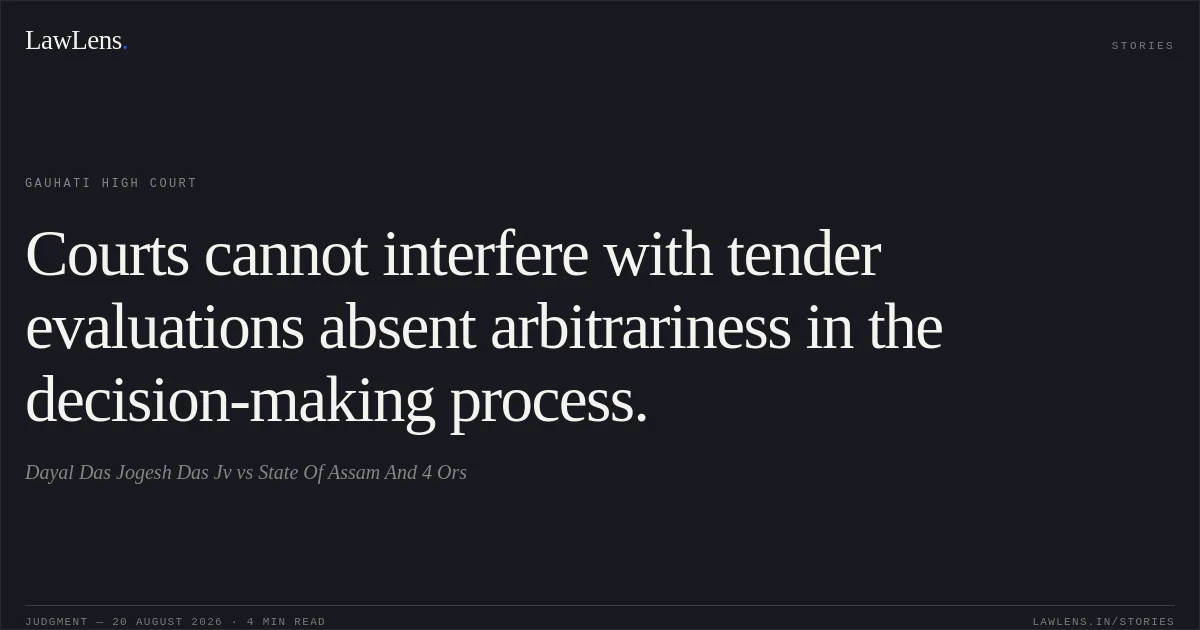
Source reference: pp.4–5, 11Whether the tender authority’s decision-making process was arbitrary, unreasonable, non-transparent, or otherwise amenable to interference under Article 226 of the Constitution.
Source reference: pp.5–8, 11–12Whether the petitioner was entitled to relief despite the financial bids having already been opened and respondent no. 4 having submitted the lower bid.
Source reference: pp.9–12Law Applied
The Court applied Article 226 judicial-review principles governing public tenders, under which the Court examines the legality, fairness, transparency, and rationality of the decision-making process rather than substituting its own evaluation for that of the tender authority.
Source reference: p.12Clause 4.3(h) required reports on the bidder’s financial standing, “such as profit and loss statement and auditor’s Report for the past five years”; the expression “such as” was treated as illustrative rather than automatically mandatory in respect of each specified document.
Source reference: pp.10–11Clause 4.5A required the bidder to demonstrate work experience equivalent to 50% of the contract value in any one of the preceding five years, while Clause 4.7 addressed misleading or false representations; Clause 23.8(iii) concerned communication of technical responsiveness and opening of financial bids.
Source reference: pp.4–6, 9The Court considered the effect of Sections 44AD and 44AB of the Income Tax Act, 1961, as relied upon by the respondents, regarding the requirement of profit-and-loss and audit-related documents for lower-turnover cases.
Source reference: pp.7–9It relied on Banshidhar Construction (P) Ltd. v. Bharat Coking Coal Ltd., (2024) 10 SCC 273, for transparency and fairness in State distribution; Bharat Coking Coal Ltd. v. AMR Dev Prabha, (2020) 16 SCC 759, for the distinction between contractual interpretation and statutory interpretation in tender matters; Raunaq International Ltd. v. I.V.R. Construction Ltd., (1999) 1 SCC 492, concerning public interest and the consequences of injunctive interference in tenders; and Dhaniram Gogoi v. State of Assam, 1998 (4) GLT 37, and Tarun Bharali v. State of Assam, (1991) 2 GLR 296, on the importance of price and public interest in public settlements.
Source reference: pp.5, 8, 12Reasoning
The Court held that Clause 4.3(h) principally required proof of the bidder’s financial standing, while the listed documents were introduced by the illustrative expression “such as” and could not be treated as rigidly mandatory in every case.
Source reference: pp.10–11Although respondent no. 4 had not furnished profit-and-loss statements for two financial years, the Court accepted the respondents’ explanation that the turnover for those years was below ₹2 crore and that such statements were not statutorily mandatory in the circumstances relied upon.
Source reference: p.11More importantly, respondent no. 4 had submitted financial documents, including Chartered Accountant certificates, for the relevant five-year period. The Court treated those certificates as having legal force and rejected the UDIN objection because the certificates had been issued by two different Chartered Accountants, who would necessarily have distinct UDINs.
Source reference: p.11The allegations of interpolation and manipulation involved disputed factual questions requiring technical or evidentiary examination. Since the tender authority had scrutinised the documents and concluded that respondent no. 4 satisfied the technical requirements, the High Court declined to re-evaluate the financial material or substitute its own assessment in certiorari jurisdiction.
Source reference: p.11The Court further found that the e-mode tender process was transparent because the relevant information was available on the online portal and could be monitored by participating bidders.
Source reference: pp.7–9, 11–12The petitioner’s failure to disclose that the financial bids had already been opened on 30 May 2026 was considered material, particularly because respondent no. 4’s bid was approximately ₹51 lakh lower. The Court regarded the price difference as directly relevant to public interest and concluded that the interim order had been obtained without placing the complete procedural history before the Court.
Source reference: pp.9–12Consequently, no arbitrariness, unreasonableness, lack of transparency, or procedural illegality was established in the decision to treat respondent no. 4 as technically responsive.
Source reference: p.12Holding
The Court held that respondent no. 4 had substantially fulfilled the tender requirements, that the financial-standing requirement under Clause 4.3(h) was satisfied through the documents and Chartered Accountant certificates submitted, and that the disputed allegations regarding interpolation and turnover manipulation did not warrant judicial interference.
The tender process was found to be transparent and the authority’s decision to declare respondent no. 4 technically responsive was neither arbitrary nor unreasonable.
Source reference: p.12The writ petition was therefore dismissed, the interim order was vacated, and there was no order as to costs.
Source reference: p.13Acts & Sections Cited
2 provisions across 1 statute referred to in this judgment. Linked provisions open on LawLens.
Income Tax Act, 19612
Original Court PDF
Dayal Das Jogesh Das JvvsState Of Assam And 4 Ors
Click to open original judgment
Original judgment, available to read, download and summarize on LawLens.in