Facts
A complaint alleged irregularities in identifying beneficiaries under a housing scheme, including allotments to relatives of the Gram Panchayat President.
Source reference: paras. 2–6; pp. 3–5The petitioner, a Panchayat Development Officer, was proceeded against under Rule 14-A of the Karnataka Civil Services (Classification, Control and Appeal) Rules, 1957.
Source reference: paras. 2–6; pp. 3–5The enquiry found the charges proved, including that multiple beneficiaries belonged to one family and that housing records contained discrepancies.
Source reference: paras. 2–6; pp. 3–5The State Government withheld 10% of the petitioner’s pension for five years.
Source reference: paras. 2–6; pp. 3–5The Karnataka State Administrative Tribunal dismissed his challenge to that penalty, and he sought judicial review of the Tribunal’s order.
Source reference: paras. 2–6, 12–16; pp. 3–5, 8–14Issues
Whether the Tribunal’s refusal to interfere with the pension penalty was legally sustainable, having regard to the enquiry findings and the limits of judicial review
Source reference: paras. 13–18, 22–25; pp. 10–15, 17–21Whether the petitioner was entitled to exoneration because the other officer charged in the same proceedings was exonerated
Source reference: paras. 19–21, 24; pp. 15–16, 20–21Law Applied
Rule 14-A of the Karnataka Civil Services (Classification, Control and Appeal) Rules, 1957, governed the entrustment of the departmental enquiry to the Lokayukta; Rule 3(1)(i)–(iii) of the Karnataka Civil Services (Conduct) Rules, 1966, formed the basis of the misconduct charge.
Source reference: paras. 3, 12; pp. 3, 8–10Section 12(3) of the Karnataka Lokayukta Act, 1984, was referred to in connection with the Lokayukta’s recommendation for action.
Source reference: para. 12; p. 8Under Articles 226 and 227 of the Constitution, a reviewing court does not reappreciate evidence or act as an appellate authority in disciplinary matters; intervention is confined to recognised grounds, including procedural unfairness, consideration of irrelevant matters, findings unsupported by evidence, or punishment that shocks the conscience.
Source reference: paras. 22–23; pp. 17–20The Court relied on Union of India v. Pranab Kumar Nath, 2025 SCC OnLine SC 2893, which cited Union of India v. P. Gunasekaran.
Source reference: paras. 22–23; pp. 17–20Reasoning
The Court found that the petitioner had received an opportunity to defend himself and cross-examine witnesses, and that the enquiry report relied on oral and documentary evidence concerning family relationships, beneficiary selection, and inconsistencies in housing records.
Source reference: paras. 13–15, 17–18; pp. 10–15The petitioner’s parity argument failed because the other officer had handed over charge before the beneficiary list was prepared, whereas the petitioner was the PDO when the beneficiaries were identified.
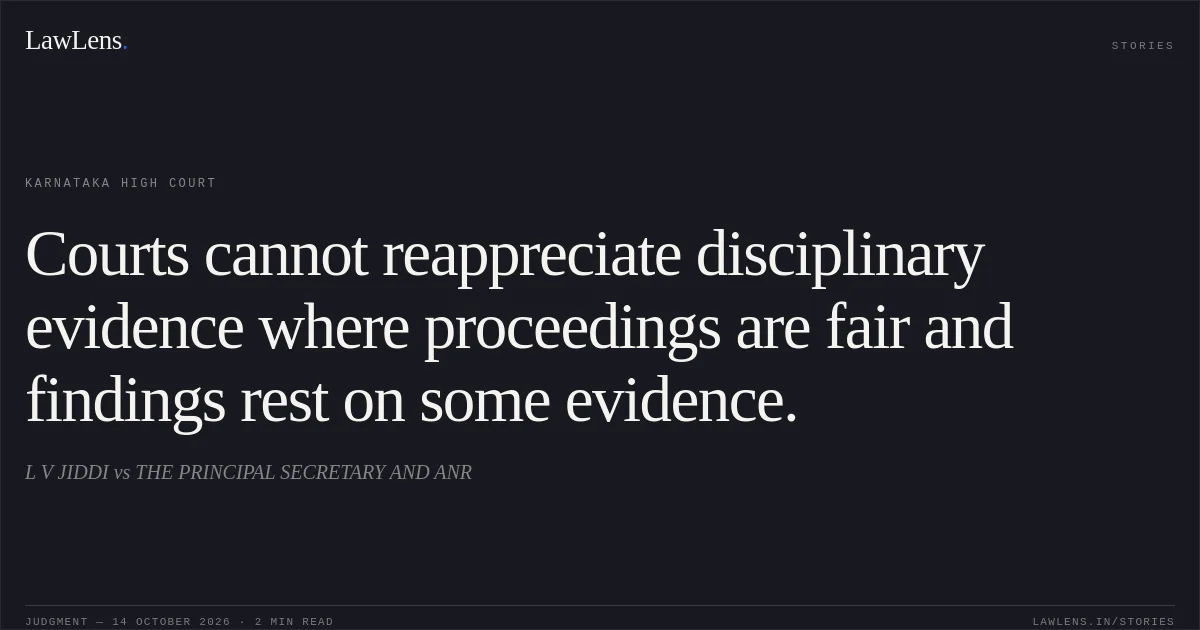
Source reference: paras. 19–21, 24; pp. 15–16, 20–21The Court held that the petitioner’s challenge did not establish a recognised ground for judicial review; reassessing the evidence or the merits of the disciplinary findings was not permissible.
Source reference: paras. 22–25; pp. 17–21Holding
The Court answered the issues against the petitioner.
It held that the Tribunal committed no error in dismissing the application and found no basis to disturb the disciplinary penalty.
Source reference: paras. 25–26; p. 21The writ petition was dismissed.
Source reference: paras. 25–26; p. 21Acts & Sections Cited
1 provisions across 1 statute referred to in this judgment. Each provision opens on LawLens.
KARNATAKA LOKAYUKTA ACT, 19841
Original Court PDF
L V JIDDIvsTHE PRINCIPAL SECRETARY AND ANR
Click to open original judgment
Original judgment, available to read, download and summarize on LawLens.in


