Facts
The Appellant, Master Shubh Chowdhari, was one of seven Indian riders who obtained a Certificate of Capability (“COC”) for participation in the Show Jumping event at the Youth Olympic Games, Dakar, 2026 (“YOG 2026”).
Source reference: pp. 2–3, paras. 2–5EFI’s notified selection criteria required consideration of technical difficulty and level of competitions, consistency of international performance, recency, stability of the horse-rider combination, championship readiness, competitiveness at CSI1*/CSI2* events, and overall merit.
Source reference: pp. 3–4, paras. 5–7After the Appellant submitted his recent competition results, EFI initially ranked Respondent No. 3 first, Respondent No. 4 second, and the Appellant third, giving preference to performances at 135 cm over those at 130 cm.
Source reference: p. 4, para. 10Following the Appellant’s challenge, EFI reconsidered the selection. A reconstituted five-member Selection Committee assessed results between 8 May and 25 July 2026, treated 130 cm and 135 cm results equally, and regarded a completed round involving not more than eight penalties as a “qualifying performance”.
Source reference: pp. 5–6, paras. 12–16; pp. 20–21, paras. 23–25Under Selection Decision II dated 27 August 2026, Respondent No. 3 was ranked first, the Appellant second, and Respondent No. 4 third. The Appellant challenged the decision, contending that EFI had unlawfully introduced the undisclosed criterion of the number of qualifying performances and that he ought to have been ranked by reference to average penalties.
Source reference: pp. 5–6, para. 17The learned Single Judge dismissed the writ petition, holding that the decision was neither mala fide, arbitrary, perverse, nor contrary to the notified criteria. The Appellant consequently preferred the present appeal.
Source reference: pp. 5–6, para. 17Issues
Whether EFI’s use of the number of qualifying performances, based on completed rounds with not more than eight penalties, constituted an impermissible alteration or introduction of selection criteria after commencement of the selection process?
Source reference: pp. 20–23, paras. 21–27Whether the Appellant was entitled to have the riders ranked by reference to average penalty points rather than the number and consistency of qualifying performances?
Source reference: pp. 22–23, para. 26Whether Selection Decision II was inadequately reasoned, arbitrary, perverse, mala fide, or contrary to the notified selection criteria so as to warrant judicial interference?
Source reference: pp. 23–25, paras. 28–31Whether the enlargement of the Selection Committee from three to five members invalidated the reconsideration process?
Source reference: p. 24, para. 29Law Applied
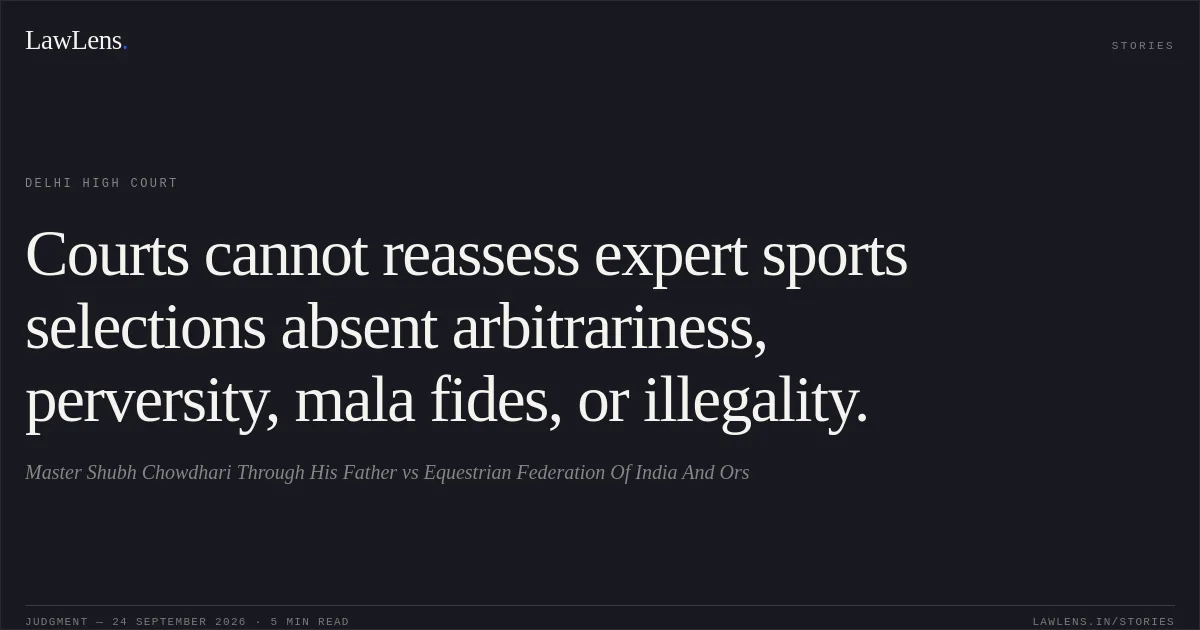
The Court applied the principle that judicial review of expert sports-selection decisions is limited and that courts do not sit in appeal over comparative sporting merit or substitute their own assessment for that of a duly constituted expert committee; interference is justified only where the decision is mala fide, arbitrary, irrational, perverse, or contrary to binding criteria, as recognised in Dalpat Abasaheb Solunke v. B.S. Mahajan, Basavaiah v. H.L. Ramesh, Sushil Kumar v. Union of India, and Anush Agarwalla v. Ad-Hoc Committee for Governance of Equestrian Federation of India.
Source reference: pp. 14–15, para. 19.1; pp. 24–25, para. 30The Court further applied the principle that reasons must be tested on the basis of the reasons contemporaneously recorded and cannot ordinarily be supplemented by subsequent explanations.
Source reference: p. 23, para. 28Chirag Khandal v. Equestrian Federation of India was distinguished as prohibiting a change in an existing criterion, while Manjeet v. Indian Olympic Association was distinguished as involving departure from a binding international qualification system.
Source reference: p. 23, para. 27The Court held that a selection body may adopt a reasonable and uniform methodology to operationalise broadly notified criteria such as consistency, competitiveness, recency, and overall merit, provided that the methodology is rational, non-discriminatory, and applied equally to all candidates.
Source reference: pp. 20–23, paras. 22–27Reasoning
The Court distinguished between the notified criteria and the methodology used to implement them. The criteria required assessment of consistency, competitiveness, technical level, recency, and overall merit, but did not prescribe the precise assessment period, treatment of incomplete rounds, or method of evaluating consistency.
Source reference: pp. 20–21, para. 22The Selection Committee’s methodology—using the period from 8 May to 25 July 2026, giving equal weight to 130 cm and 135 cm results, excluding incomplete two-phase competitions, and treating completed rounds with not more than eight penalties as qualifying performances—was held to be a permissible operationalisation of the notified criteria rather than a new criterion.
Source reference: p. 21, para. 23The eight-penalty threshold was objectively connected to the FEI’s COC standard, had also been relied upon by the Appellant to demonstrate consistency, and was applied uniformly, including to exclude the Appellant’s own 12-penalty result.
Source reference: pp. 21–22, para. 25The Court rejected ranking by average penalties because an average based on a smaller number of selected results could favour a rider who competed less frequently and did not necessarily establish repeated consistency. The Appellant’s own calculations also varied depending on which result was included or excluded.
Source reference: p. 22, para. 26The Minutes disclosed the assessment period, competition formats, treatment of two-phase events, qualifying-performance methodology, and comparative ranking, and therefore supplied adequate contemporaneous reasons.
Source reference: p. 23, para. 28The Court found no rule prohibiting enlargement of the Selection Committee from three to five members. The reconstitution followed the Appellant’s own objection to the original Committee, and he participated in the reconsideration through his father without objecting to the Committee’s composition.
Source reference: p. 24, para. 29Since the methodology was uniformly applied and no mala fides, perversity, arbitrariness, or violation of binding criteria was established, judicial substitution of the Court’s assessment for that of the expert Selection Committee was impermissible.
Source reference: pp. 24–25, paras. 30–31Holding
The Court held that Selection Decision II did not unlawfully alter the notified selection criteria. EFI was entitled to adopt a rational and uniform methodology for assessing consistency and overall merit, including counting completed performances involving not more than eight penalties.
Ranking by average penalties was not mandated by the criteria, and the Selection Decision was supported by adequate contemporaneous reasons.
Source reference: pp. 21–24, paras. 25–29The appeal was dismissed, the judgment of the learned Single Judge dated 17 September 2026 was upheld, and all pending applications were disposed of without an order as to costs.
Source reference: p. 26, paras. 34–35The Court nevertheless directed EFI to frame and implement future selection criteria and timelines with greater clarity and precision to avoid uncertainty and repeated litigation.
Source reference: p. 25, para. 33Original Court PDF
Master Shubh Chowdhari Through His FathervsEquestrian Federation Of India And Ors
Click to open original judgment
Original judgment, available to read, download and summarize on LawLens.in